Juengel Eva, Nowaz Snigdha, Makarevi Jasmina, Natsheh Iyad, Werner Isabella, Nelson Karen, Reiter Michael, Tsaur Igor, Mani Jens, Harder Sebastian, Bartsch Georg, Haferkamp Axel, Blaheta Roman A
Department of Urology, Goethe-University, Interdisciplinary Science Building, Building 25A, Room 404, Theodor-Stern-Kai 7, Frankfurt / Main D-60590, Germany.
Mol Cancer. 2014 Jun 16;13:152. doi: 10.1186/1476-4598-13-152.
Targeted therapies have improved therapeutic options of treating renal cell carcinoma (RCC). However, drug response is temporary due to resistance development.
Functional and molecular changes in RCC Caki-1 cells, after acquired resistance to the mammalian target of rapamycin (mTOR)-inhibitor everolimus (Cakires), were investigated with and without additional application of the histone deacetylase (HDAC)-inhibitor valproic acid (VPA). Cell growth was evaluated by MTT assay, cell cycle progression and apoptosis by flow cytometry. Target molecules of everolimus and VPA, apoptotic and cell cycle regulating proteins were investigated by western blotting. siRNA blockade was performed to evaluate the functional relevance of the proteins.
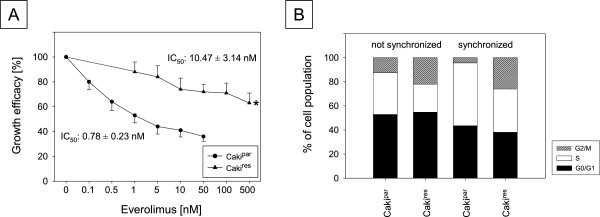
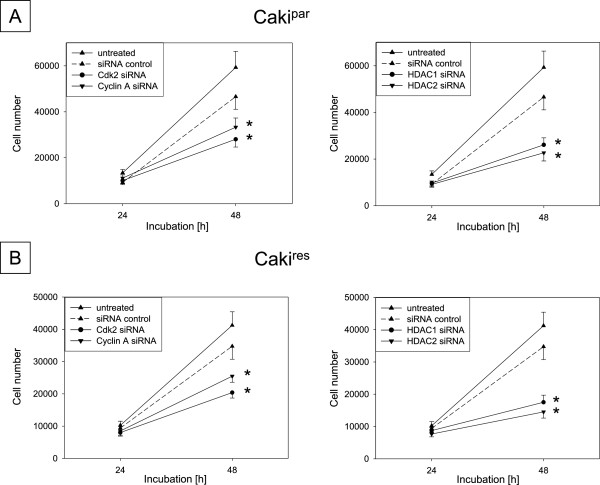
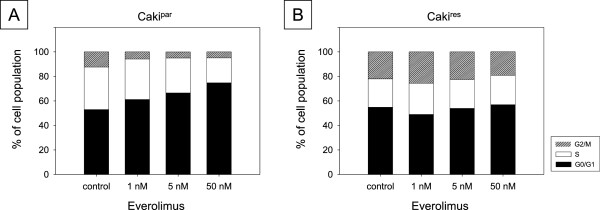
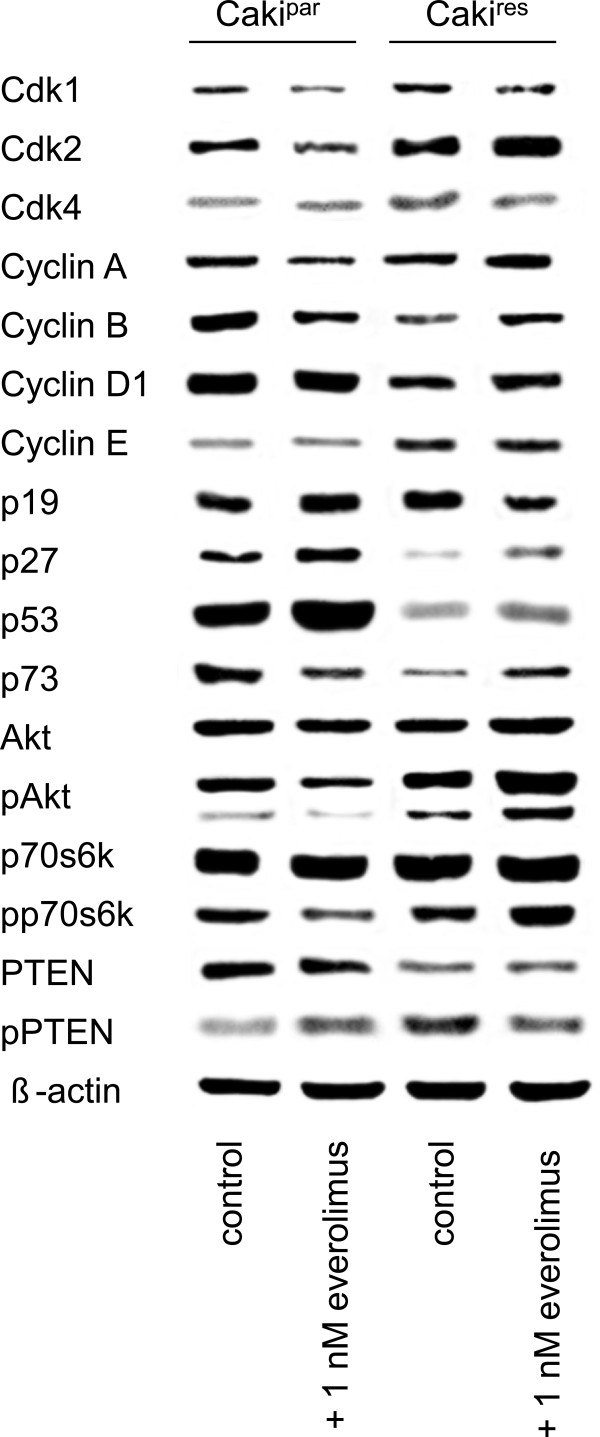
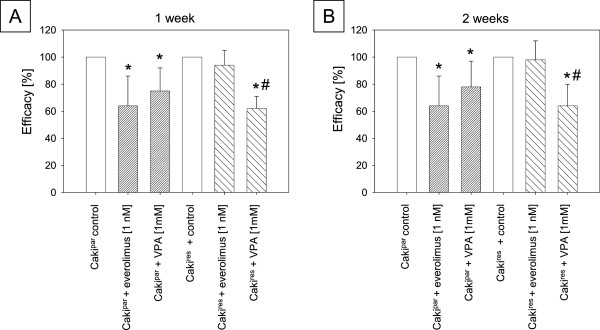
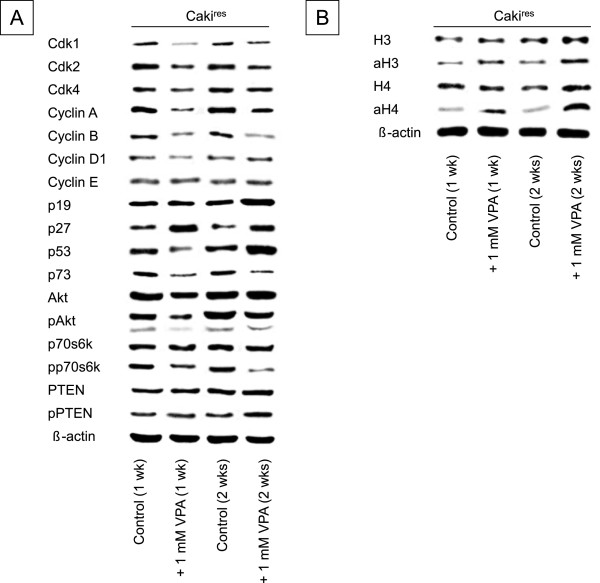
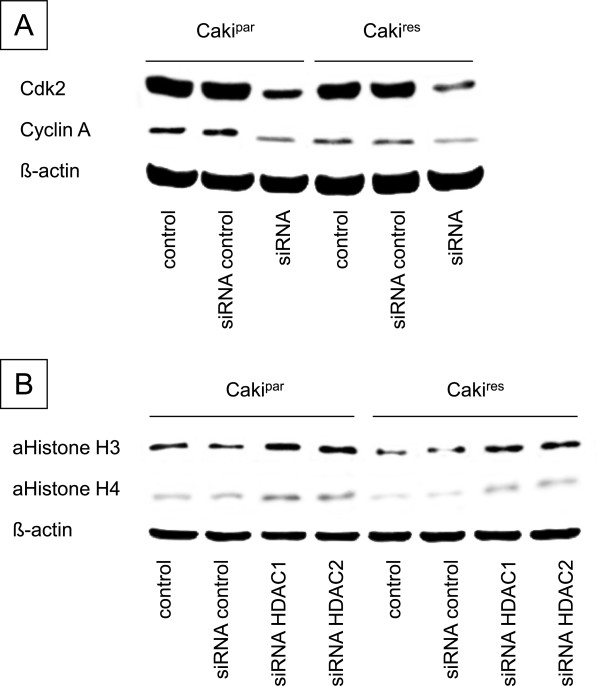
Everolimus resistance was accompanied by significant increases in the percentage of G2/M-phase cells and in the IC50. Akt and p70S6K, targets of everolimus, were activated in Cakires compared to drug sensitive cells. The most prominent change in Cakires cells was an increase in the cell cycle activating proteins cdk2 and cyclin A. Knock-down of cdk2 and cyclin A caused significant growth inhibition in the Cakires cells. The HDAC-inhibitor, VPA, counteracted everolimus resistance in Cakires, evidenced by a significant decrease in tumor growth and cdk2/cyclin A.
It is concluded that non-response to everolimus is characterized by increased cdk2/cyclin A, driving RCC cells into the G2/M-phase. VPA hinders everolimus non-response by diminishing cdk2/cyclin A. Therefore, treatment with HDAC-inhibitors might be an option for patients with advanced renal cell carcinoma and acquired everolimus resistance.
靶向治疗改善了肾细胞癌(RCC)的治疗选择。然而,由于耐药性的产生,药物反应是暂时的。
研究肾癌细胞系Caki-1对雷帕霉素哺乳动物靶点(mTOR)抑制剂依维莫司产生获得性耐药(Cakires)后,在添加或不添加组蛋白去乙酰化酶(HDAC)抑制剂丙戊酸(VPA)的情况下的功能和分子变化。通过MTT法评估细胞生长,通过流式细胞术评估细胞周期进程和凋亡。通过蛋白质印迹法研究依维莫司和VPA的靶分子、凋亡和细胞周期调节蛋白。进行小干扰RNA(siRNA)阻断以评估蛋白质的功能相关性。
依维莫司耐药伴随着G2/M期细胞百分比和半数抑制浓度(IC50)的显著增加。与药物敏感细胞相比,依维莫司的靶标Akt和p70S6K在Cakires细胞中被激活。Cakires细胞中最显著的变化是细胞周期激活蛋白细胞周期蛋白依赖性激酶2(cdk2)和细胞周期蛋白A增加。敲低cdk2和细胞周期蛋白A导致Cakires细胞显著生长抑制。HDAC抑制剂VPA抵消了Cakires细胞对依维莫司的耐药性,肿瘤生长和cdk2/细胞周期蛋白A显著降低证明了这一点。
得出的结论是,对依维莫司无反应的特征是cdk2/细胞周期蛋白A增加,促使肾癌细胞进入G2/M期。VPA通过减少cdk2/细胞周期蛋白A来阻碍对依维莫司的无反应。因此,对于晚期肾细胞癌和获得性依维莫司耐药的患者,使用HDAC抑制剂治疗可能是一种选择。