Ji Hongtao, Liu Ling, Li Kexue, Xie Qingen, Wang Zhijuan, Zhao Xuhua, Li Xia
The State Key Laboratory of Plant Cell & Chromosome Engineering, Center for Agricultural Research Resources, Institute of Genetics and Developmental Biology, Chinese Academy of Sciences, 286 Huaizhong Road, Shijiazhuang, Hebei 050021, China.
The State Key Laboratory of Plant Cell & Chromosome Engineering, Center for Agricultural Research Resources, Institute of Genetics and Developmental Biology, Chinese Academy of Sciences, 286 Huaizhong Road, Shijiazhuang, Hebei 050021, China
J Exp Bot. 2014 Sep;65(17):4863-72. doi: 10.1093/jxb/eru255. Epub 2014 Jun 16.
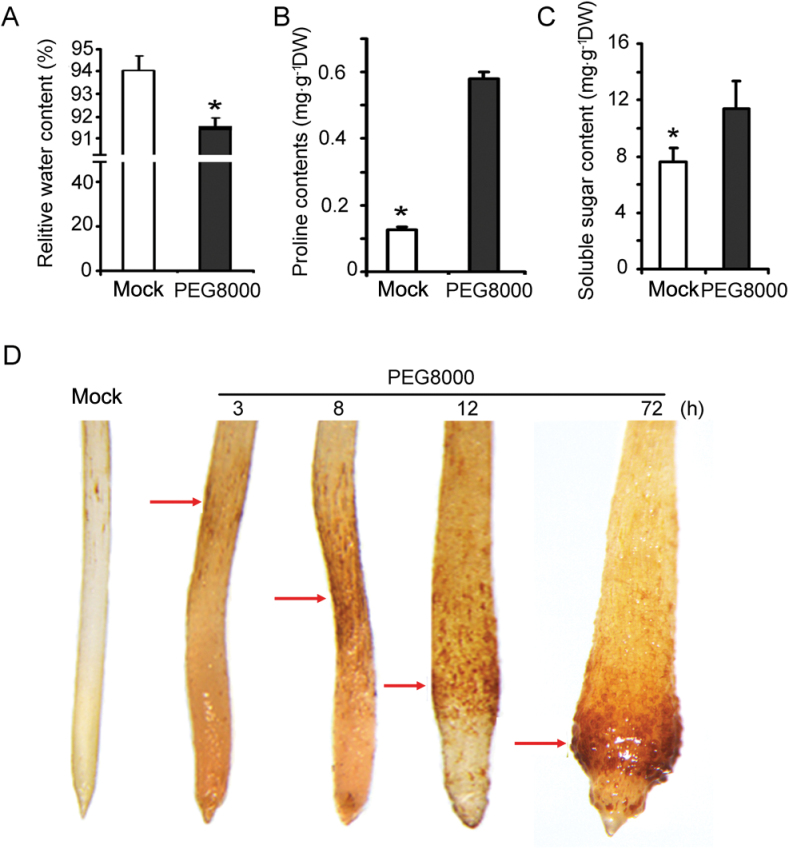
Water stress is one of the major environmental stresses causing growth retardation and yield loss of plants. In the past decades, osmotic adjustment, antioxidant protection, and stomatal movement have been extensively studied, but much less attention has been paid to the study of root system reprogramming to maximize water absorption and survival under water stress. Here, it is shown that polyethylene glycol (PEG)-simulated mild and moderate osmotic stress induced premature differentiation of the root apical meristem (RAM). It is demonstrated that RAM premature differentiation is a conserved adaptive mechanism that is widely adopted by various plants to cope with osmotic stress simulated by PEG 8000, and the occurrence of RAM premature differentiation is directly related to stress tolerance of plants. It is shown that the osmotic stress-induced premature differentiation caused growth cessation of primary roots allowing outgrowth of lateral roots. This work has uncovered a key mechanism for controlling the plastic development of the root system by which plants are capable of survival, growth, or reproduction under water stress.
水分胁迫是导致植物生长迟缓及产量损失的主要环境胁迫之一。在过去几十年里,渗透调节、抗氧化保护及气孔运动已得到广泛研究,但对于根系重编程以在水分胁迫下最大化水分吸收及存活能力的研究却少得多。在此研究中发现,聚乙二醇(PEG)模拟的轻度和中度渗透胁迫诱导了根尖分生组织(RAM)的过早分化。证明了RAM过早分化是一种保守的适应性机制,被各种植物广泛采用以应对PEG 8000模拟的渗透胁迫,且RAM过早分化的发生与植物的胁迫耐受性直接相关。研究表明,渗透胁迫诱导的过早分化导致主根生长停止,从而使侧根长出。这项工作揭示了一种控制根系可塑性发育的关键机制,通过该机制植物能够在水分胁迫下存活、生长或繁殖。