Albert Paul R, Vahid-Ansari Faranak, Luckhart Christine
Neuroscience, Ottawa Hospital Research Institute, University of Ottawa Ottawa, ON, Canada.
Neuroscience, Ottawa Hospital Research Institute, University of Ottawa Ottawa, ON, Canada ; Department of Cellular and Molecular Medicine, University of Ottawa Ottawa ON, Canada.
Front Behav Neurosci. 2014 Jun 6;8:199. doi: 10.3389/fnbeh.2014.00199. eCollection 2014.
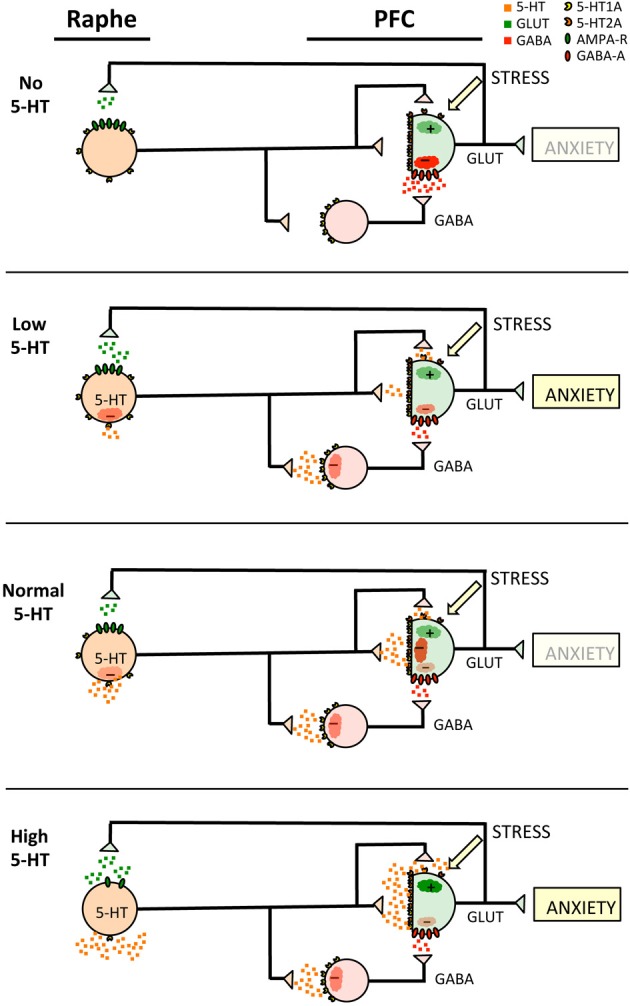
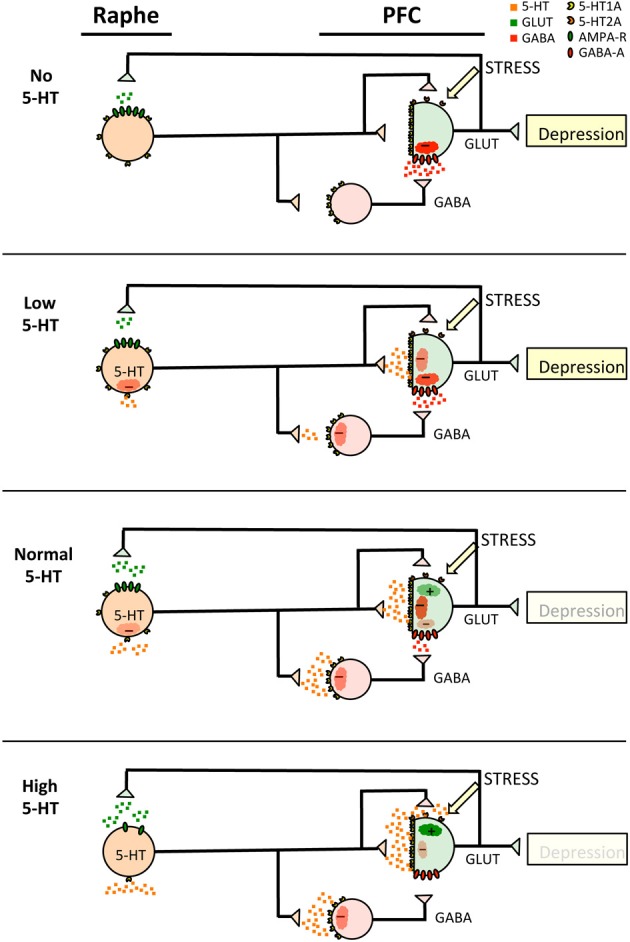
Decreased serotonergic activity has been implicated in anxiety and major depression, and antidepressants directly or indirectly increase the long-term activity of the serotonin system. A key component of serotonin circuitry is the 5-HT1A autoreceptor, which functions as the major somatodendritic autoreceptor to negatively regulate the "gain" of the serotonin system. In addition, 5-HT1A heteroreceptors are abundantly expressed post-synaptically in the prefrontal cortex (PFC), amygdala, and hippocampus to mediate serotonin actions on fear, anxiety, stress, and cognition. Importantly, in the PFC 5-HT1A heteroreceptors are expressed on at least two antagonist neuronal populations: excitatory pyramidal neurons and inhibitory interneurons. Rodent models implicate the 5-HT1A receptor in anxiety- and depression-like phenotypes with distinct roles for pre- and post-synaptic 5-HT1A receptors. In this review, we present a model of serotonin-PFC circuitry that integrates evidence from mouse genetic models of anxiety and depression involving knockout, suppression, over-expression, or mutation of genes of the serotonin system including 5-HT1A receptors. The model postulates that behavioral phenotype shifts as serotonin activity increases from none (depressed/aggressive not anxious) to low (anxious/depressed) to high (anxious, not depressed). We identify a set of conserved transcription factors including Deaf1, Freud-1/CC2D1A, Freud-2/CC2D1B and glucocorticoid receptors that may confer deleterious regional changes in 5-HT1A receptors in depression, and how future treatments could target these mechanisms. Further studies to specifically test the roles and regulation of pyramidal vs. interneuronal populations of 5-HT receptors are needed better understand the role of serotonin in anxiety and depression and to devise more effective targeted therapeutic approaches.
血清素能活性降低与焦虑症和重度抑郁症有关,而抗抑郁药直接或间接地增加血清素系统的长期活性。血清素神经回路的一个关键组成部分是5-HT1A自身受体,它作为主要的躯体树突自身受体,对血清素系统的“增益”进行负调节。此外,5-HT1A异源受体在额叶前皮质(PFC)、杏仁核和海马体的突触后大量表达,以介导血清素对恐惧、焦虑、压力和认知的作用。重要的是,在额叶前皮质中,5-HT1A异源受体在至少两种拮抗性神经元群体上表达:兴奋性锥体神经元和抑制性中间神经元。啮齿动物模型表明,5-HT1A受体在焦虑样和抑郁样表型中起作用,突触前和突触后5-HT1A受体具有不同的作用。在这篇综述中,我们提出了一个血清素-PFC神经回路模型,该模型整合了来自焦虑和抑郁小鼠遗传模型的证据,这些模型涉及血清素系统基因(包括5-HT1A受体)的敲除、抑制、过表达或突变。该模型假设,随着血清素活性从无(抑郁/攻击性,无焦虑)增加到低(焦虑/抑郁)再到高(焦虑,无抑郁),行为表型会发生变化。我们确定了一组保守的转录因子,包括Deaf1、Freud-1/CC2D1A、Freud-2/CC2D1B和糖皮质激素受体,它们可能在抑郁症中导致5-HT1A受体发生有害的区域变化,以及未来的治疗如何针对这些机制。需要进一步的研究来专门测试5-HT受体锥体神经元与中间神经元群体的作用和调节,以更好地理解血清素在焦虑和抑郁中的作用,并设计出更有效的靶向治疗方法。