Luttikholt Saskia, Veldhuis Anouk, van den Brom René, Moll Lammert, Lievaart-Peterson Karianne, Peperkamp Klaas, van Schaik Gerdien, Vellema Piet
Department of Small Ruminant Health, GD Animal Health, Deventer, The Netherlands.
Department of Epidemiology, GD Animal Health, Deventer, The Netherlands.
PLoS One. 2014 Jun 17;9(6):e100135. doi: 10.1371/journal.pone.0100135. eCollection 2014.
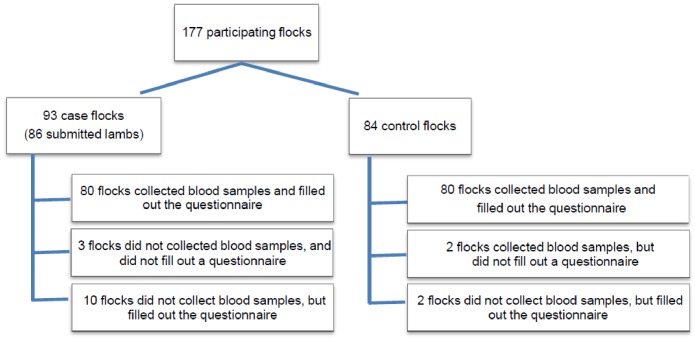
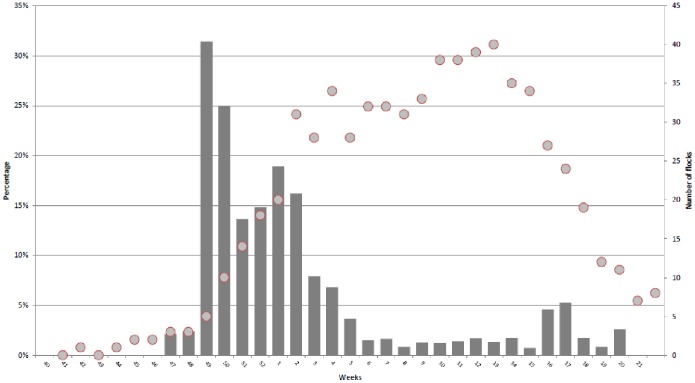
In Northwestern Europe, an epizootic outbreak of congenital malformations in newborn lambs due to infection with Schmallenberg virus (SBV) started at the end of 2011. The objectives of this study were to describe clinical symptoms of SBV infection, the effect of infection on mortality rates, and reproductive performance in sheep, as well as to identify and quantify flock level risk factors for SBV infections resulting in malformations in newborn lambs. A case-control study design was used, with 93 case flocks that had notified malformed lambs and 84 control flocks with no such lambs. Overall animal seroprevalence in case flocks was estimated at 82.0% (95% CI: 74.3-87.8), and was not significantly different from the prevalence in control flocks being 76.4% (95% CI: 67.2-83.6). The percentages of stillborn lambs or lambs that died before weaning, repeat breeders, and lambs with abnormal suckling behaviour were significantly higher in case flocks compared to control flocks. However, effect of SBV infection on mortality rates and reproductive performance seemed to be limited. Multivariable analysis showed that sheep flocks with an early start of the mating season, i.e. before August 2011 (OR = 33.1; 95% CI: 10.0-109.8) and in August 2011 (OR = 8.2; 95% CI: 2.7-24.6) had increased odds of malformations in newborn lambs caused by SBV compared to sheep flocks with a start of the mating season in October 2011. Other flock-level risk factors for malformations in newborn lambs were purchase of silage (OR 5.0; 95% CI: 1.7-15.0) and flocks with one or more dogs (OR = 3.3; 95% CI: 1.3-8.3). Delaying mating until October could be a potential preventive measure for naïve animals to reduce SBV induced losses. As duration of immunity after infection with SBV is expected to last for several years, future SBV induced congenital malformations are mainly expected in offspring of early mated seronegative animals.
在欧洲西北部,2011年末开始出现因感染施马伦贝格病毒(SBV)导致新生羔羊先天性畸形的 epizootic 疫情。本研究的目的是描述SBV感染的临床症状、感染对绵羊死亡率和繁殖性能的影响,以及识别和量化导致新生羔羊畸形的SBV感染的畜群水平风险因素。采用病例对照研究设计,93个报告有畸形羔羊的病例畜群和84个没有此类羔羊的对照畜群。病例畜群中动物总体血清阳性率估计为82.0%(95%可信区间:74.3 - 87.8),与对照畜群中76.4%(95%可信区间:67.2 - 83.6)的阳性率无显著差异。与对照畜群相比,病例畜群中死产羔羊或断奶前死亡羔羊、重复配种母羊以及有异常吮乳行为羔羊的百分比显著更高。然而,SBV感染对死亡率和繁殖性能的影响似乎有限。多变量分析表明,配种季节开始较早的绵羊群体,即2011年8月之前(比值比 = 33.1;95%可信区间:10.0 - 109.8)和2011年8月(比值比 = 8.2;95%可信区间:2.7 - 24.6),与2011年10月开始配种季节的绵羊群体相比,因SBV导致新生羔羊畸形的几率增加。新生羔羊畸形的其他畜群水平风险因素包括购买青贮饲料(比值比5.0;95%可信区间:1.7 - 15.0)和有一只或多只狗的畜群(比值比 = 3.3;95%可信区间:1.3 - 8.3)。将配种推迟到10月可能是一种潜在的预防措施,可减少初产动物因SBV造成的损失。由于感染SBV后的免疫持续期预计持续数年,未来预计SBV诱导的先天性畸形主要出现在早期配种的血清阴性动物的后代中。