Köhler Leonore, Meinke-Franze Claudia, Hein Jürgen, Fendrich Konstanze, Heymann Romy, Thyrian Jochen René, Hoffmann Wolfgang
German Centre for Neurodegenerative Diseases (DZNE) Greifswald, Ellernholzstrasse 1-2, Greifswald, D-17489, Germany.
Curr Alzheimer Res. 2014;11(6):538-48. doi: 10.2174/1567205011666140618100727.
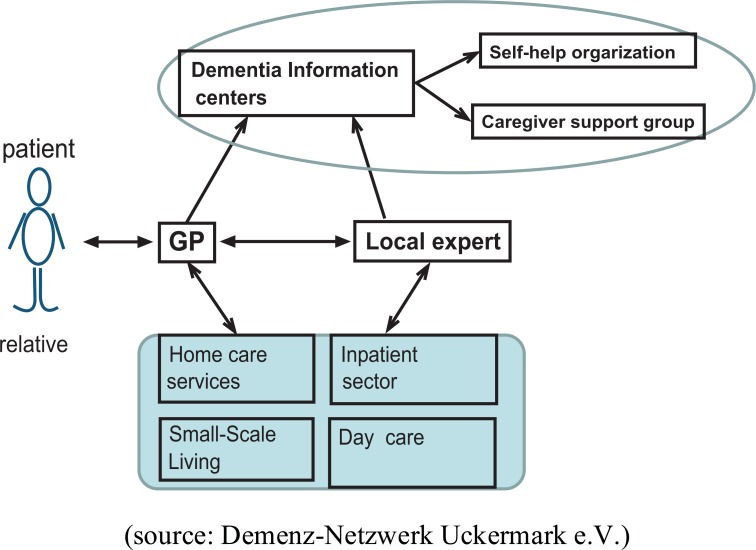
Most persons with dementia live at home and are treated in the primary care. However, the ambulatory health care system in Germany contains a lot of "interface problems" and is not optimized for the future challenges. Innovative concepts like regional networks in dementia care exist on a project level and need to be tested for efficacy to encourage implementation. The goal of the study is the scientific evaluation of an already existing regional dementia network.
Prospective randomized controlled trial of 235 community-living elderly with dementia and their family caregivers of network treatment (n=117) compared to usual care (n=118) in a predominantly rural region. The allocation to intervention or control group was based on network membership of their General Practitioner. Intervention patients received diagnostic evaluation and subsequent treatment according to network guidelines. Main outcome measures were the early contact with a neurologic or psychiatric specialist and dementia-specific medication as well as quality of life of the patients, and as secondary outcomes caregiver burden and caregiver health-related quality of life.
Network patients were more likely to receive antidementive drugs (50.5 % vs. 35.8 %; p=0.035) and had more often contact to a neurologist (18.6 % vs. 2.8 %; p<0.001). No group differences were found on patient's quality of life nor overall effects or treatment by time effects. Intervention caregivers reported no significant improvements in health related quality of life measured by SF-36 and EQ-5D.
The management of dementia patients in an interdisciplinary regional network solelyprovides measurable advantages with respect to the provision of dementia-specific medication and utilization of medical treatment i.e. referral rates to specialists. Further evaluation research is needed to identify relevant mechanismsof collaborative processes with respect to their impact on patient and caregiver related outcomes.
大多数痴呆症患者居家生活并在初级保健机构接受治疗。然而,德国的门诊医疗保健系统存在诸多“衔接问题”,且未针对未来挑战进行优化。痴呆症护理方面的创新理念,如区域网络,仅在项目层面存在,需要对其疗效进行测试以促进实施。本研究的目的是对一个现有的区域痴呆症网络进行科学评估。
在一个以农村为主的地区,对235名社区居住的老年痴呆症患者及其家庭照顾者进行前瞻性随机对照试验,将网络治疗组(n = 117)与常规治疗组(n = 118)进行比较。干预组或对照组的分配基于其全科医生的网络成员身份。干预组患者根据网络指南接受诊断评估及后续治疗。主要结局指标包括与神经科或精神科专科医生的早期接触、痴呆症特异性药物治疗以及患者的生活质量,次要结局指标包括照顾者负担和照顾者与健康相关的生活质量。
网络治疗组患者更有可能接受抗痴呆药物治疗(50.5%对35.8%;p = 0.035),且更常接触神经科医生(18.6%对2.8%;p < 0.001)。在患者生活质量、总体疗效或时间效应治疗方面未发现组间差异。干预组照顾者报告称,通过SF-36和EQ-5D测量的与健康相关的生活质量没有显著改善。
跨学科区域网络中痴呆症患者的管理仅在提供痴呆症特异性药物治疗和医疗利用(即转诊至专科医生的比例)方面具有可衡量的优势。需要进一步的评估研究来确定协作过程的相关机制及其对患者和照顾者相关结局的影响。