Leducq Jean-Baptiste, Gosset Célia C, Gries Rita, Calin Kevin, Schmitt Eric, Castric Vincent, Vekemans Xavier
Institut de Biologie Intégrative et des Systèmes, Département de Biologie, PROTEO, Pavillon Charles-Eugène-Marchand, 1030 avenue de la Médecine - Université Laval - Québec (QC) G1V 0A6, Canada Institut des Sciences de l'Évolution UMR 5554, CNRS, Université Montpellier 2, Place Eugène Bataillon, C.C. 065 - 34095 Montpellier cedex 05, France
Institut des Sciences de l'Évolution UMR 5554, CNRS, Université Montpellier 2, Place Eugène Bataillon, C.C. 065 - 34095 Montpellier cedex 05, France Laboratoire Génétique et Evolution des Populations Végétales, CNRS UMR 8198, Université Lille1, F-59655 Villeneuve d'Ascq cedex, France.
G3 (Bethesda). 2014 Jun 17;4(6):983-92. doi: 10.1534/g3.114.010843.
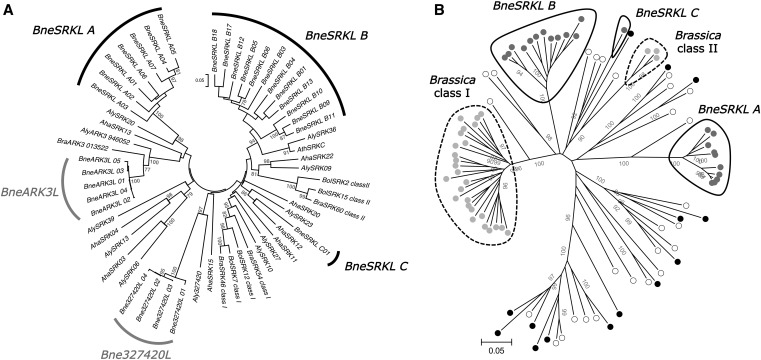
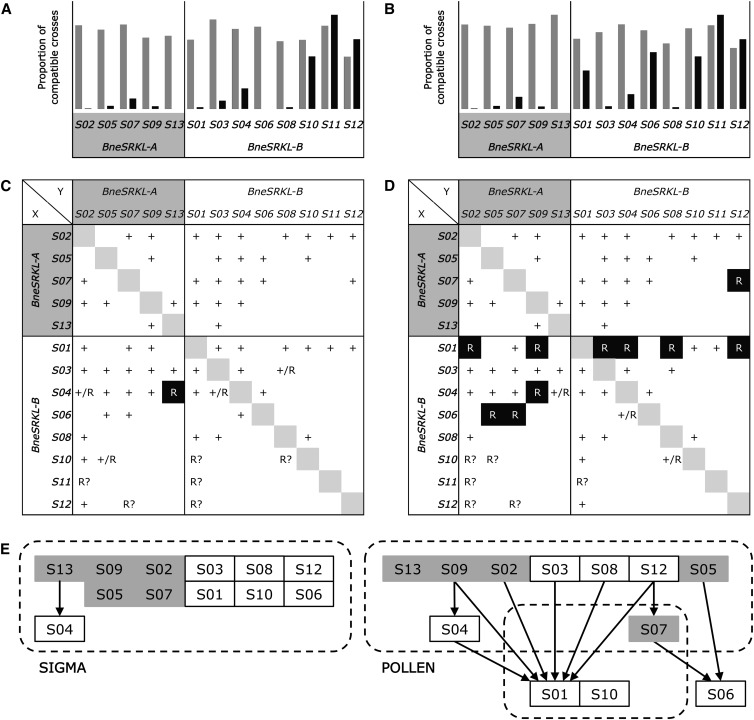
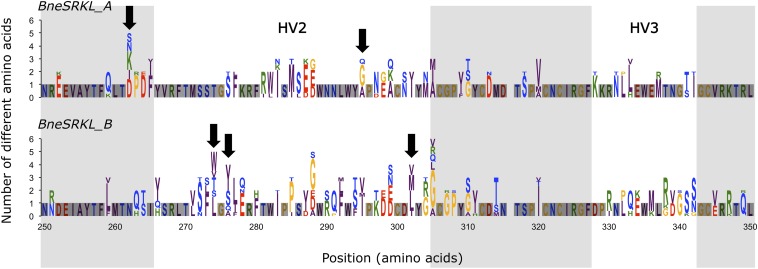
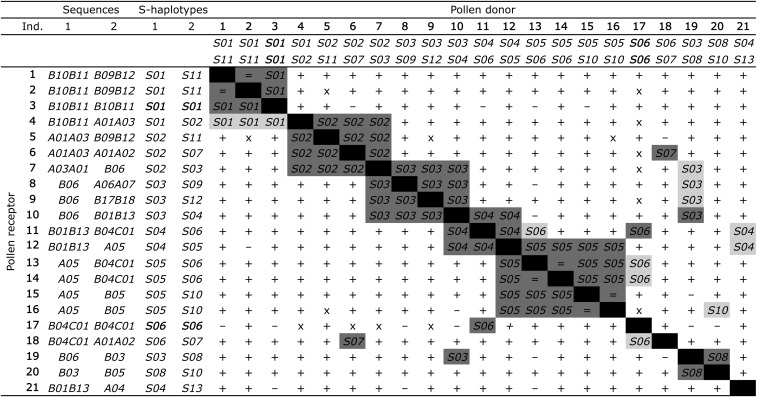
Self-incompatibility (SI) is a genetic system that prevents self-fertilization in many Angiosperms. Although plants from the Brassicaceae family present an apparently unique SI system that is ancestral to the family, investigations at the S-locus responsible for SI have been mostly limited to two distinct lineages (Brassica and Arabidopsis-Capsella, respectively). Here, we investigated SI in a third deep-branching lineage of Brassicaceae: the tribe Biscutelleae. By coupling sequencing of the SI gene responsible for pollen recognition (SRK) with phenotypic analyses based on controlled pollinations, we identified 20 SRK-like sequences functionally linked to 13 S-haplotypes in 21 individuals of Biscutella neustriaca and 220 seedlings. We found two genetic and phylogenetic features of SI in Biscutelleae that depart from patterns observed in the reference Arabidopsis clade: (1) SRK-like sequences cluster into two main phylogenetic lineages interspersed within the many SRK lineages of Arabidopsis; and (2) some SRK-like sequences are transmitted by linked pairs, suggesting local duplication within the S-locus. Strikingly, these features also were observed in the Brassica clade but probably evolved independently, as the two main SRK clusters in Biscutella are distinct from those in Brassica. In the light of our results and of what has been previously observed in other Brassicaceae, we discuss the ecological and evolutionary implications on SI plant populations of the high diversity and the complex dominance relationships we found at the S-locus in Biscutelleae.
自交不亲和性(SI)是一种遗传系统,可防止许多被子植物发生自花受精。尽管十字花科植物呈现出一种明显独特的、该科所特有的自交不亲和系统,但对负责自交不亲和的S位点的研究大多局限于两个不同的谱系(分别为芸苔属和拟南芥-荠菜属)。在此,我们研究了十字花科第三个深度分支谱系:双角果族的自交不亲和性。通过将负责花粉识别的自交不亲和基因(SRK)的测序与基于控制授粉的表型分析相结合,我们在21株新斯特里亚双角果和220株幼苗中鉴定出20个与13种S单倍型功能相关的SRK样序列。我们发现双角果族自交不亲和性的两个遗传和系统发育特征与参考拟南芥分支中观察到的模式不同:(1)SRK样序列聚集成两个主要系统发育谱系,散布在拟南芥的许多SRK谱系中;(2)一些SRK样序列通过连锁对传递,表明S位点内存在局部重复。引人注目的是,这些特征在芸苔属分支中也有观察到,但可能是独立进化的,因为双角果属中的两个主要SRK簇与芸苔属中的不同。根据我们的研究结果以及之前在其他十字花科植物中观察到的情况,我们讨论了在双角果族S位点发现的高多样性和复杂显性关系对自交不亲和植物种群的生态和进化影响。