Huang Xiao-Xi, Zhu Li-Na, Wu Bin, Huo Yan-Fang, Duan Na-Na, Kong De-Ming
State Key Laboratory of Medicinal Chemical Biology, Nankai University, Tianjin 300071, PR China Collaborative Innovation Center of Chemical Science and Engineering (Tianjin), Tianjin 300071, PR China.
Collaborative Innovation Center of Chemical Science and Engineering (Tianjin), Tianjin 300071, PR China Department of Chemistry, Tianjin University, Tianjin 300072, PR China.
Nucleic Acids Res. 2014 Jul;42(13):8719-31. doi: 10.1093/nar/gku526. Epub 2014 Jun 17.
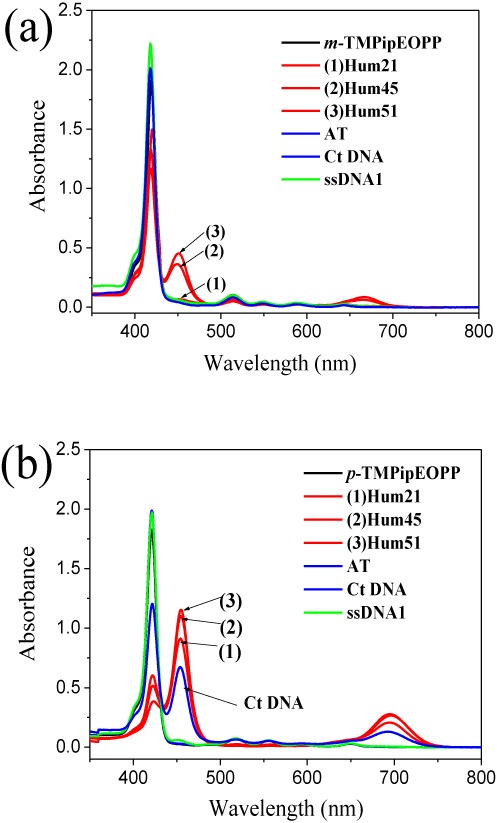
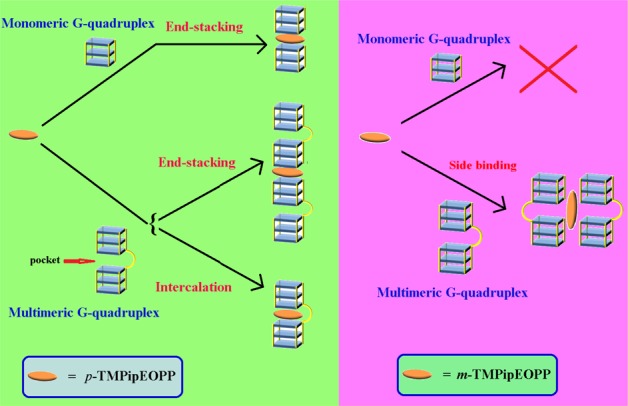
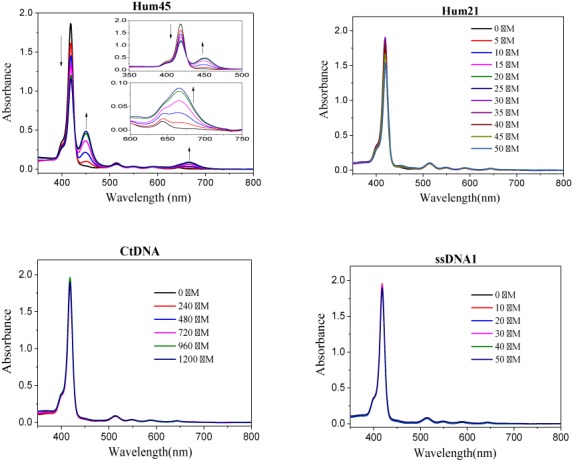
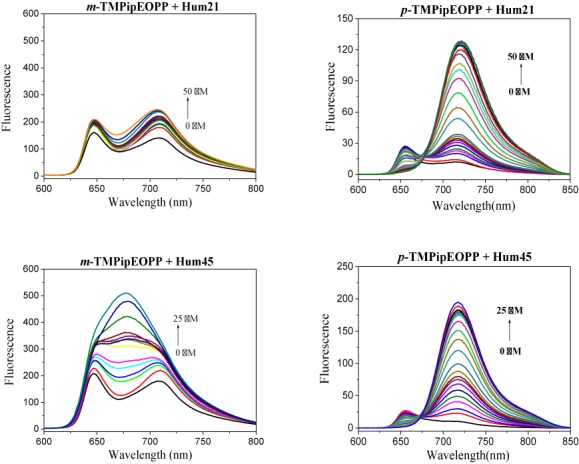
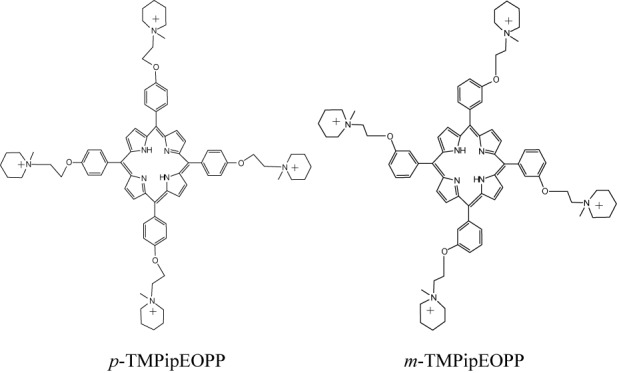
Ligands that can interact specifically with telomeric multimeric G-quadruplexes could be developed as promising anticancer drugs with few side effects related to other G-quadruplex-forming regions. In this paper, a new cationic porphyrin derivative, m-TMPipEOPP, was synthesized and characterized. Its multimeric G-quadruplex recognition specificity under molecular crowding conditions was compared to its isomer p-TMPipEOPP. The slight structural difference accounts for different multimeric G-quadruplex recognition specificity for the two isomers. p-TMPipEOPP can barely discriminate between multimeric and monomeric G-quadruplexes. By contrast, m-TMPipEOPP can bind with multimeric but not with monomeric G-quadruplexes. p-TMPipEOPP might bind to multimeric G-quadruplexes by two modes: sandwich-like end-stacking mode and pocket-dependent intercalative mode. Increasing the pocket size between adjacent two G-quadruplex units is beneficial for the latter mode. m-TMPipEOPP might bind to multimeric G-quadruplexes by a side binding mode, which confers m-TMPipEOPP with higher multimeric G-quadruplex recognition specificity compared to p-TMPipEOPP. m-TMPipEOPP increases the stability of multimeric G-quadruplex under both dilute and molecular crowding conditions but its G-quadruplex-stabilizing ability is a little weaker than p-TMPipEOPP. These results provide important information for the design of highly specific multimeric G-quadruplex ligands. Another interesting finding is that pocket size is an important factor in determining the stability of multimeric G-quadruplexes.
能够与端粒多聚体G-四链体特异性相互作用的配体,有望开发成为副作用少的抗癌药物,因为其副作用与其他形成G-四链体的区域无关。本文合成并表征了一种新型阳离子卟啉衍生物m-TMPipEOPP。将其在分子拥挤条件下对多聚体G-四链体的识别特异性与其异构体p-TMPipEOPP进行了比较。微小的结构差异导致这两种异构体对多聚体G-四链体具有不同的识别特异性。p-TMPipEOPP几乎无法区分多聚体和单体G-四链体。相比之下,m-TMPipEOPP能与多聚体G-四链体结合,但不能与单体G-四链体结合。p-TMPipEOPP可能通过两种模式与多聚体G-四链体结合:三明治状的末端堆积模式和口袋依赖性插入模式。增加相邻两个G-四链体单元之间的口袋大小有利于后一种模式。m-TMPipEOPP可能通过侧面结合模式与多聚体G-四链体结合,这使得m-TMPipEOPP比p-TMPipEOPP具有更高的多聚体G-四链体识别特异性。在稀释和分子拥挤条件下,m-TMPipEOPP均能提高多聚体G-四链体的稳定性,但其G-四链体稳定能力略弱于p-TMPipEOPP。这些结果为设计高特异性的多聚体G-四链体配体提供了重要信息。另一个有趣的发现是,口袋大小是决定多聚体G-四链体稳定性的重要因素。