Halpern Benjamin S, Longo Catherine, Scarborough Courtney, Hardy Darren, Best Benjamin D, Doney Scott C, Katona Steven K, McLeod Karen L, Rosenberg Andrew A, Samhouri Jameal F
National Center for Ecological Analysis and Synthesis, Santa Barbara, California, United States of America; Bren School of Environmental Science and Management, University of California, Santa Barbara, California, United States of America; Imperial College London, Silwood Park Campus, Ascot, United Kingdom.
National Center for Ecological Analysis and Synthesis, Santa Barbara, California, United States of America.
PLoS One. 2014 Jun 18;9(6):e98995. doi: 10.1371/journal.pone.0098995. eCollection 2014.
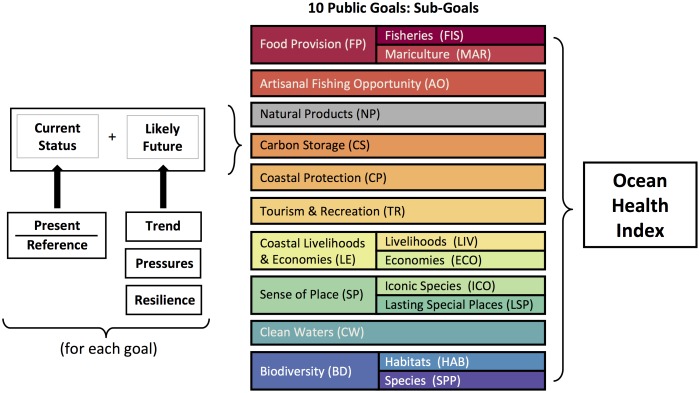
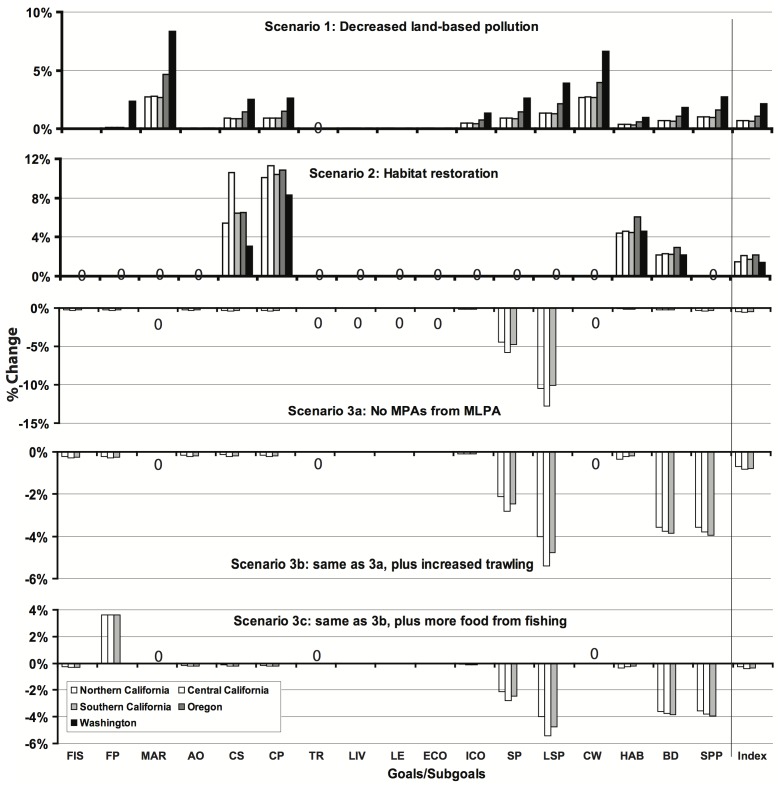
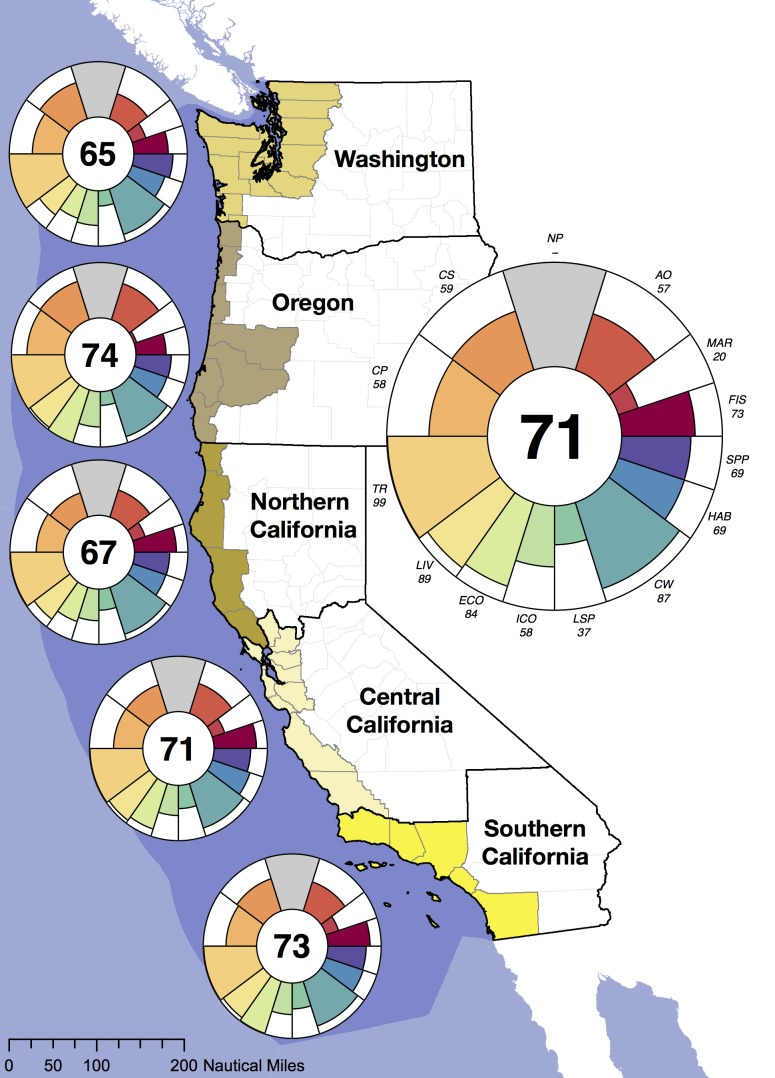
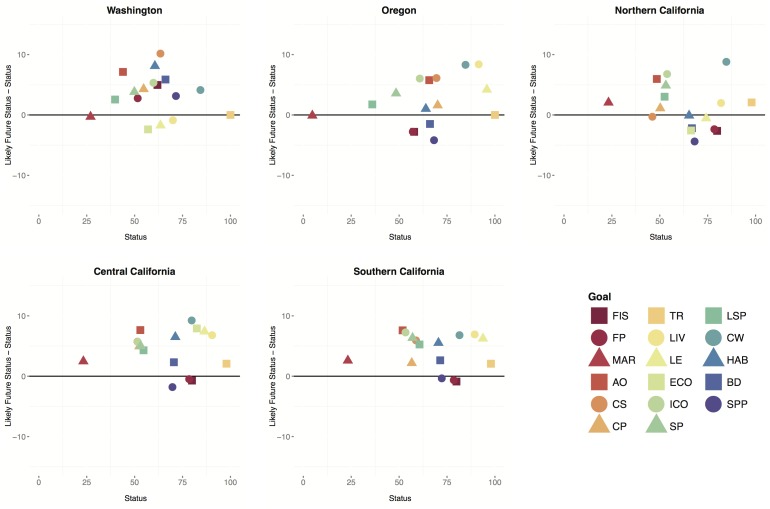
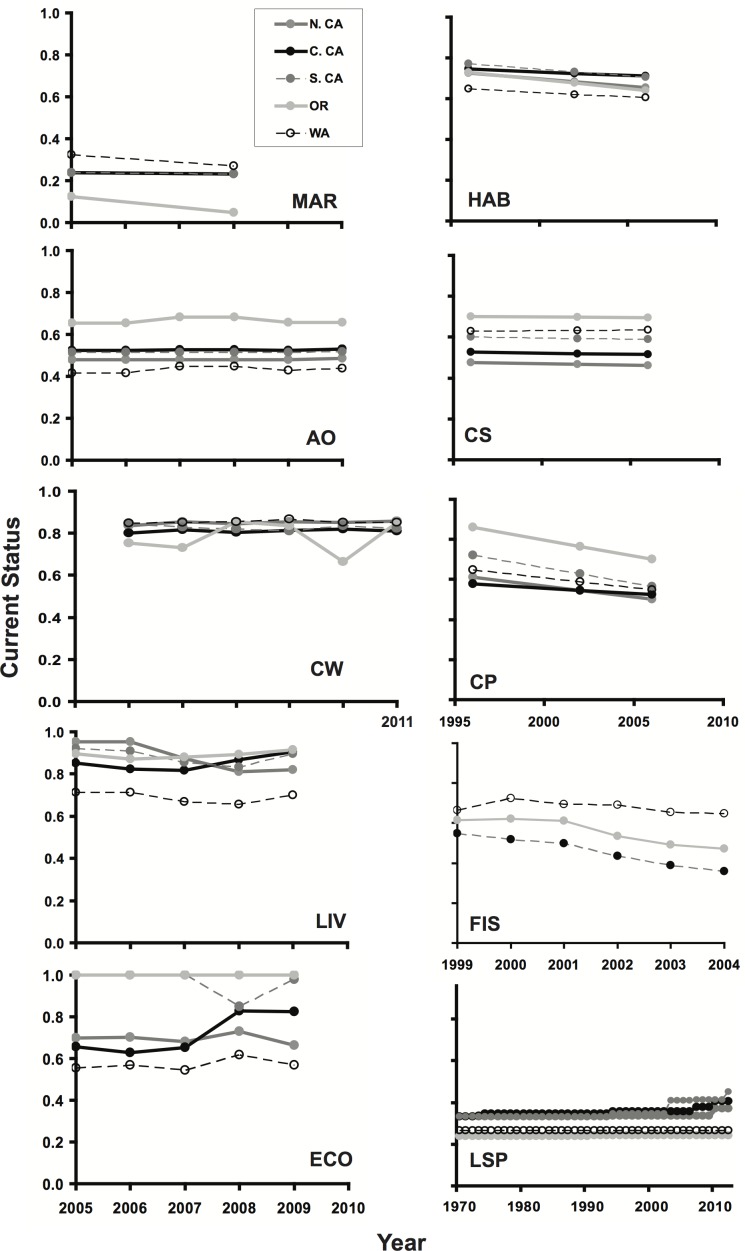
Management of marine ecosystems increasingly demands comprehensive and quantitative assessments of ocean health, but lacks a tool to do so. We applied the recently developed Ocean Health Index to assess ocean health in the relatively data-rich US west coast region. The overall region scored 71 out of 100, with sub-regions scoring from 65 (Washington) to 74 (Oregon). Highest scoring goals included tourism and recreation (99) and clean waters (87), while the lowest scoring goals were sense of place (48) and artisanal fishing opportunities (57). Surprisingly, even in this well-studied area data limitations precluded robust assessments of past trends in overall ocean health. Nonetheless, retrospective calculation of current status showed that many goals have declined, by up to 20%. In contrast, near-term future scores were on average 6% greater than current status across all goals and sub-regions. Application of hypothetical but realistic management scenarios illustrate how the Index can be used to predict and understand the tradeoffs among goals and consequences for overall ocean health. We illustrate and discuss how this index can be used to vet underlying assumptions and decisions with local stakeholders and decision-makers so that scores reflect regional knowledge, priorities and values. We also highlight the importance of ongoing and future monitoring that will provide robust data relevant to ocean health assessment.
海洋生态系统的管理越来越需要对海洋健康进行全面和定量的评估,但却缺乏这样一种工具。我们应用最近开发的海洋健康指数来评估数据相对丰富的美国西海岸地区的海洋健康状况。整个地区在满分为100分的评分中得分为71分,各次区域的得分从65分(华盛顿州)到74分(俄勒冈州)不等。得分最高的目标包括旅游与休闲(99分)和清洁水域(87分),而得分最低的目标是地方感(48分)和个体渔业机会(57分)。令人惊讶的是,即使在这个研究充分的地区,数据限制也妨碍了对过去海洋健康总体趋势的有力评估。尽管如此,对当前状况的追溯计算表明,许多目标已经下降,降幅高达20%。相比之下,所有目标和次区域的近期未来得分平均比当前状况高出6%。应用假设但现实的管理情景说明了该指数如何能够用于预测和理解目标之间的权衡以及对整体海洋健康的影响。我们举例并讨论了该指数如何能够用于与当地利益相关者和决策者一起审查潜在假设和决策,以便分数能够反映区域知识、优先事项和价值观。我们还强调了持续监测和未来监测的重要性,这些监测将提供与海洋健康评估相关的有力数据。