Luo Jie, Zhou Jianhong, Cheng Qi, Zhou Caiyun, Ding Zhiming
Department of Gynecologic Oncology, Women's Hospital, School of Medicine, Zhejiang University, Hangzhou, Zhejiang 310006, P.R. China.
Oncol Lett. 2014 Apr;7(4):1043-1048. doi: 10.3892/ol.2014.1841. Epub 2014 Jan 29.
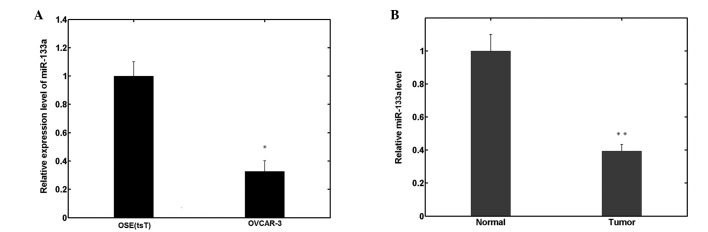
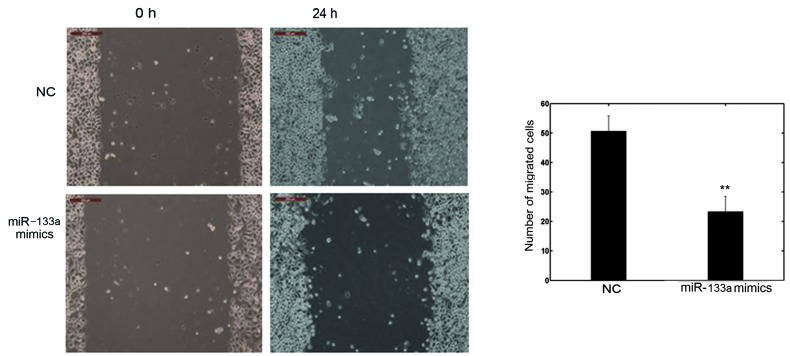
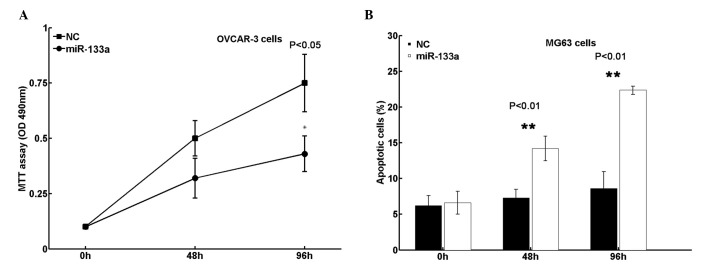
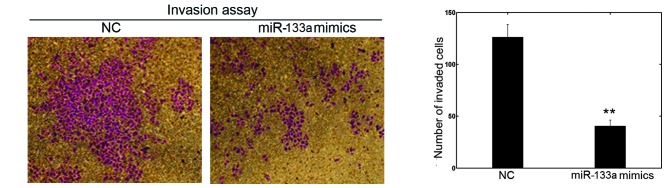
It has been demonstrated that microRNA (miR)-133a is downregulated in a number of human malignancies and is closely associated with the progression of tumors. The present study was conducted to investigate the contribution of miR-133a to the initiation and malignant progression of human epithelial ovarian cancer (EOC). Quantitative polymerase chain reaction was employed to detect the expression of miR-133a in the human EOC OVCAR-3 cell line, normal human ovarian surface epithelial (tsT) cells and 96 tissue samples, including 70 EOC tissues and 26 normal ovarian tissue sections. Additionally, analysis of the correlation between miR-133a levels and clinicopathological characteristics was carried out. The effect of miR-133a on cell viability, apoptosis, invasion and migration was investigated following transfection with miR-133a mimics and negative control small interfering RNA in OVCAR-3 cells. Marked downregulation of miR-133a was observed in the OVCAR-3 cell line and primary tumor samples, and it was found that reduced miR-133a expression significantly correlated with advanced clinical stages, poor histological differentiation and lymph node metastasis. Furthermore, OVCAR-3 cell viability, invasion and migration were significantly inhibited, while cell apoptosis was increased, following transfection of miR-133a mimics. The present study reveals the critical role that miR-133a plays in EOC pathogenesis and development, indicating that it may act as a promising biomarker for predicting EOC progression and as a potential target for gene therapy.
已有研究表明,微小RNA(miR)-133a在多种人类恶性肿瘤中表达下调,且与肿瘤进展密切相关。本研究旨在探讨miR-133a对人类上皮性卵巢癌(EOC)起始和恶性进展的作用。采用定量聚合酶链反应检测miR-133a在人类EOC OVCAR-3细胞系、正常人卵巢表面上皮(tsT)细胞及96份组织样本(包括70份EOC组织和26份正常卵巢组织切片)中的表达。此外,还分析了miR-133a水平与临床病理特征之间的相关性。用miR-133a模拟物和阴性对照小干扰RNA转染OVCAR-3细胞后,研究了miR-133a对细胞活力、凋亡、侵袭和迁移的影响。在OVCAR-3细胞系和原发性肿瘤样本中观察到miR-133a明显下调,且发现miR-133a表达降低与临床晚期、组织学分化差和淋巴结转移显著相关。此外,转染miR-133a模拟物后,OVCAR-3细胞的活力、侵袭和迁移受到显著抑制,而细胞凋亡增加。本研究揭示了miR-133a在EOC发病机制和发展中的关键作用,表明它可能作为预测EOC进展的有前景的生物标志物以及基因治疗的潜在靶点。