Soliman Ashraf, DeSanctis Vincenzo, Yassin Mohamed, Elalaily Rania, Eldarsy Nagwa E
Department of Pediatric, Alexandria University Children's Hospital, Alexandria, Egypt.
Pediatric and Adolescent Outpatient Clinic, Quisisana Hospital, 44121 Ferrara, Italy.
Indian J Endocrinol Metab. 2014 May;18(3):274-82. doi: 10.4103/2230-8210.131130.
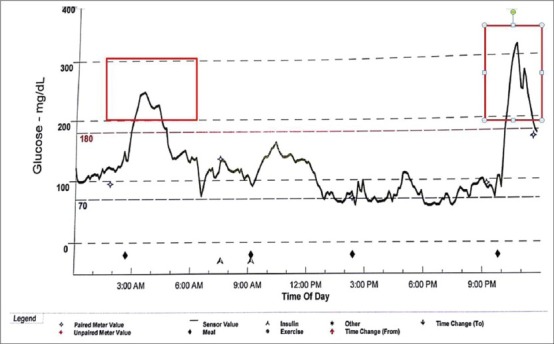
Continuous glucose monitoring (CGM) systems are an emerging technology that allows frequent glucose measurements to monitor glucose trends in real time. Their use as a diagnostic tool is still developing and appears to be promising. Combining intermittent glucose self-monitoring (SGM) and CGM combines the benefits of both. Significant improvement in the treatment modalities that may prevent the progress of prediabetes to diabetes have been achieved recently and dictates screening of high risk patients for early diagnosis and management of glycemic abnormalities. The use of CGMS in the diagnosis of early dysglycemia (prediabetes) especially in high risk patients appears to be an attractive approach. In this review we searched the literature to investigate the value of using CGMS as a diagnostic tool compared to other known tools, namely oral glucose tolerance test (OGTT) and measurement of glycated hemoglobin (HbA1C) in high risk groups. Those categories of patients include adolescents and adults with obesity especially those with family history of type 2 diabetes mellitus, polycystic ovary syndrome (PCO), gestational diabetes, cystic fibrosis, thalassemia major, acute coronary syndrome (ACS), and after renal transplantation. It appears that the ability of the CGMS for frequently monitoring (every 5 min) glucose changes during real-life settings for 3 to 5 days stretches the chance to detect more glycemic abnormalities during basal and postprandial conditions compared to other short-timed methods.
连续血糖监测(CGM)系统是一项新兴技术,它能够进行频繁的血糖测量,以实时监测血糖变化趋势。其作为一种诊断工具仍在发展之中,且前景似乎颇为广阔。将间歇性自我血糖监测(SGM)与CGM相结合,可兼收两者之利。近期在治疗方式上取得了显著进展,这些进展可能会阻止糖尿病前期发展为糖尿病,这就要求对高危患者进行筛查,以便早期诊断和管理血糖异常情况。在诊断早期血糖异常(糖尿病前期)时使用CGM系统,尤其是在高危患者中使用,似乎是一种颇具吸引力的方法。在本综述中,我们检索了文献,以研究在高危人群中,与其他已知工具(即口服葡萄糖耐量试验(OGTT)和糖化血红蛋白(HbA1C)测量)相比,使用CGM系统作为诊断工具的价值。这些患者类别包括肥胖的青少年和成年人,尤其是那些有2型糖尿病家族史、多囊卵巢综合征(PCO)、妊娠期糖尿病、囊性纤维化、重型地中海贫血、急性冠状动脉综合征(ACS)以及肾移植后的患者。与其他短期方法相比,CGM系统在现实生活环境中每5分钟频繁监测血糖变化3至5天的能力,似乎增加了在基础状态和餐后状态下检测到更多血糖异常的机会。