Zheng Hai-Qing, Zhang Li-Ying, Luo Jing, Li Li-Li, Li Menglin, Zhang Qingjie, Hu Xi-Quan
Department of Rehabilitation Medicine Science, the Third Affiliated Hospital of Sun Yat-sen University, Guangzhou 510630, China.
Int J Mol Sci. 2014 Jun 18;15(6):10974-88. doi: 10.3390/ijms150610974.
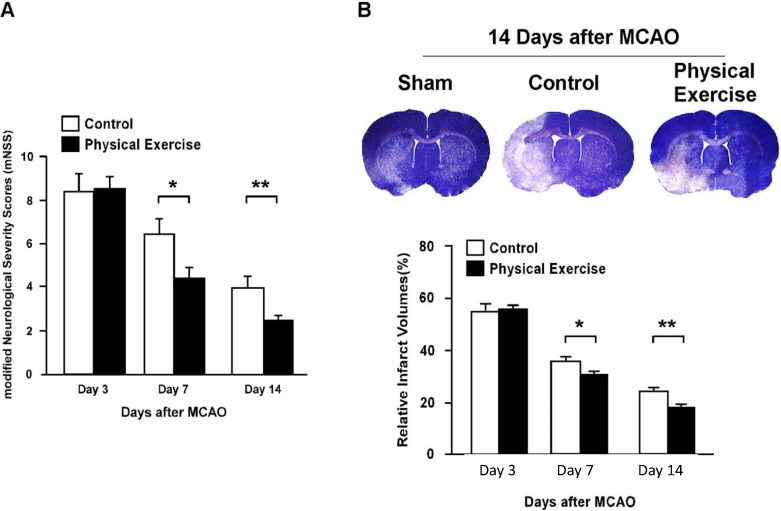
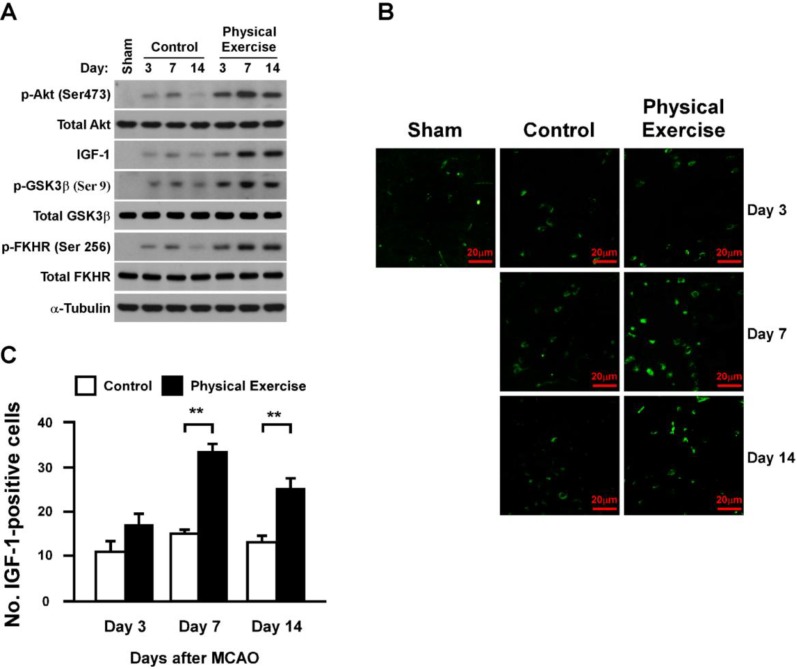
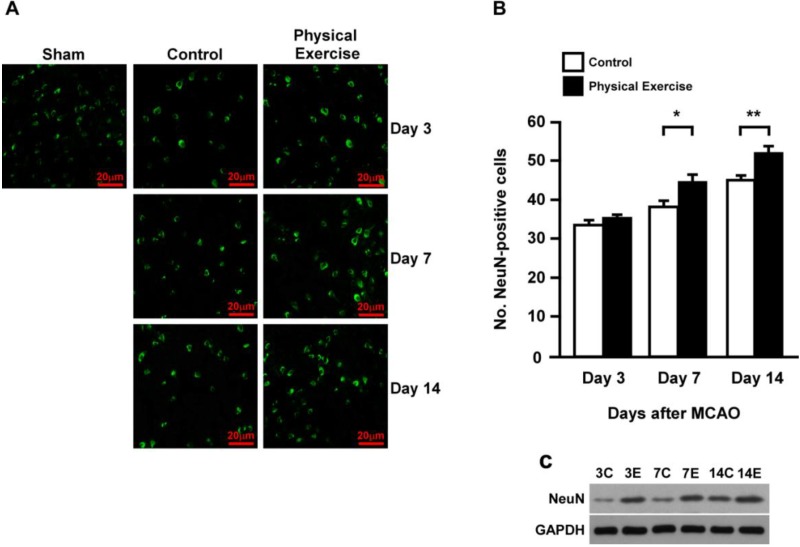
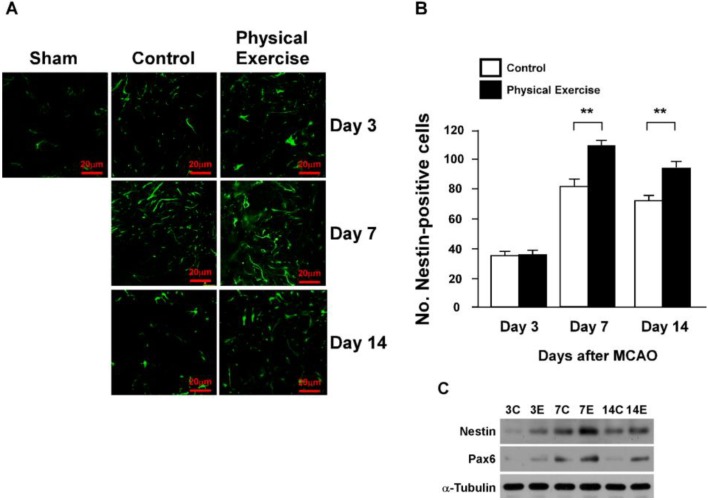
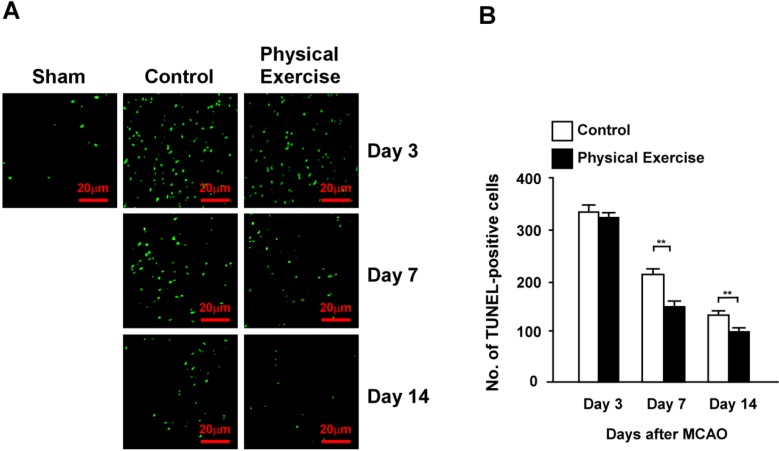
Although physical exercise is an effective strategy for treatment of ischemic stroke, the underlying protective mechanisms are still not well understood. It has been recently demonstrated that neural progenitor cells play a vital role in the recovery of neurological function (NF) through differentiation into mature neurons. In the current study, we observed that physical exercise significantly reduced the infarct size and improved damaged neural functional recovery after an ischemic stroke. Furthermore, we found that the treatment not only exhibited a significant increase in the number of neural progenitor cells and neurons but also decreased the apoptotic cells in the peri-infarct region, compared to a control in the absence of exercise. Importantly, the insulin-like growth factor-1 (IGF-1)/Akt signaling pathway was dramatically activated in the peri-infarct region of rats after physical exercise training. Therefore, our findings suggest that physical exercise directly influences the NF recovery process by increasing neural progenitor cell count via activation of the IGF-1/Akt signaling pathway.
尽管体育锻炼是治疗缺血性中风的有效策略,但其潜在的保护机制仍未得到充分理解。最近有研究表明,神经祖细胞通过分化为成熟神经元,在神经功能(NF)恢复中发挥着至关重要的作用。在本研究中,我们观察到体育锻炼显著减小了缺血性中风后的梗死面积,并改善了受损神经功能的恢复。此外,与未进行锻炼的对照组相比,我们发现该治疗不仅使神经祖细胞和神经元数量显著增加,还减少了梗死周边区域的凋亡细胞。重要的是,体育锻炼训练后,大鼠梗死周边区域的胰岛素样生长因子-1(IGF-1)/Akt信号通路被显著激活。因此,我们的研究结果表明,体育锻炼通过激活IGF-1/Akt信号通路增加神经祖细胞数量,直接影响神经功能的恢复过程。