Thiagarajah Jay R, Yildiz Hasan, Carlson Taylor, Thomas Alyssa R, Steiger Casey, Pieretti Alberto, Zukerberg Lawrence R, Carrier Rebecca L, Goldstein Allan M
Department of Gastroenterology and Nutrition, Boston Children's Hospital, Boston, Massachusetts, United States of America.
Department of Chemical Engineering, Northeastern University, Boston, Massachusetts, United States of America.
PLoS One. 2014 Jun 19;9(6):e99944. doi: 10.1371/journal.pone.0099944. eCollection 2014.
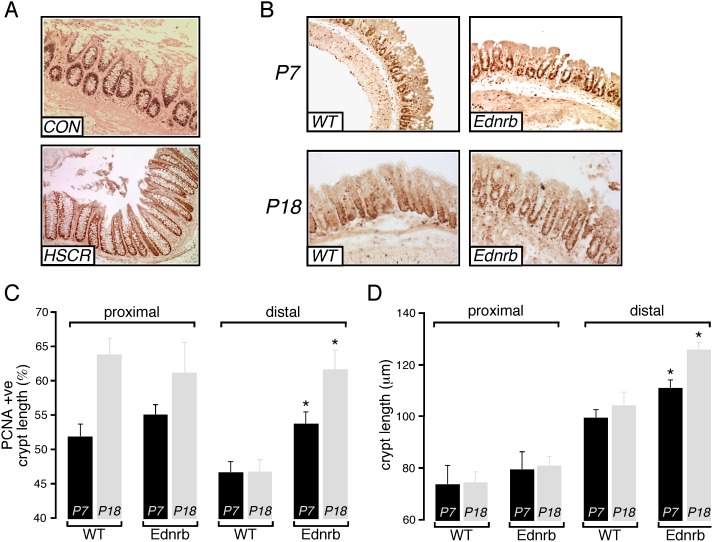
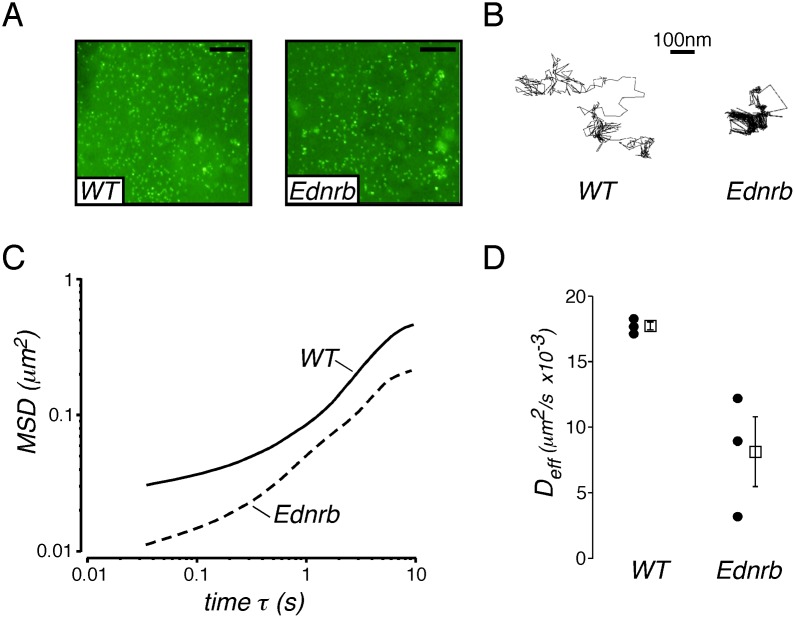
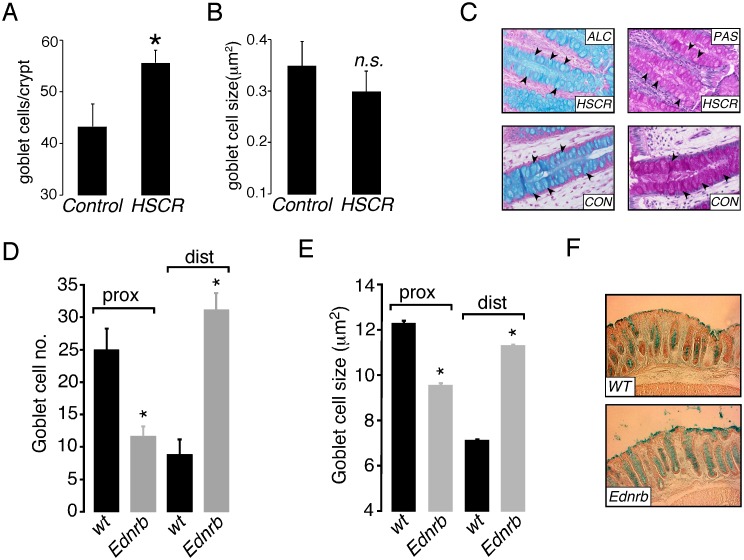
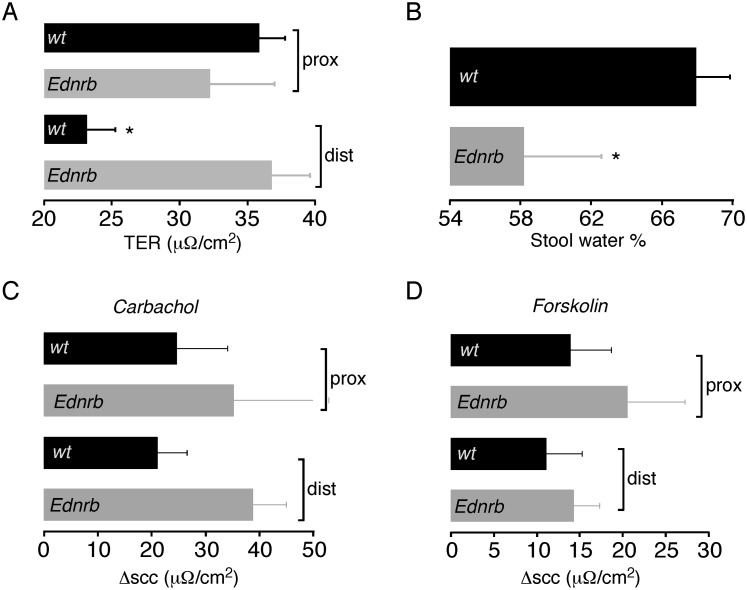
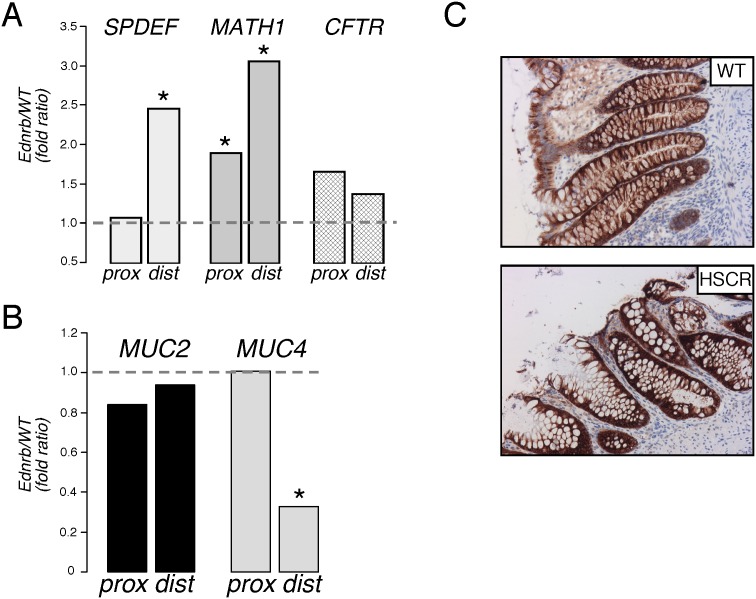
Hirschsprung disease-associated enterocolitis (HAEC) leads to significant mortality and morbidity, but its pathogenesis remains unknown. Changes in the colonic epithelium related to goblet cells and the luminal mucus layer have been postulated to play a key role. Here we show that the colonic epithelium of both aganglionic and ganglionic segments are altered in patients and in mice with Hirschsprung disease (HSCR). Structurally, goblet cells were altered with increased goblet cell number and reduced intracellular mucins in the distal colon of biopsies from patients with HSCR. Endothelin receptor B (Ednrb) mutant mice showed increased goblet cell number and size and increased cell proliferation compared to wild-type mice in aganglionic segments, and reduced goblet cell size and number in ganglionic segments. Functionally, compared to littermates, Ednrb-/- mice showed increased transepithelial resistance, reduced stool water content and similar chloride secretion in the distal colon. Transcript levels of goblet cell differentiation factors SPDEF and Math1 were increased in the distal colon of Ednrb-/- mice. Both distal colon from Ednrb mice and biopsies from HSCR patients showed reduced Muc4 expression as compared to controls, but similar expression of Muc2. Particle tracking studies showed that mucus from Ednrb-/- mice provided a more significant barrier to diffusion of 200 nm nanoparticles as compared to wild-type mice. These results suggest that aganglionosis is associated with increased goblet cell proliferation and differentiation and subsequent altered surface mucus properties, prior to the development of inflammation in the distal colon epithelium. Restoration of normal goblet cell function and mucus layer properties in the colonic epithelium may represent a therapeutic strategy for prevention of HAEC.
先天性巨结肠相关小肠结肠炎(HAEC)会导致显著的死亡率和发病率,但其发病机制仍不清楚。据推测,与杯状细胞和肠腔黏液层相关的结肠上皮变化起着关键作用。在此,我们表明,先天性巨结肠(HSCR)患者和小鼠的无神经节段和有神经节段的结肠上皮均发生了改变。在结构上,HSCR患者活检标本的远端结肠中,杯状细胞发生改变,杯状细胞数量增加,细胞内黏蛋白减少。与野生型小鼠相比,内皮素受体B(Ednrb)突变小鼠的无神经节段杯状细胞数量和大小增加,细胞增殖增加,而有神经节段杯状细胞大小和数量减少。在功能上,与同窝小鼠相比,Ednrb-/-小鼠远端结肠的跨上皮电阻增加,粪便含水量降低,氯化物分泌相似。Ednrb-/-小鼠远端结肠中杯状细胞分化因子SPDEF和Math1的转录水平升高。与对照组相比,Ednrb小鼠的远端结肠和HSCR患者的活检标本中Muc4表达均降低,但Muc2表达相似。粒子追踪研究表明,与野生型小鼠相比,Ednrb-/-小鼠的黏液对200 nm纳米颗粒的扩散提供了更显著的屏障。这些结果表明,在远端结肠上皮发生炎症之前,无神经节症与杯状细胞增殖和分化增加以及随后表面黏液特性改变有关。恢复结肠上皮中正常的杯状细胞功能和黏液层特性可能是预防HAEC的一种治疗策略。