Danielsen E Thomas, Moeller Morten E, Dorry Elad, Komura-Kawa Tatsuya, Fujimoto Yoshinori, Troelsen Jesper T, Herder Rachel, O'Connor Michael B, Niwa Ryusuke, Rewitz Kim F
Department of Biology, University of Copenhagen, Copenhagen, Denmark.
Graduate School of Life and Environmental Sciences, University of Tsukuba, Tsukuba, Ibaraki, Japan.
PLoS Genet. 2014 Jun 19;10(6):e1004343. doi: 10.1371/journal.pgen.1004343. eCollection 2014 Jun.
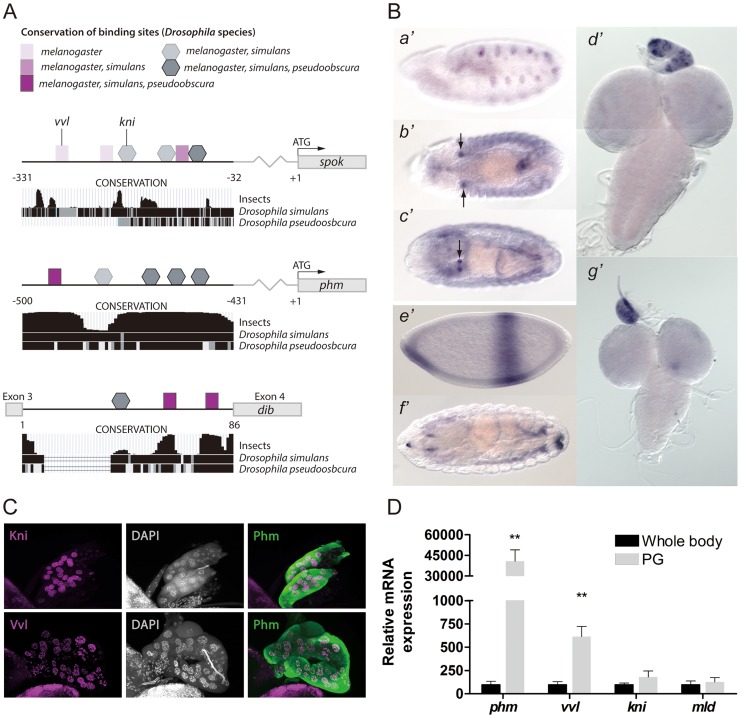
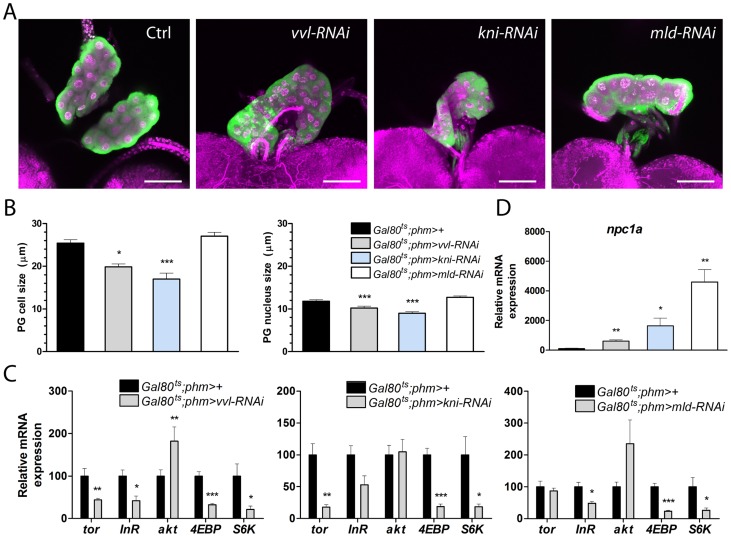
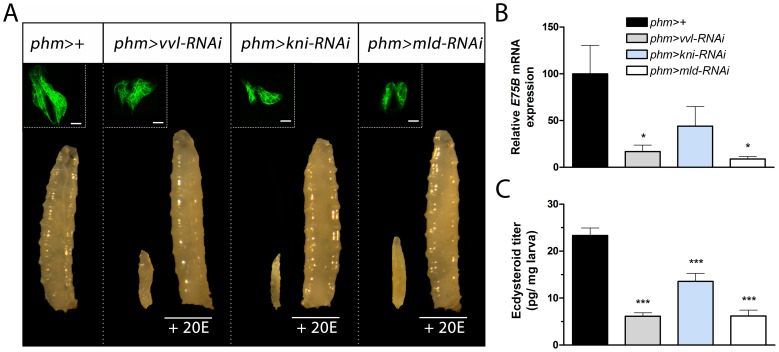
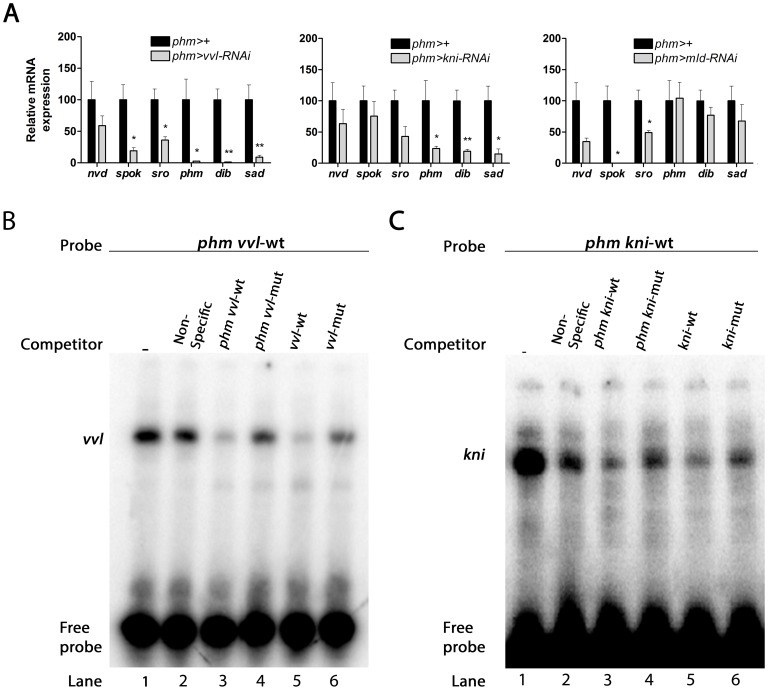
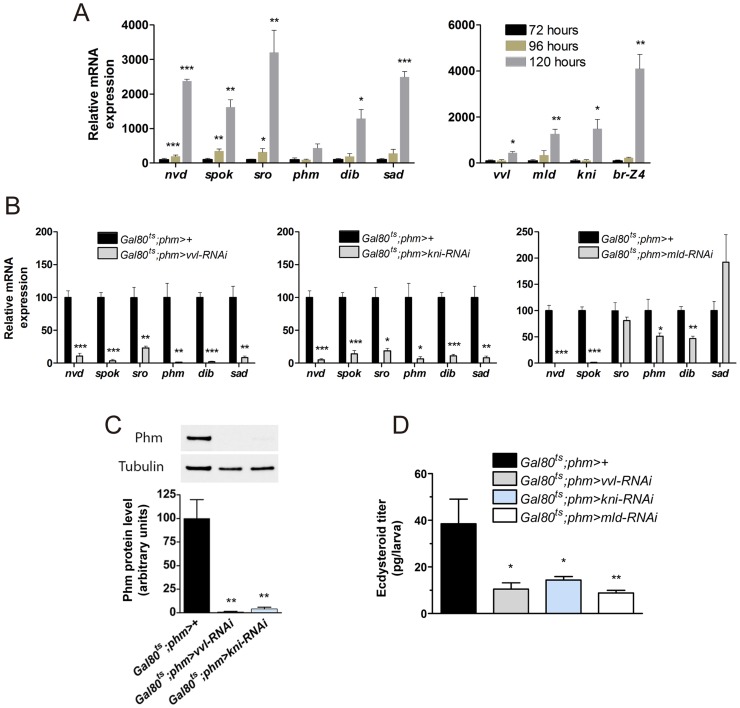
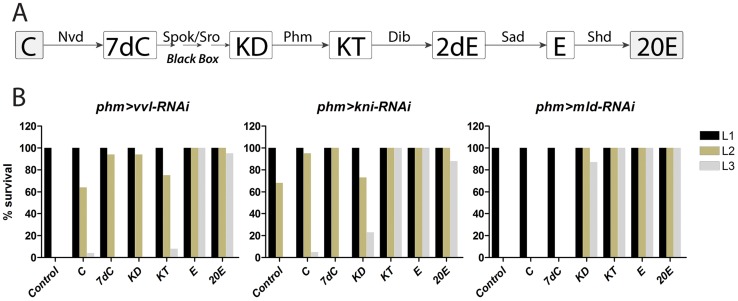
Specialized endocrine cells produce and release steroid hormones that govern development, metabolism and reproduction. In order to synthesize steroids, all the genes in the biosynthetic pathway must be coordinately turned on in steroidogenic cells. In Drosophila, the steroid producing endocrine cells are located in the prothoracic gland (PG) that releases the steroid hormone ecdysone. The transcriptional regulatory network that specifies the unique PG specific expression pattern of the ecdysone biosynthetic genes remains unknown. Here, we show that two transcription factors, the POU-domain Ventral veins lacking (Vvl) and the nuclear receptor Knirps (Kni), have essential roles in the PG during larval development. Vvl is highly expressed in the PG during embryogenesis and is enriched in the gland during larval development, suggesting that Vvl might function as a master transcriptional regulator in this tissue. Vvl and Kni bind to PG specific cis-regulatory elements that are required for expression of the ecdysone biosynthetic genes. Knock down of either vvl or kni in the PG results in a larval developmental arrest due to failure in ecdysone production. Furthermore, Vvl and Kni are also required for maintenance of TOR/S6K and prothoracicotropic hormone (PTTH) signaling in the PG, two major pathways that control ecdysone biosynthesis and PG cell growth. We also show that the transcriptional regulator, Molting defective (Mld), controls early biosynthetic pathway steps. Our data show that Vvl and Kni directly regulate ecdysone biosynthesis by transcriptional control of biosynthetic gene expression and indirectly by affecting PTTH and TOR/S6K signaling. This provides new insight into the regulatory network of transcription factors involved in the coordinated regulation of steroidogenic cell specific transcription, and identifies a new function of Vvl and Knirps in endocrine cells during post-embryonic development.
专门的内分泌细胞产生并释放类固醇激素,这些激素控制着发育、新陈代谢和繁殖。为了合成类固醇,生物合成途径中的所有基因必须在类固醇生成细胞中协同开启。在果蝇中,产生类固醇的内分泌细胞位于前胸腺(PG),该腺体释放类固醇激素蜕皮激素。指定蜕皮激素生物合成基因独特的PG特异性表达模式的转录调控网络仍然未知。在这里,我们表明,两个转录因子,即POU结构域的腹侧静脉缺失(Vvl)和核受体克尼普斯(Kni),在幼虫发育期间的前胸腺中具有重要作用。Vvl在胚胎发育期间在前胸腺中高度表达,并在幼虫发育期间在腺体中富集,这表明Vvl可能在该组织中作为主要转录调节因子发挥作用。Vvl和Kni与蜕皮激素生物合成基因表达所需的PG特异性顺式调控元件结合。在前胸腺中敲低vvl或kni会导致幼虫发育停滞,原因是蜕皮激素产生失败。此外,Vvl和Kni也是前胸腺中TOR/S6K和促前胸腺激素(PTTH)信号维持所必需的,这是控制蜕皮激素生物合成和前胸腺细胞生长的两个主要途径。我们还表明,转录调节因子蜕皮缺陷(Mld)控制生物合成途径的早期步骤。我们的数据表明,Vvl和Kni通过转录控制生物合成基因表达直接调节蜕皮激素生物合成,并通过影响PTTH和TOR/S6K信号间接调节。这为参与类固醇生成细胞特异性转录协调调节的转录因子调控网络提供了新的见解,并确定了Vvl和克尼普斯在胚胎后发育期间内分泌细胞中的新功能。