Hirsch Jan D, Metz Kelli R, Hosokawa Patrick W, Libby Anne M
Skaggs School of Pharmacy and Pharmaceutical Sciences, University of California, San Diego, La Jolla, California; Veterans Affairs of San Diego Healthcare System, San Diego, California.
Pharmacotherapy. 2014 Aug;34(8):826-35. doi: 10.1002/phar.1452. Epub 2014 Jun 20.
The Medication Regimen Complexity Index (MRCI) is a 65-item instrument that can be used to quantify medication regimen complexity at the patient level, capturing all prescribed and over-the-counter medications. Although the MRCI has been used in several studies, the narrow scope of the initial validation limits application at a population or clinical practice level.
To conduct a MRCI validation pertinent to the desired clinical use to identify patients for medication therapy management interventions.
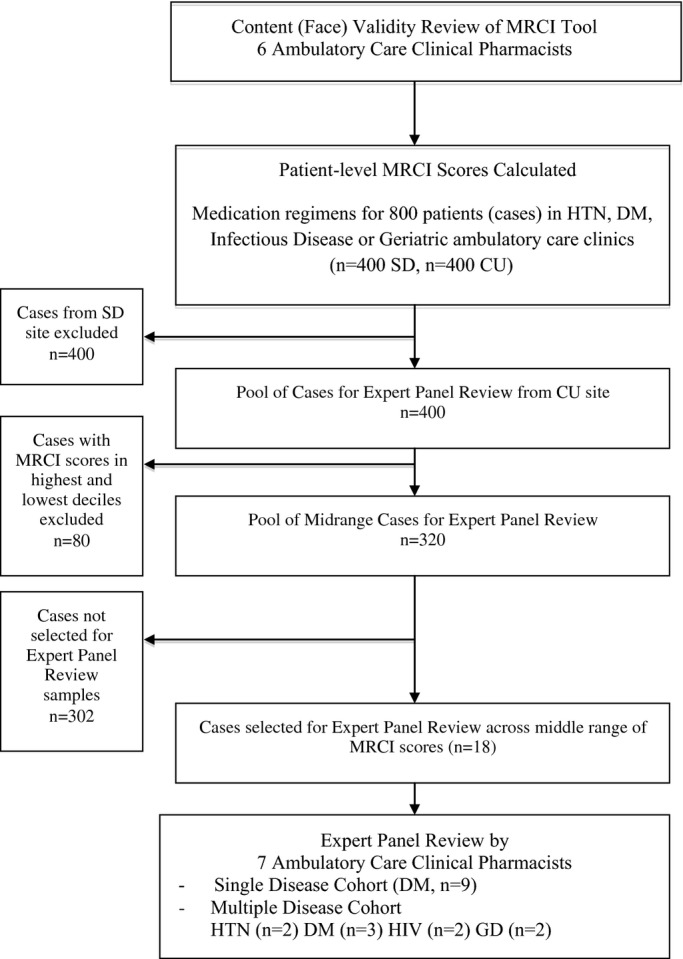
An expert panel of clinical pharmacists ranked medication regimen complexity for two samples of cases: a single-disease cohort (diabetes mellitus) and a multiple-disease cohort (diabetes mellitus, hypertension, human immunodeficiency virus infection, geriatric depression). Cases for expert panel review were selected from 400 ambulatory clinic patients, and each case description included data that were available via claims or electronic medical records (EMRs). Construct validity was assessed using patient-level MRCI scores, medication count, and additional patient data. Concordance was evaluated using weighted κ agreement statistic, and correlations were determined using Spearman rank-order correlation coefficient (ρ) or Kendall τ.
Moderate to good concordance between patient-level MRCI scores and expert medication regimen complexity ranking was observed (claims data, consensus ranking: single-disease cohort 0.55, multiple disease cohort 0.63). In contrast, only fair to moderate concordance was observed for medication count (single-disease cohort 0.33, multiple-disease cohort 0.48). Adding more-detailed administration directions from EMR data did not improve concordance. MRCI convergent validity was supported by strong correlations with medication count (all cohorts 0.90) and moderate correlations with morbidity measures (e.g., all cohorts; number of comorbidities 0.46, Chronic Disease Score 0.46). Nonsignificant correlation of MRCI scores with age and gender (all cohorts 0.08 and 0.06, respectively) supported MRCI divergent validity.
This study used cross-sectional, retrospective patient data for a small number of patients and clinical pharmacists from only two universities; therefore, results may have limited generalizability.
The patient-level MRCI is a valid tool for assessing medication regimen complexity that can be applied by using data commonly found in claims and EMR databases and could be useful to identify patients who may benefit from medication therapy management.
药物治疗方案复杂性指数(MRCI)是一种包含65个项目的工具,可用于在患者层面量化药物治疗方案的复杂性,涵盖所有处方药和非处方药。尽管MRCI已在多项研究中使用,但其最初验证的范围较窄,限制了其在人群或临床实践层面的应用。
进行与预期临床用途相关的MRCI验证,以识别适合药物治疗管理干预的患者。
一个临床药剂师专家小组对两个病例样本的药物治疗方案复杂性进行了排名:单一疾病队列(糖尿病)和多种疾病队列(糖尿病、高血压、人类免疫缺陷病毒感染、老年抑郁症)。专家小组审查的病例选自400名门诊患者,每个病例描述都包含可通过索赔或电子病历(EMR)获得的数据。使用患者层面的MRCI评分、用药数量和其他患者数据评估结构效度。使用加权κ一致性统计量评估一致性,并使用Spearman等级相关系数(ρ)或Kendall τ确定相关性。
观察到患者层面的MRCI评分与专家对药物治疗方案复杂性的排名之间存在中度至良好的一致性(索赔数据,共识排名:单一疾病队列0.55,多种疾病队列0.63)。相比之下,用药数量的一致性仅为一般至中度(单一疾病队列0.33,多种疾病队列0.48)。从EMR数据中添加更详细的给药说明并未提高一致性。MRCI的收敛效度得到了与用药数量的强相关性(所有队列0.90)以及与发病率指标的中度相关性(例如,所有队列;合并症数量0.46,慢性病评分0.46)的支持。MRCI评分与年龄和性别的相关性不显著(所有队列分别为0.08和0.06)支持了MRCI的区分效度。
本研究使用了来自少数患者的横断面回顾性患者数据,且临床药剂师仅来自两所大学;因此,结果的普遍性可能有限。
患者层面的MRCI是评估药物治疗方案复杂性的有效工具,可通过使用索赔和EMR数据库中常见的数据来应用,并且可能有助于识别可能从药物治疗管理中受益的患者。