Rezaeitalab Fariborz, Moharrari Fatemeh, Saberi Soheila, Asadpour Hadi, Rezaeetalab Fariba
Department of Neurology, School of Medicine, Mashhad University of Medical Sciences, Mashhad, Iran.
Psychiatry and Behavioral Sciences Research Center, Ibn-e- Sina Hospital, School of Medicine, Mashhad University of Medical Sciences, Mashhad, Iran.
J Res Med Sci. 2014 Mar;19(3):205-10.
Obstructive sleep apnea syndrome (OSAS) is a common sleep disorder characterized by repeated upper airway obstruction during sleep. While respiratory pauses followed by loud snoring and daytime sleepiness are the main symptoms of OSAS, the patients may complain from sleep disruption, headache, mood disturbance, irritability, and memory impairment. However, the association of sleep apnea with anxiety and depression is not completely understood. Adherence to continuous positive airway pressure (CPAP), the treatment of choice for OSAS, may be influenced by psychological conditions, especially claustrophobia. The aim of this study was to evaluate the association of OSAS with anxiety and depression symptoms. This study also investigated the association of anxiety with body mass index (BMI) and the severity of OSAS.
We conducted a cross-sectional study on 178 adult individuals diagnosed with OSAS at the sleep laboratory between September 2008 and May 2012. The participants were interviewed according to a checklist regarding both their chief complaints and other associated symptoms. The psychological status was assessed according to Beck anxiety inventory (BAI) and Beck depression inventory (BDI) scoring. The severity of breathing disorder was classified as mild, moderate, and severe based on apnea-hypopnea index (AHI) which was ascertained by overnight polysomnography. Daytime sleepiness was assessed by Epworth sleepiness scale (ESS).
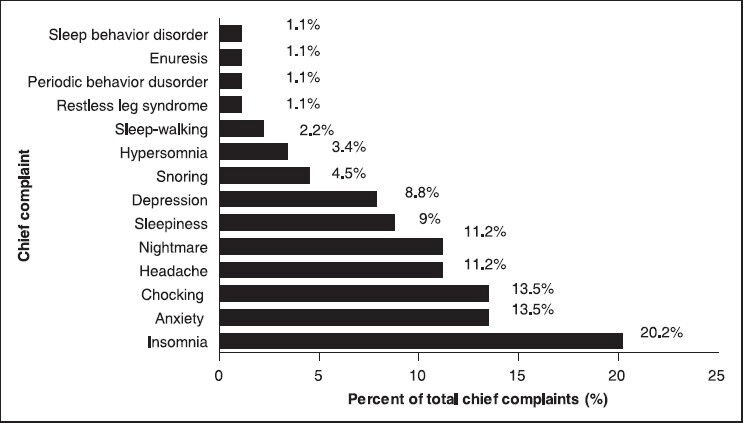
The mean (SD) age of participants was 50.33 years. In terms of sex, 85.5% of the study population were males and14.4% were females. We found no relation between sex and the symptoms of OSAS. Regarding the frequency of anxiety and depression symptoms, 53.9% of the individuals had some degree of anxiety, while 46.1% demonstrated depressive symptoms. In terms of OSAS severity, this study showed that OSAS severity was associated with the frequency of anxiety, chocking, and sleepiness (P : 0.001). According to polysomnographic results, we found that the majority of patients suffering from anxiety and chocking (66.7% and 71.4%, respectively) had severe OSAS, while only 23.1% of patients with sleepiness had severe OSAS.
Our study showed that the frequency of anxiety in OSAS patients is higher than in the general population regardless of the gender. Furthermore, it is more likely that OSAS patients present with anxiety and depression than the typical symptoms.
阻塞性睡眠呼吸暂停综合征(OSAS)是一种常见的睡眠障碍,其特征为睡眠期间反复出现上呼吸道阻塞。虽然呼吸暂停后伴有大声打鼾和日间嗜睡是阻塞性睡眠呼吸暂停综合征的主要症状,但患者可能会抱怨睡眠中断、头痛、情绪紊乱、易怒和记忆力减退。然而,睡眠呼吸暂停与焦虑和抑郁之间的关联尚未完全明确。坚持持续气道正压通气(CPAP)作为阻塞性睡眠呼吸暂停综合征的首选治疗方法,可能会受到心理状况的影响,尤其是幽闭恐惧症。本研究的目的是评估阻塞性睡眠呼吸暂停综合征与焦虑和抑郁症状之间的关联。本研究还调查了焦虑与体重指数(BMI)和阻塞性睡眠呼吸暂停综合征严重程度之间的关联。
我们对2008年9月至2012年5月期间在睡眠实验室被诊断为阻塞性睡眠呼吸暂停综合征的178名成年人进行了一项横断面研究。根据一份关于主要症状和其他相关症状的清单对参与者进行访谈。根据贝克焦虑量表(BAI)和贝克抑郁量表(BDI)评分评估心理状态。根据通过夜间多导睡眠图确定的呼吸暂停低通气指数(AHI),将呼吸障碍的严重程度分为轻度、中度和重度。通过爱泼华嗜睡量表(ESS)评估日间嗜睡情况。
参与者的平均(标准差)年龄为50.33岁。在性别方面,研究人群中85.5%为男性,14.4%为女性。我们发现性别与阻塞性睡眠呼吸暂停综合征的症状之间没有关联。关于焦虑和抑郁症状的发生率,5