Cheng Yen-Po, Lin Chin, Lin Ping-Yi, Cheng Chun-Yuan, Ma Hsin-I, Chen Chien-Min, Hueng Dueng-Yuan
Division of Neurosurgery, Department of Surgery, Changhua Christian Hospital, Changhua, China.
Graduate Institute of Life Science, National Defense Medical Center, Taipei, Taiwan, ROC.
Surg Neurol Int. 2014 May 26;5:78. doi: 10.4103/2152-7806.133205. eCollection 2014.
High-grade primary glioma have poor prognosis and predictive biomarkers is very important. Midkine (MDK), a heparin-binding growth factor, is important in regulating carcinogenesis, cell proliferation, mitogenesis, and angiogenesis. This study aimed to identify over-expression of MDK in gliomas and correlate this with clinical outcomes. The authors put forward their hypothesis correlating proliferation and poor survival with over-expression of this novel protein.
Two datasets from Gene Expression Omnibus (GEO) included human data of 100 and 180 patients, respectively. The MDK expression, World Health Organization (WHO) pathological grade, sex, age, and survival time were identified for statistical analysis.
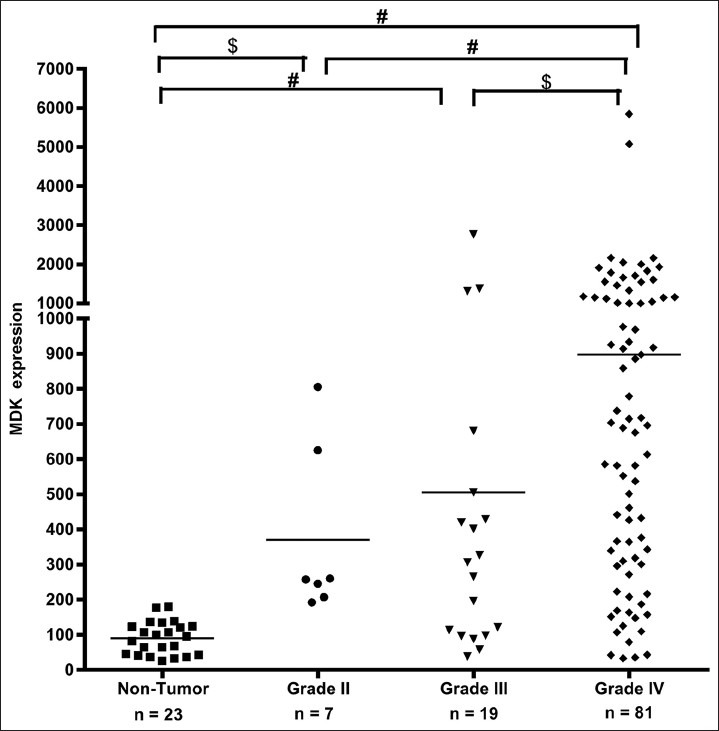
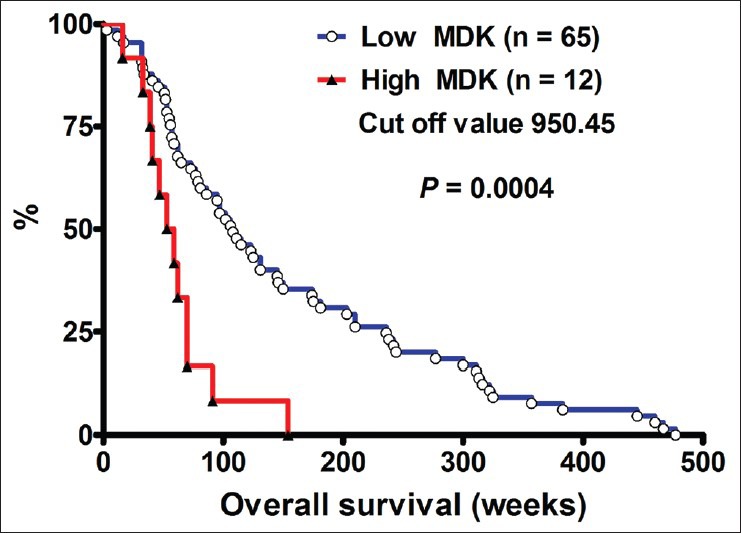
A search of the GEO profile revealed that MDK expression level was statistically greater in the WHO grade IV compared with grade II (P = 0.002), in grades III and IV compared with nontumor control (P = 0.044 and P < 0.001, respectively) after adjustments using the Bonferroni method. By the Kaplan-Meier survival curve, the high MDK expression group had poorer survival outcome (2.38-fold hazard, 95% confidence interval: 1.22-4.63) than the low MDK expression group after adjustments for WHO grade and age.
Taken together, there is a positive correlation between MDK expression and WHO grading of human gliomas. Moreover, MDK over-expression is significant correlated to poor survival outcome in high-grade, suggesting that MDK may be an important therapeutic target.
高级别原发性胶质瘤预后较差,寻找预测性生物标志物非常重要。中期因子(MDK)是一种肝素结合生长因子,在调节肿瘤发生、细胞增殖、有丝分裂和血管生成中起重要作用。本研究旨在确定MDK在胶质瘤中的过表达情况,并将其与临床结果相关联。作者提出了他们的假设,即这种新蛋白的过表达与增殖和不良生存相关。
来自基因表达综合数据库(GEO)的两个数据集分别包含100例和180例患者的人类数据。确定MDK表达、世界卫生组织(WHO)病理分级、性别、年龄和生存时间以进行统计分析。
对GEO数据的搜索显示,使用Bonferroni方法调整后,WHO四级胶质瘤中MDK的表达水平在统计学上高于二级(P = 0.002),三级和四级与非肿瘤对照相比也更高(分别为P = 0.044和P < 0.001)。通过Kaplan-Meier生存曲线分析,在调整WHO分级和年龄后,MDK高表达组的生存结果比低表达组差(风险比为2.38倍,95%置信区间:1.22 - 4.63)。
综上所述,MDK表达与人类胶质瘤的WHO分级之间存在正相关。此外,MDK过表达与高级别胶质瘤的不良生存结果显著相关,提示MDK可能是一个重要的治疗靶点。