Department of Urology, Huashan Hospital, Fudan University, Shanghai, China.
Fudan Institute of Urology, Huashan Hospital, Fudan University, Shanghai, China.
Cancer Sci. 2022 Nov;113(11):3698-3709. doi: 10.1111/cas.15546. Epub 2022 Sep 6.
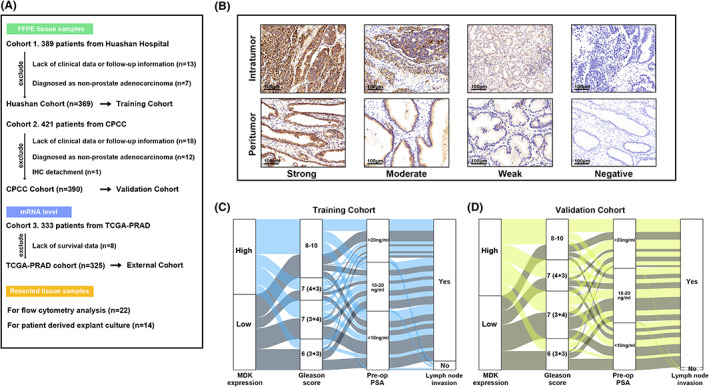
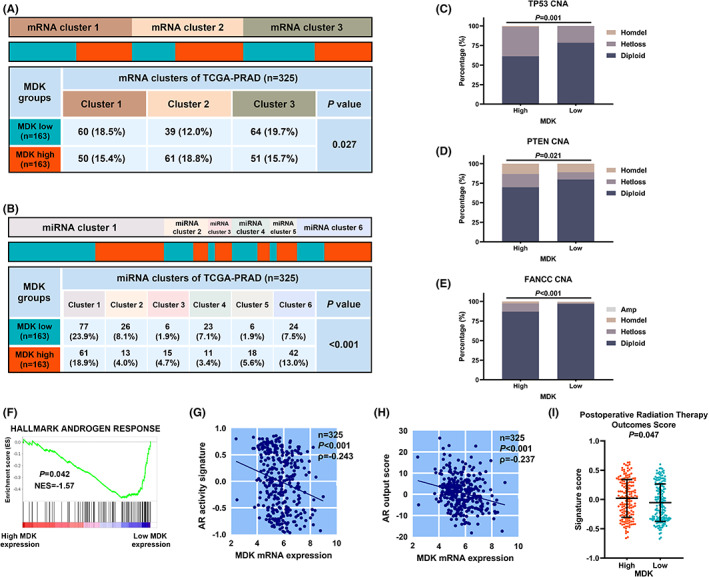
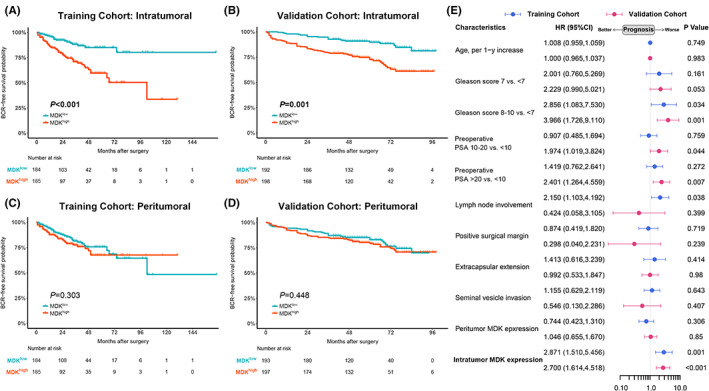
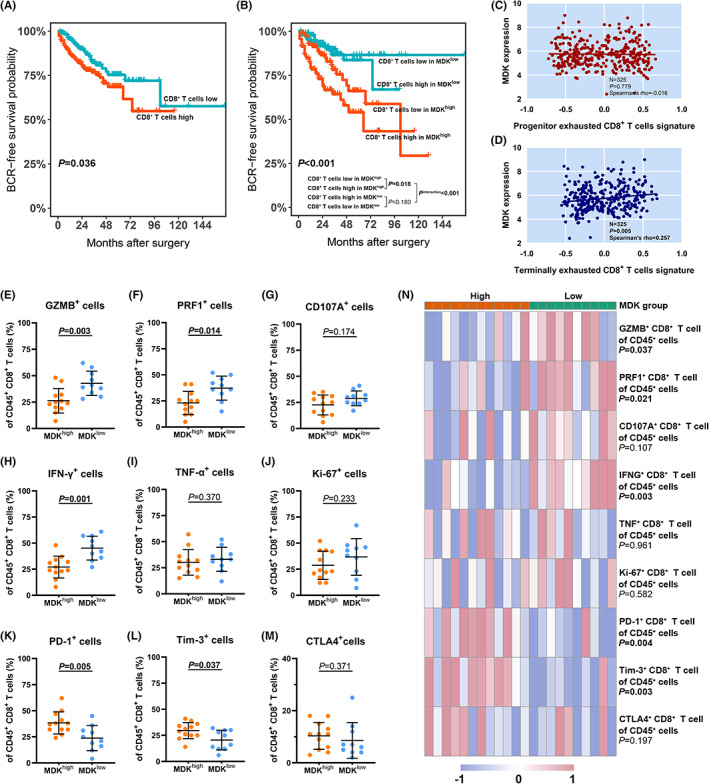
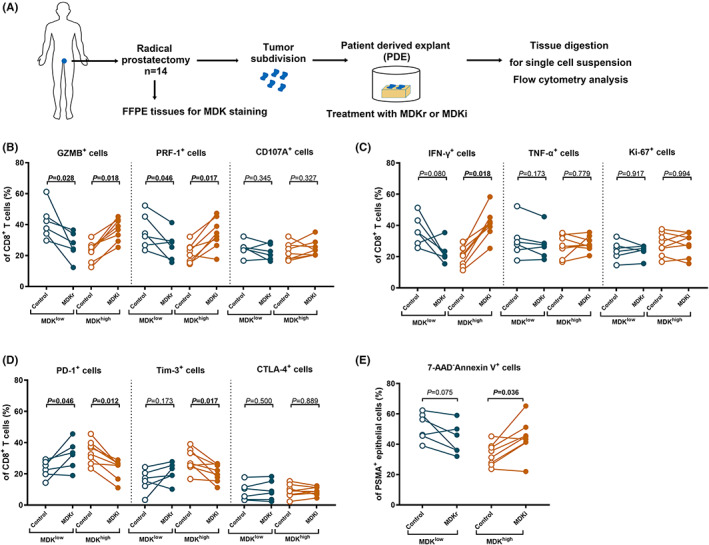
Recent studies identified Midkine (MDK) as playing a key role in immune regulation. In this study, we aimed to discover the clinical significance and translational relevance in prostate cancer (PCa). We retrospectively analyzed 759 PCa patients who underwent radical prostatectomy from Huashan Hospital, Fudan University (training cohort, n = 369) and Chinese Prostate Cancer Consortium (validation cohort, n = 390). A total of 325 PCa patients from The Cancer Genome Atlas (TCGA) database (external cohort) were analyzed for exploration. Immune landscape and antitumor immunity were assessed through immunohistochemistry and flow cytometry. Patient-derived explant culture system was applied for evaluating the targeting potential of MDK. We found that intratumoral MDK expression correlated with PCa progression, which indicated an unfavorable biochemical recurrence (BCR)-free survival for postoperative PCa patients. Addition of MDK expression to the postoperative risk assessment tool CAPRA-S could improve its prognostic value. Tumors with MDK abundance characterized the tumor-infiltrating CD8 T cells with less cytotoxicity production and increased immune checkpoint expression, which were accompanied by enriched immunosuppressive contexture. Moreover, MDK inhibition could reactivate CD8 T cell antitumor immunity. MDK mRNA expression negatively correlated with androgen receptor activity signature and positively associated with radiotherapy-related signature. In conclusion, intratumoral MDK expression could serve as an independent prognosticator for BCR in postoperative PCa patients. MDK expression impaired the antitumor function of CD8 T cells through orchestrating an immunoevasive microenvironment, which could be reversed by MDK inhibition. Moreover, tumors with MDK enrichment possessed potential sensitivity to postoperative radiotherapy while resistance to adjuvant hormonal therapy of PCa. MDK could be considered as a potential therapeutic target for PCa.
最近的研究表明,中期因子(MDK)在免疫调节中发挥关键作用。本研究旨在探讨其在前列腺癌(PCa)中的临床意义和转化相关性。我们回顾性分析了 759 例在复旦大学华山医院接受根治性前列腺切除术的 PCa 患者(训练队列,n=369)和中国前列腺癌联盟(验证队列,n=390)。我们还分析了来自癌症基因组图谱(TCGA)数据库的 325 例 PCa 患者(外部队列)。通过免疫组化和流式细胞术评估免疫景观和抗肿瘤免疫。应用患者来源的离体培养系统评估 MDK 的靶向潜力。我们发现,肿瘤内 MDK 表达与 PCa 进展相关,提示术后 PCa 患者生化复发(BCR)无复发生存不良。将 MDK 表达添加到术后风险评估工具 CAPRA-S 中可以提高其预后价值。MDK 丰度高的肿瘤具有较少细胞毒性产物的浸润性 CD8 T 细胞和增加的免疫检查点表达特征,伴有丰富的免疫抑制结构。此外,MDK 抑制可重新激活 CD8 T 细胞抗肿瘤免疫。MDK mRNA 表达与雄激素受体活性特征呈负相关,与放疗相关特征呈正相关。总之,肿瘤内 MDK 表达可作为术后 PCa 患者 BCR 的独立预后标志物。MDK 表达通过调节免疫逃避微环境损害 CD8 T 细胞的抗肿瘤功能,MDK 抑制可逆转这种功能。此外,MDK 富集的肿瘤可能对术后放疗有潜在敏感性,而对 PCa 的辅助激素治疗有抵抗性。MDK 可被视为 PCa 的潜在治疗靶点。