Department of Paper and Bioprocess Engineering, SUNY College of Environmental Science and Forestry, 1 Forestry Drive, Syracuse 13210, NY, USA.
AMB Express. 2014 Mar 18;4:28. doi: 10.1186/s13568-014-0028-9. eCollection 2014.
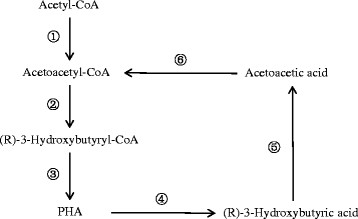
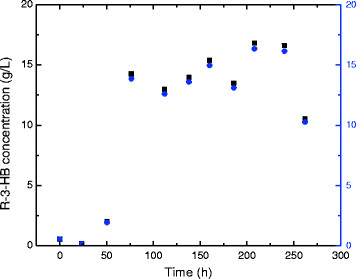
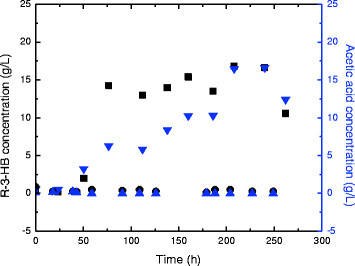
(R)-hydroxyalkanoic acids (R-HAs) are valuable building blocks for the synthesis of fine chemicals and biopolymers because of the chiral center and the two active functional groups. Hydroxyalkanoic acids fermentation can revolutionize the polyhydroxyalkanoic acids (PHA) production by increasing efficiency and enhancing product utility. Modifying the fermentation conditions that promotes the in vivo depolymerization and secretion to fermentation broth in wild type bacteria is a novel and promising approach to produce R-HAs. Wood extract hydrolysate (WEH) was found to be a suitable substrate for R-3-hydroxybutyric acid (R-3-HB) production by Burkholderia cepacia. Using Paulownia elongate WEH as a feedstock, the R-3-HB concentration in fermentation broth reached as high as 14.2 g/L after 3 days of batch fermentation and the highest concentration of 16.8 g/L was obtained at day 9. Further investigation indicated that the composition of culture medium contributed to the enhanced R-3-HB production.
(R)-羟基烷酸(R-HAs)是合成精细化学品和生物聚合物的有价值的结构单元,因为其含有手性中心和两个活性官能团。羟基烷酸发酵可以通过提高效率和增强产品用途来彻底改变聚羟基烷酸(PHA)的生产。通过改变发酵条件来促进野生型细菌体内的解聚和向发酵液中的分泌是生产 R-HAs 的一种新颖且有前途的方法。研究发现,杨木提取物水解物(WEH)是洋葱伯克霍尔德氏菌生产 R-3-羟基丁酸(R-3-HB)的合适底物。以泡桐 WEH 为原料,经过 3 天的分批发酵,发酵液中 R-3-HB 的浓度高达 14.2 g/L,在第 9 天获得了最高浓度 16.8 g/L。进一步的研究表明,培养基的组成有助于提高 R-3-HB 的产量。