Department of Gastroenterology, General Hospital of Shenyang Military Command, Shenyang 110840, Liaoning Province, China.
Endosc Ultrasound. 2013 Oct;2(4):181-9. doi: 10.4103/2303-9027.121238.
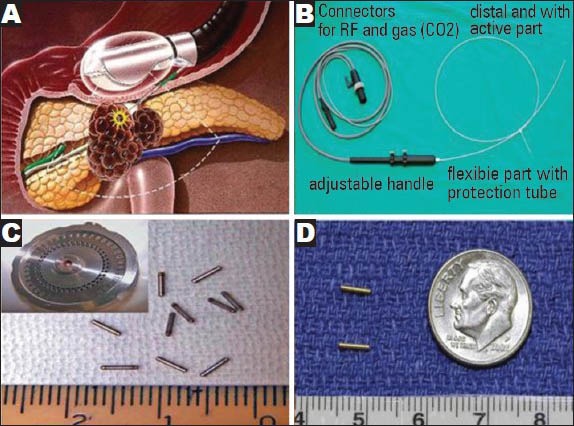
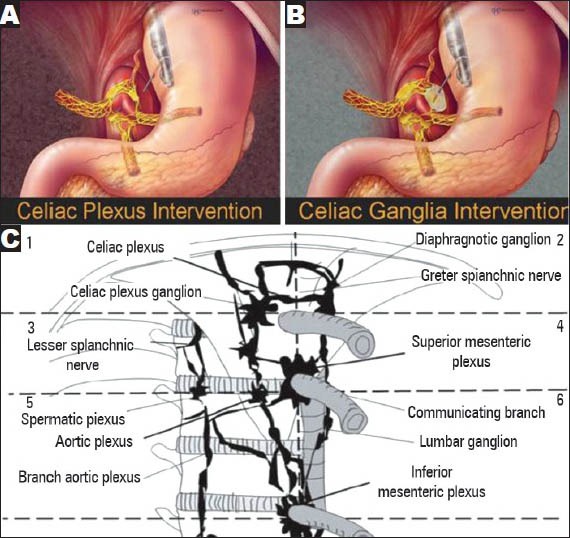
Endoscopic ultrasound (EUS) can help diagnose diseases with high accuracy because it overcomes the limitations of gastrointestinal gas and abdominal fat. The emergence of curved linear-array echoendoscopy has significantly promoted the applications of the technique to new levels. The advancement has appeared from EUS imaging to EUS-guided fine needle aspiration, drainage and injection. Computed tomography and magnetic resonance imaging present certain limitations for diagnosing pancreatic tumors due to the specificity of the location of such growths. In addition, traditional chemotherapy does not show ideal results because pancreatic cancer (PC) exhibits hypovascular characteristics. Interventional EUS can overcome these limitations and has potential to become the mainstream method of PC local treatment in the future. This paper reviews the use of interventional EUS in the treatment of PC based on previous studies.
内镜超声(EUS)可以帮助准确诊断疾病,因为它克服了胃肠道气体和腹部脂肪的限制。弯曲线性阵列回声内镜的出现极大地促进了该技术向新的水平应用。这一进步已经从 EUS 成像发展到 EUS 引导下的细针抽吸、引流和注射。由于胰腺肿瘤位置的特殊性,计算机断层扫描和磁共振成像在诊断胰腺肿瘤方面存在一定的局限性。此外,由于胰腺癌(PC)具有低血管特征,传统化疗效果并不理想。介入性 EUS 可以克服这些局限性,并有潜力成为未来 PC 局部治疗的主流方法。本文基于以往的研究,综述了介入性 EUS 在 PC 治疗中的应用。