Kraus Dror, Horowitz-Kraus Tzipi
Department of Pediatric Neurology, Cincinnati Children's Hospital Medical Center, Cincinnati, Ohio, United States of America.
Pediatric Neuroimaging Research Consortium, Cincinnati Children's Hospital Medical Center, Cincinnati, Ohio, United States of America; Edmond J. Safra Brain Research Center for the Study of Learning Disabilities, Faculty of Education, University of Haifa, Haifa, Israel.
PLoS One. 2014 Jun 20;9(6):e100486. doi: 10.1371/journal.pone.0100486. eCollection 2014.
Individuals with dyslexia exhibit associated learning deficits and impaired executive functions. The Wisconsin Card Sorting Test (WCST) is a learning-based task that relies heavily on executive functioning, in particular, attention shift and working memory. Performance during early and late phases of a series within the task represents learning and implementation of a newly learned rule. Here, we aimed to examine two event-related potentials associated with learning, feedback-related negativity (FRN)-P300 complex, in individuals with dyslexia performing the WCST.
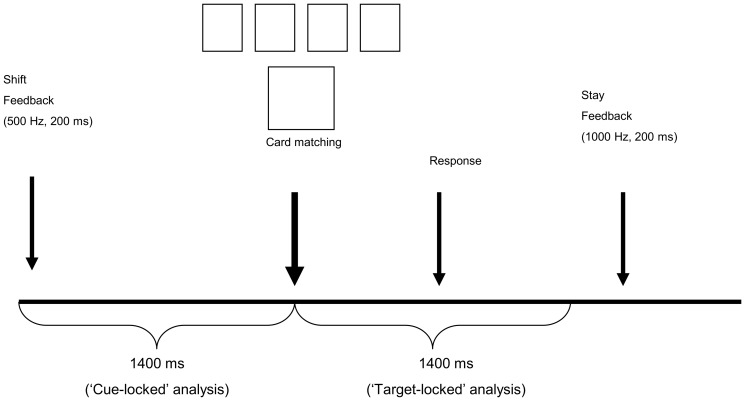
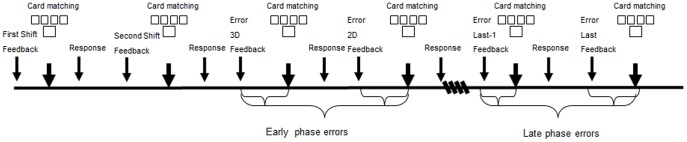
Adolescents with dyslexia and age-matched typical readers performed the Madrid card sorting test (MCST), a computerized version of the WCST. Task performance, reading measures, and cognitive measures were collected. FRN and the P300 complex were acquired using the event-related potentials methodology and were compared in early vs late errors within a series.
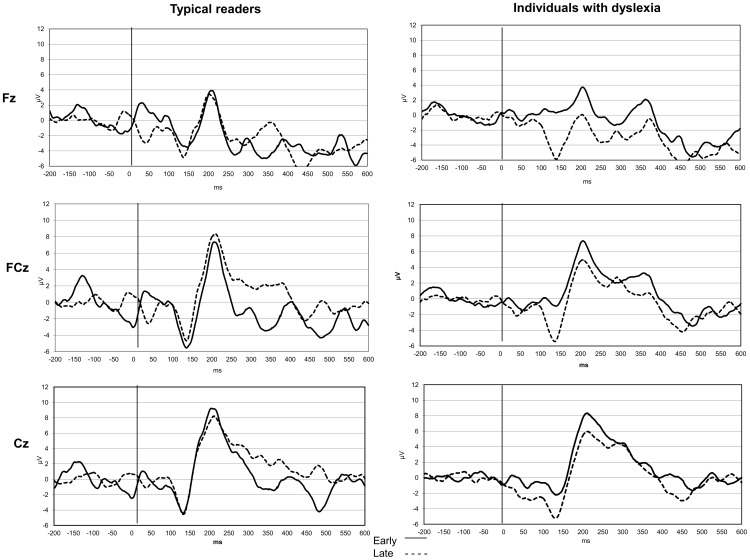
While performing the MCST, both groups showed a significant reduction in average reaction times and a trend toward decreased error rates. Typical readers performed consistently better than individuals with dyslexia. FRN amplitudes in early phases were significantly smaller in dyslexic readers, but were essentially equivalent to typical readers in the late phase. P300 amplitudes were initially smaller among readers with dyslexia and tended to decrease further in late phases. Differences in FRN amplitudes for early vs late phases were positively correlated with those of P300 amplitudes in the entire sample.
Individuals with dyslexia demonstrate a behavioral and electrophysiological change within single series of the MCST. However, learning patterns seem to differ between individuals with dyslexia and typical readers. We attribute these differences to the lower baseline performance of individuals with dyslexia. We suggest that these changes represent a fast compensatory mechanism, demonstrating the importance of learning strategies on reading among individuals with dyslexia.
诵读困难症患者存在相关的学习缺陷和执行功能受损。威斯康星卡片分类测验(WCST)是一项基于学习的任务,严重依赖执行功能,特别是注意力转移和工作记忆。任务系列中早期和晚期的表现代表了新学规则的学习和应用。在此,我们旨在研究诵读困难症患者在进行WCST时与学习相关的两种事件相关电位,即反馈相关负波(FRN)-P300复合体。
患有诵读困难症的青少年和年龄匹配的正常阅读者进行了马德里卡片分类测验(MCST),这是WCST的计算机化版本。收集了任务表现、阅读测量和认知测量数据。使用事件相关电位方法获取FRN和P300复合体,并在系列内的早期与晚期错误中进行比较。
在进行MCST时,两组的平均反应时间均显著缩短,并呈现出错误率下降的趋势。正常阅读者的表现始终优于诵读困难症患者。诵读困难症患者早期的FRN波幅显著较小,但在后期与正常阅读者基本相当。诵读困难症患者的P300波幅最初较小,且在后期有进一步下降的趋势。整个样本中早期与晚期FRN波幅的差异与P300波幅的差异呈正相关。
诵读困难症患者在MCST的单个系列中表现出行为和电生理变化。然而,诵读困难症患者和正常阅读者的学习模式似乎有所不同。我们将这些差异归因于诵读困难症患者较低的基线表现。我们认为这些变化代表了一种快速的补偿机制,证明了学习策略对诵读困难症患者阅读的重要性。