Pomianowska Ewa, Schjølberg Aasa R, Clausen Ole Petter F, Gladhaug Ivar P
Institute of Clinical Medicine, Faculty of Medicine, University of Oslo, Oslo, Norway.
BMC Cancer. 2014 Jun 20;14:458. doi: 10.1186/1471-2407-14-458.
Overexpression of cyclooxygenase-2 (COX-2) has been implicated in oncogenesis and progression of adenocarcinomas of the pancreatic head. The data on the prognostic importance of COX expression in these tumours is inconsistent and conflicting. We evaluated how COX-2 overexpression affected overall postoperative survival in pancreatic head adenocarcinomas.
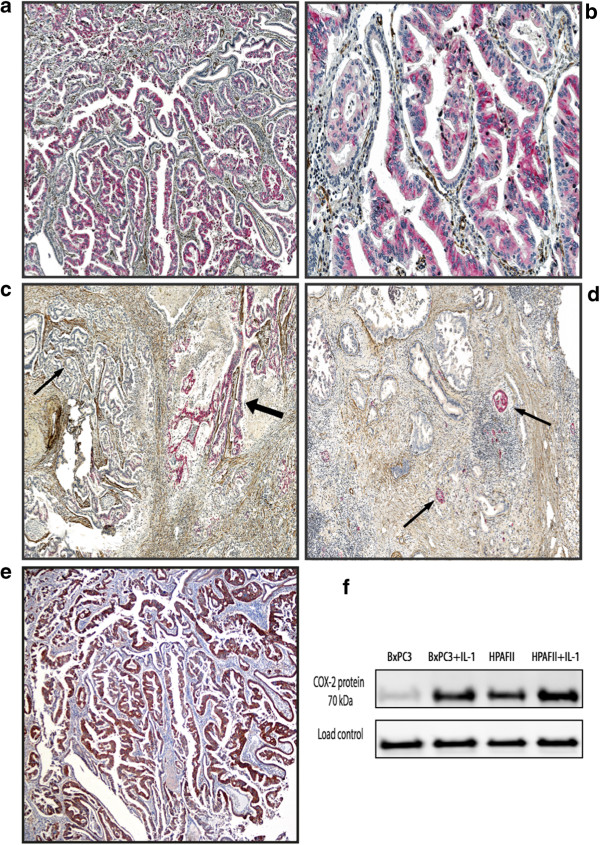
The study included 230 consecutive pancreatoduodenectomies for pancreatic cancer (PC, n = 92), ampullary cancer (AC, n = 62) and distal bile duct cancer (DBC, n = 76). COX-2 expression was assessed by immunohistochemistry. Associations between COX-2 expression and histopathologic variables including degree of differentiation, histopathologic type of differentiation (pancreatobiliary vs. intestinal) and lymph node ratio (LNR) were evaluated. Unadjusted and adjusted survival analysis was performed.
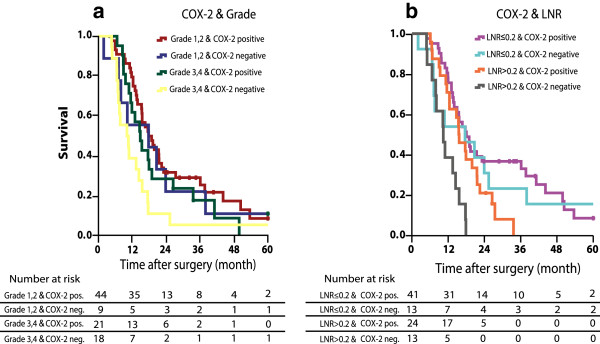
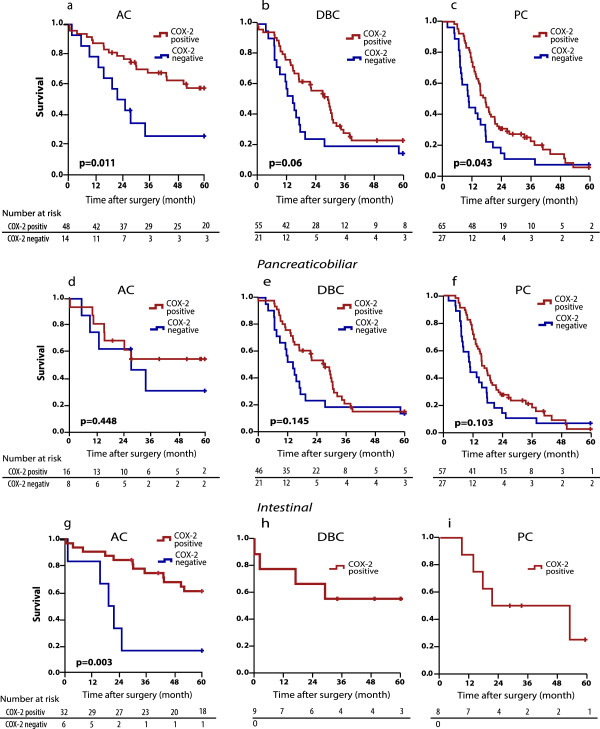
COX-2 staining was positive in 71% of PC, 77% in AC and 72% in DBC. Irrespective of tumour origin, overall patient survival was more favourable in patients with COX-2 positive tumours than COX-2 negative (p = 0.043 in PC, p = 0.011 in AC, p = 0.06 in DBC). In tumours of pancreatobiliary type of histopathological differentiation, COX-2 expression did not significantly affect overall patient survival. In AC with intestinal differentiation COX-2 expression significantly predicted favourable survival (p = 0.003). In PC, COX-2 expression was significantly associated with high degree of differentiation (p = 0.002). COX-2 and LNR independently predicted good prognosis in a multivariate model.
COX-2 is overexpressed in pancreatic cancer, ampullary cancer and distal bile duct cancer and confers a survival benefit in all three cancer types. In pancreatic cancer, COX-2 overexpression is significantly associated with the degree of differentiation and independently predicts a favourable prognosis.
环氧合酶-2(COX-2)的过表达与胰头腺癌的发生和进展有关。关于COX表达在这些肿瘤中的预后重要性的数据并不一致且相互矛盾。我们评估了COX-2过表达如何影响胰头腺癌的术后总体生存。
该研究纳入了连续230例行胰十二指肠切除术的患者,其中胰腺癌(PC,n = 92)、壶腹癌(AC,n = 62)和远端胆管癌(DBC,n = 76)。通过免疫组织化学评估COX-2表达。评估COX-2表达与组织病理学变量之间的关联,包括分化程度、组织病理学分化类型(胰胆管型与肠型)和淋巴结比率(LNR)。进行了未调整和调整后的生存分析。
COX-2染色在71%的PC、77%的AC和72%的DBC中呈阳性。无论肿瘤起源如何,COX-2阳性肿瘤患者的总体生存均比COX-2阴性患者更有利(PC中p = 0.043,AC中p = 0.011,DBC中p = 0.06)。在组织病理学分化为胰胆管型的肿瘤中,COX-2表达并未显著影响患者总体生存。在肠型分化的AC中,COX-2表达显著预测生存良好(p = 0.003)。在PC中,COX-2表达与高分化程度显著相关(p = 0.002)。在多变量模型中,COX-2和LNR独立预测良好预后。
COX-2在胰腺癌、壶腹癌和远端胆管癌中过表达,并在这三种癌症类型中均带来生存益处。在胰腺癌中,COX-2过表达与分化程度显著相关,并独立预测良好预后。