Syrjänen Johanna Liinamaria, Pellegrini Luca, Davies Owen Richard
Department of Biochemistry, University of Cambridge, Cambridge, United Kingdom.
Elife. 2014 Jun 20;3:e02963. doi: 10.7554/eLife.02963.
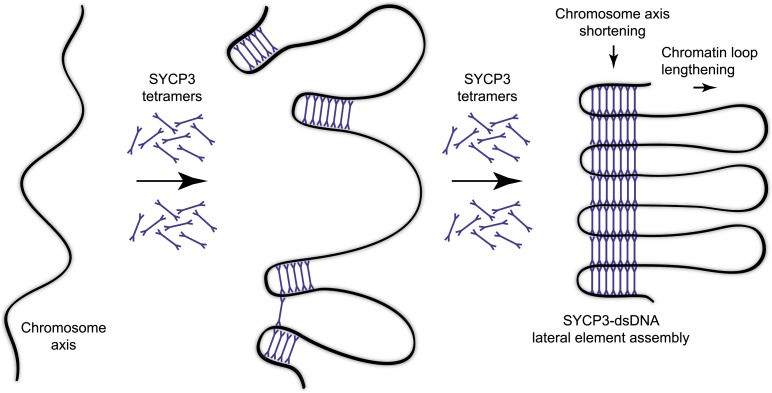
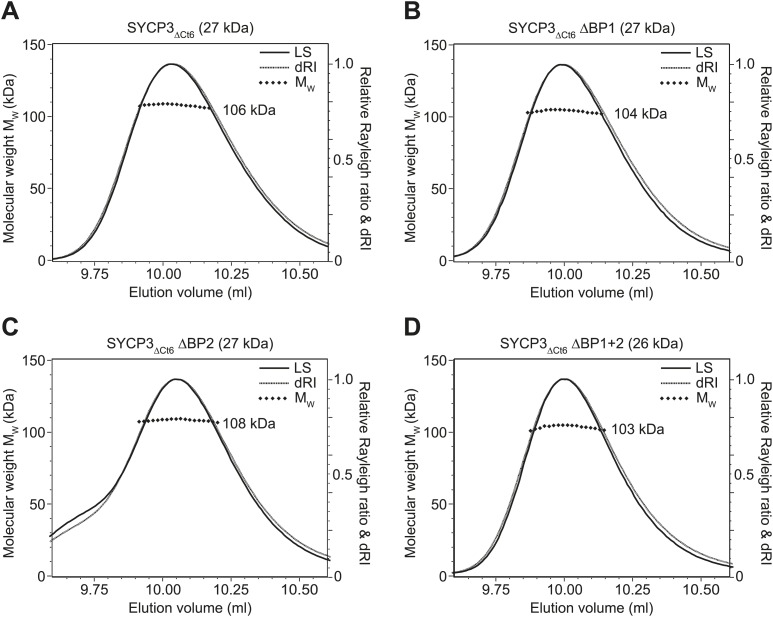
The synaptonemal complex (SC) is an evolutionarily-conserved protein assembly that holds together homologous chromosomes during prophase of the first meiotic division. Whilst essential for meiosis and fertility, the molecular structure of the SC has proved resistant to elucidation. The SC protein SYCP3 has a crucial but poorly understood role in establishing the architecture of the meiotic chromosome. Here we show that human SYCP3 forms a highly-elongated helical tetramer of 20 nm length. N-terminal sequences extending from each end of the rod-like structure bind double-stranded DNA, enabling SYCP3 to link distant sites along the sister chromatid. We further find that SYCP3 self-assembles into regular filamentous structures that resemble the known morphology of the SC lateral element. Together, our data form the basis for a model in which SYCP3 binding and assembly on meiotic chromosomes leads to their organisation into compact structures compatible with recombination and crossover formation.
联会复合体(SC)是一种在进化上保守的蛋白质组装体,在第一次减数分裂前期将同源染色体聚集在一起。虽然对减数分裂和生育至关重要,但SC的分子结构已证明难以阐明。SC蛋白SYCP3在建立减数分裂染色体的结构中起着关键但了解甚少的作用。在这里,我们表明人类SYCP3形成了一个长度为20 nm的高度拉长的螺旋四聚体。从杆状结构的两端延伸的N端序列结合双链DNA,使SYCP3能够连接姐妹染色单体上的远距离位点。我们进一步发现SYCP3自组装成规则的丝状结构,类似于已知的SC侧元件形态。总之,我们的数据为一个模型奠定了基础,在该模型中,SYCP3在减数分裂染色体上的结合和组装导致它们组织成与重组和交叉形成相容的紧凑结构。