Qi Shu-Tao, Liang Li-Feng, Xian Ye-Xing, Liu Jian-Qiao, Wang Weihua
Key Laboratory of Major Obstetrics Diseases of Guangdong Province, The Third Hospital Affiliated to Guangzhou Medical University, Guangdong, China.
Key Laboratory of Major Obstetrics Diseases of Guangdong Province, The Third Hospital Affiliated to Guangzhou Medical University, Guangdong, China ; Reproductive Medicine Center, the Third Hospital Affiliated to Guangzhou Medical University, Guangdong, China.
J Ovarian Res. 2014 Jun 13;7:65. doi: 10.1186/1757-2215-7-65. eCollection 2014.
Aneuploidy is one of the major factors that result in low efficiency in human infertility treatment by in vitro fertilization (IVF). The development of DNA microarray technology allows for aneuploidy screening by analyzing all 23 pairs of chromosomes in human embryos. All chromosome screening for aneuploidy is more accurate than partial chromosome screening, as errors can occur in any chromosome. Currently, chromosome screening for aneuploidy is performed in developing embryos, mainly blastocysts. It has not been performed in arrested embryos and/or compared between developing embryos and arrested embryos from the same IVF cycle.
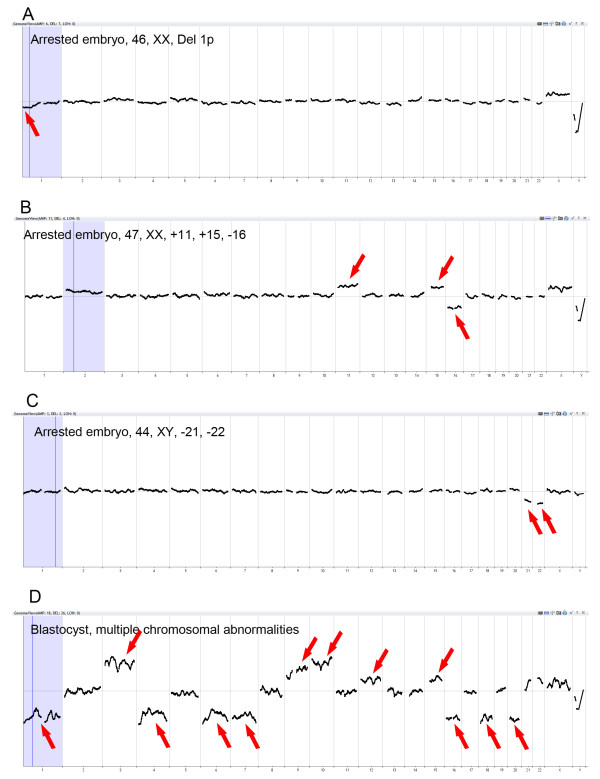
The present study was designed to examine all chromosomes in blastocysts and arrested embryos from the same cycle in patients of advanced maternal ages. Embryos were produced by routine IVF procedures. A total of 90 embryos (45 blastocysts and 45 arrested embryos) from 17 patients were biopsied and analyzed by the Agilent DNA array platform.
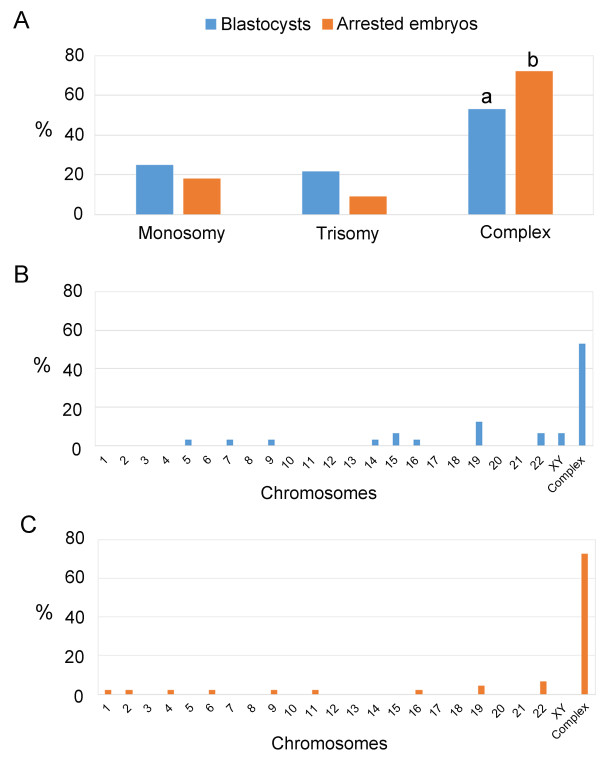
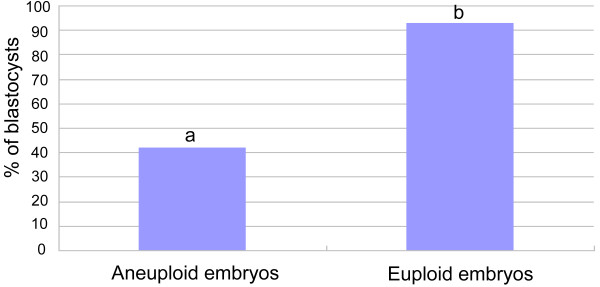
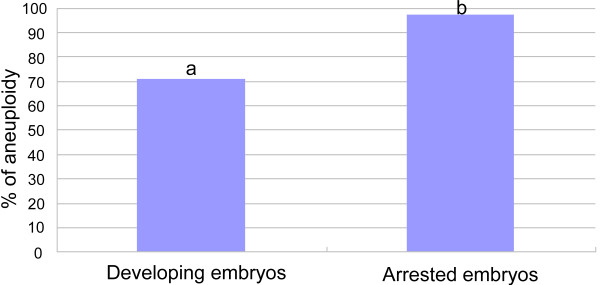
It was found that 50% of the embryos developed to blastocyst stage; however, only 15.6% of the embryos (both blastocyst and arrested) were euploid, and most (84.4%) of the embryos had chromosomal abnormalities. Further analysis indicated that 28.9% of blastocysts were euploid and 71.1% were aneuploid. By contrast, only one (2.2%) arrested embryo was euploid while others (97.8%) were aneuploid. The prevalence of multiple chromosomal abnormalities in the aneuploid embryos was also higher in the arrested embryos than in the blastocysts.
These results indicate that high proportions of human embryos from patients of advanced maternal age are aneuploid, and the arrested embryos are more likely to have abnormal chromosomes than developing embryos.
非整倍体是导致人类体外受精(IVF)治疗效率低下的主要因素之一。DNA微阵列技术的发展使得通过分析人类胚胎中的所有23对染色体来进行非整倍体筛查成为可能。对所有染色体进行非整倍体筛查比部分染色体筛查更准确,因为任何染色体都可能出现错误。目前,非整倍体的染色体筛查是在发育中的胚胎(主要是囊胚)中进行的。尚未在停滞胚胎中进行,也未在同一IVF周期的发育胚胎和停滞胚胎之间进行比较。
本研究旨在检查高龄产妇患者同一周期的囊胚和停滞胚胎中的所有染色体。胚胎通过常规IVF程序产生。对17名患者的90个胚胎(45个囊胚和45个停滞胚胎)进行活检,并通过安捷伦DNA阵列平台进行分析。
发现50%的胚胎发育到囊胚阶段;然而,只有15.6%的胚胎(囊胚和停滞胚胎)是整倍体,大多数(84.4%)胚胎存在染色体异常。进一步分析表明,28.9%的囊胚是整倍体,71.1%是非整倍体。相比之下,只有一个(2.2%)停滞胚胎是整倍体,其他(97.8%)是非整倍体。非整倍体胚胎中多染色体异常的发生率在停滞胚胎中也高于囊胚。
这些结果表明,高龄产妇患者的人类胚胎中很大比例是非整倍体,并且停滞胚胎比发育胚胎更有可能具有异常染色体。