Gualano Maria Rosaria, Bert Fabrizio, Scaioli Giacomo, Passi Stefano, La Torre Giuseppe, Siliquini Roberta
Department of Public Health, University of Turin, via Santena 5 bis, 10126 Turin, Italy.
Department of Public Health and Infectious Diseases, Sapienza University of Rome, Piazzale Aldo Moro 5, 00185 Rome, Italy.
Biomed Res Int. 2014;2014:293219. doi: 10.1155/2014/293219. Epub 2014 May 15.
The aim of the present work is to describe the state of the art of tobacco habits in Italy, eight years after the law was introduced.
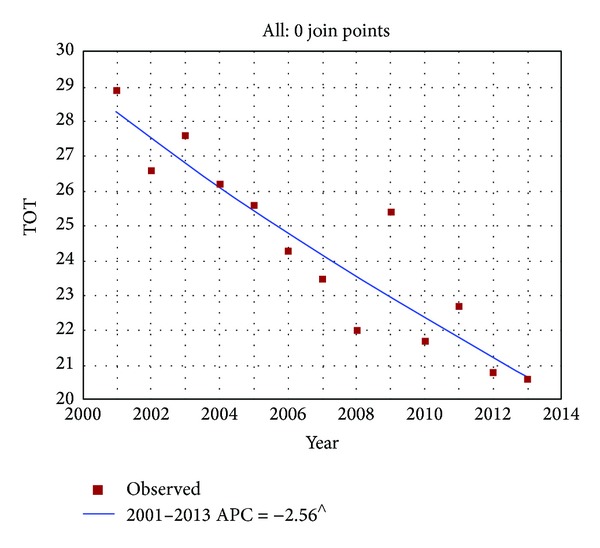
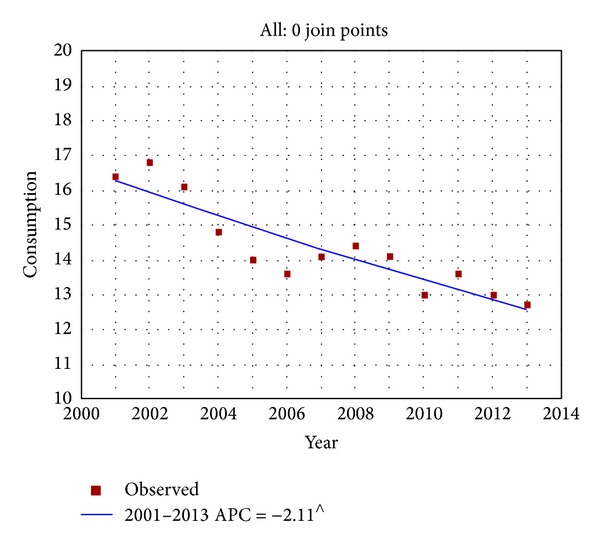
Time series analyses, based on estimates of smoking prevalence/consumption derived from the openly available data of national surveys performed during the 2001-2013 period, were performed. Data have been expressed in percentage of smokers and daily cigarettes consumption. Time changes are expressed as expected annual percentage change (EAPC).
Over time, the percentage of Italian smokers shows a constant and statistically significant decrease (from 28.9% in 2001 to 20.6% in 2013, EAPC = -2.6%, and P < 0.001). Regarding data stratified by gender, we found a stronger reduction among men (EAPC = -2.9%, P < 0.001) than in women (EAPC = -2.5%, P < 0.001). Similarly, the consumption of tobacco smoking, measured as the number of daily cigarettes smoked, registered a downward trend (P < 0.001). No join point (time point when a significant trend change is detected) resulted from the trend analysis.
Data show a constant decrease of tobacco consumption in Italy, with no join point related to the introduction of the banning law. These findings require to reflect on the priorities of the smoking banning policies that may be focused on other intervention activities such as to increase the price of cigarettes.
本研究旨在描述意大利在引入相关法律八年后烟草使用习惯的现状。
基于2001 - 2013年期间全国公开调查数据得出的吸烟流行率/消费量估计值进行时间序列分析。数据以吸烟者百分比和每日香烟消费量表示。时间变化以预期年度百分比变化(EAPC)表示。
随着时间推移,意大利吸烟者的百分比呈现持续且具有统计学意义的下降(从2001年的28.9%降至2013年的20.6%,EAPC = -2.6%,P < 0.001)。按性别分层的数据显示,男性的下降幅度更大(EAPC = -2.9%,P < 0.001),女性为(EAPC = -2.5%,P < 0.001)。同样,以每日吸烟支数衡量的吸烟消费量呈下降趋势(P < 0.001)。趋势分析未发现转折点(检测到显著趋势变化的时间点)。
数据表明意大利的烟草消费量持续下降,且与禁烟法律的引入无关。这些发现需要反思禁烟政策的重点,可能应侧重于其他干预活动,如提高香烟价格。