La Torre Giuseppe, Gualano Maria Rosaria, Semyonov Leda, Nicolotti Nicola, Ricciardi Walter, Boccia Antonio
Department of Public Health and Infectious Diseases, Sapienza University of Rome, Rome, Italy.
Hepat Mon. 2011 Nov;11(11):895-900. doi: 10.5812/kowsar.1735143X.767. Epub 2011 Nov 30.
The World Health Organization (WHO) estimates that about 180 million people, 3% of the world population, are infected with the hepatitis C virus (HCV). In Italy, the prevalence in the general population is reported to be greater than 5% and 9% among households of HCV-positive patients.
The aim of this study was to estimate the trends of HCV infection in Italy in the period 1996-2006.
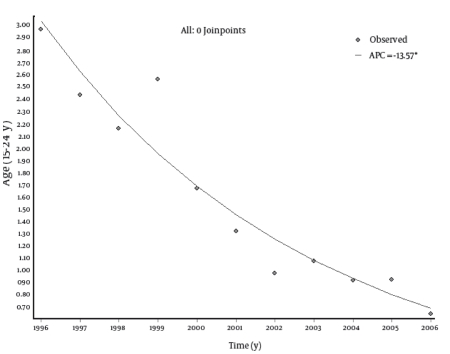
The formula ln (rate) = b × years was applied for logarithmic transformation of the incidence rates to obtain time trends of HCV infection, using the join-point regression program software version 3.3.1. Linear graphs representing trends and the annual percentage change (APC) were considered for each joinpoint. Time changes are expressed as expected annual percentage change (EAPC) with the respective 95% confidence intervals (CIs); significance levels of time trends are also reported. The null hypothesis was tested using a maximum of 3 changes in slope with an overall significance level of 0.05 divided by the number of joinpoints in the final model.
Considering all age groups, the incidence rate decreased from 2.02 to 0.55 per 100,000. The join-point analysis showed a statistically significant decrease in the incidence rates of HCV infection. No join-points were found in any age groups. Our data show that the incidence rates of HCV infections have considerably decreased in each age group throughout the studied period (1996-2006).
This decreasing trend in HCV infections is, in part, attributable to behavioral and social changes. Improved hygiene, use of precautions in medical settings, blood screening, and sexual educational campaigns seem to have contributed to reduce the transmission of infection during the last 10 years.
世界卫生组织(WHO)估计,约1.8亿人,即世界人口的3%,感染了丙型肝炎病毒(HCV)。在意大利,据报道普通人群中的患病率高于5%,在HCV阳性患者家庭中则高于9%。
本研究的目的是估计1996 - 2006年期间意大利HCV感染的趋势。
使用连接点回归程序软件版本3.3.1,将发病率公式ln(发病率)=b×年份应用于发病率的对数转换,以获得HCV感染的时间趋势。考虑每个连接点的代表趋势和年度百分比变化(APC)的线性图。时间变化表示为预期年度百分比变化(EAPC)及其各自的95%置信区间(CI);还报告了时间趋势的显著性水平。使用斜率最多变化3次进行原假设检验,总体显著性水平为0.05除以最终模型中的连接点数。
考虑所有年龄组,发病率从每10万人2.02降至0.55。连接点分析显示HCV感染发病率有统计学显著下降。在任何年龄组中均未发现连接点。我们的数据表明,在整个研究期间(1996 - 2006年),每个年龄组的HCV感染发病率均大幅下降。
HCV感染率下降趋势部分归因于行为和社会变化。卫生条件改善、医疗环境中采取预防措施、血液筛查以及性教育活动似乎在过去10年中有助于减少感染传播。