• 文献检索
  • 文档翻译
  • 深度研究
  • 学术资讯
  • Suppr Zotero 插件Zotero 插件
  • 邀请有礼
  • 套餐&价格
  • 历史记录
应用&插件
Suppr Zotero 插件Zotero 插件浏览器插件Mac 客户端Windows 客户端微信小程序
定价
高级版会员购买积分包购买API积分包
服务
文献检索文档翻译深度研究API 文档MCP 服务
关于我们
关于 Suppr公司介绍联系我们用户协议隐私条款
关注我们

Suppr 超能文献

核心技术专利:CN118964589B侵权必究
粤ICP备2023148730 号-1Suppr @ 2026

文献检索

告别复杂PubMed语法,用中文像聊天一样搜索,搜遍4000万医学文献。AI智能推荐,让科研检索更轻松。

立即免费搜索

文件翻译

保留排版,准确专业,支持PDF/Word/PPT等文件格式,支持 12+语言互译。

免费翻译文档

深度研究

AI帮你快速写综述,25分钟生成高质量综述,智能提取关键信息,辅助科研写作。

立即免费体验

智能手机上增强安全性和隐私保护的步态认证。

Secure and privacy enhanced gait authentication on smart phone.

作者信息

Hoang Thang, Choi Deokjai

机构信息

Department of Electronics and Computer Engineering, Chonnam National University, Gwangju 500-757, Republic of Korea.

出版信息

ScientificWorldJournal. 2014;2014:438254. doi: 10.1155/2014/438254. Epub 2014 May 14.

DOI:10.1155/2014/438254
PMID:24955403
原文链接:https://pmc.ncbi.nlm.nih.gov/articles/PMC4052054/
Abstract

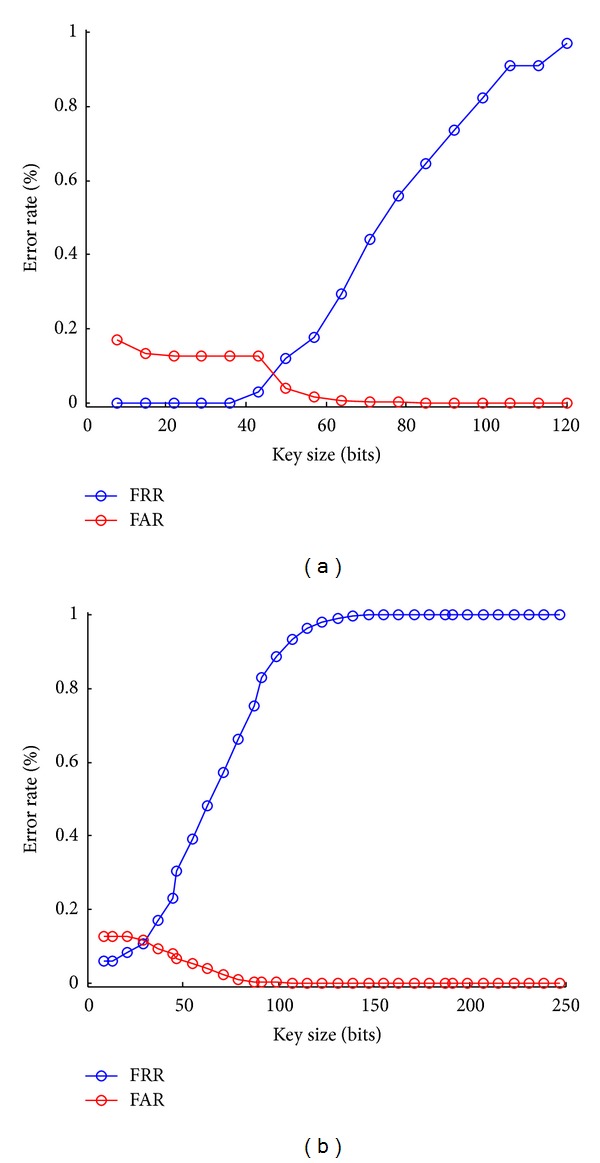
Smart environments established by the development of mobile technology have brought vast benefits to human being. However, authentication mechanisms on portable smart devices, particularly conventional biometric based approaches, still remain security and privacy concerns. These traditional systems are mostly based on pattern recognition and machine learning algorithms, wherein original biometric templates or extracted features are stored under unconcealed form for performing matching with a new biometric sample in the authentication phase. In this paper, we propose a novel gait based authentication using biometric cryptosystem to enhance the system security and user privacy on the smart phone. Extracted gait features are merely used to biometrically encrypt a cryptographic key which is acted as the authentication factor. Gait signals are acquired by using an inertial sensor named accelerometer in the mobile device and error correcting codes are adopted to deal with the natural variation of gait measurements. We evaluate our proposed system on a dataset consisting of gait samples of 34 volunteers. We achieved the lowest false acceptance rate (FAR) and false rejection rate (FRR) of 3.92% and 11.76%, respectively, in terms of key length of 50 bits.

摘要

移动技术发展所建立的智能环境给人类带来了巨大益处。然而,便携式智能设备上的认证机制,尤其是传统的基于生物特征的方法,仍然存在安全和隐私问题。这些传统系统大多基于模式识别和机器学习算法,在认证阶段,原始生物特征模板或提取的特征以未加密的形式存储,用于与新的生物特征样本进行匹配。在本文中,我们提出了一种使用生物特征密码系统的基于步态的新型认证方法,以增强智能手机上的系统安全性和用户隐私。提取的步态特征仅用于对作为认证因素的加密密钥进行生物特征加密。通过使用移动设备中的加速度计这一惯性传感器来获取步态信号,并采用纠错码来处理步态测量的自然变化。我们在一个由34名志愿者的步态样本组成的数据集上评估了我们提出的系统。在密钥长度为50位的情况下,我们分别实现了3.92%和11.76%的最低误识率(FAR)和拒识率(FRR)。
https://cdn.ncbi.nlm.nih.gov/pmc/blobs/7e20/4052054/b52c8f0a7fca/TSWJ2014-438254.006.jpg
https://cdn.ncbi.nlm.nih.gov/pmc/blobs/7e20/4052054/07a2d066ff1e/TSWJ2014-438254.001.jpg
https://cdn.ncbi.nlm.nih.gov/pmc/blobs/7e20/4052054/7da1567d022d/TSWJ2014-438254.002.jpg
https://cdn.ncbi.nlm.nih.gov/pmc/blobs/7e20/4052054/94da33e6e362/TSWJ2014-438254.003.jpg
https://cdn.ncbi.nlm.nih.gov/pmc/blobs/7e20/4052054/3964d9a66021/TSWJ2014-438254.004.jpg
https://cdn.ncbi.nlm.nih.gov/pmc/blobs/7e20/4052054/2f499775b3a3/TSWJ2014-438254.005.jpg
https://cdn.ncbi.nlm.nih.gov/pmc/blobs/7e20/4052054/b52c8f0a7fca/TSWJ2014-438254.006.jpg
https://cdn.ncbi.nlm.nih.gov/pmc/blobs/7e20/4052054/07a2d066ff1e/TSWJ2014-438254.001.jpg
https://cdn.ncbi.nlm.nih.gov/pmc/blobs/7e20/4052054/7da1567d022d/TSWJ2014-438254.002.jpg
https://cdn.ncbi.nlm.nih.gov/pmc/blobs/7e20/4052054/94da33e6e362/TSWJ2014-438254.003.jpg
https://cdn.ncbi.nlm.nih.gov/pmc/blobs/7e20/4052054/3964d9a66021/TSWJ2014-438254.004.jpg
https://cdn.ncbi.nlm.nih.gov/pmc/blobs/7e20/4052054/2f499775b3a3/TSWJ2014-438254.005.jpg
https://cdn.ncbi.nlm.nih.gov/pmc/blobs/7e20/4052054/b52c8f0a7fca/TSWJ2014-438254.006.jpg

相似文献

1
Secure and privacy enhanced gait authentication on smart phone.智能手机上增强安全性和隐私保护的步态认证。
ScientificWorldJournal. 2014;2014:438254. doi: 10.1155/2014/438254. Epub 2014 May 14.
2
Security analysis and enhancements of an effective biometric-based remote user authentication scheme using smart cards.基于智能卡的有效生物特征远程用户认证方案的安全性分析与增强
J Biomed Biotechnol. 2012;2012:519723. doi: 10.1155/2012/519723. Epub 2012 Jul 31.
3
Gait-Based Implicit Authentication Using Edge Computing and Deep Learning for Mobile Devices.基于步态的隐式身份认证,使用边缘计算和深度学习技术,用于移动设备。
Sensors (Basel). 2021 Jul 5;21(13):4592. doi: 10.3390/s21134592.
4
Secure method for biometric-based recognition with integrated cryptographic functions.基于生物特征识别的安全方法与集成密码功能。
Biomed Res Int. 2013;2013:623815. doi: 10.1155/2013/623815. Epub 2013 May 15.
5
Secure access to patient's health records using SpeechXRays a mutli-channel biometrics platform for user authentication.使用SpeechXRays(一个用于用户认证的多通道生物识别平台)安全访问患者的健康记录。
Annu Int Conf IEEE Eng Med Biol Soc. 2016 Aug;2016:2541-2544. doi: 10.1109/EMBC.2016.7591248.
6
A Secure Online Fingerprint Authentication System for Industrial IoT Devices over 5G Networks.面向 5G 网络的工业物联网设备安全在线指纹认证系统。
Sensors (Basel). 2022 Oct 7;22(19):7609. doi: 10.3390/s22197609.
7
Personal Authentication Mechanism Based on Finger Knuckle Print.基于指节指纹的个人身份验证机制。
J Med Syst. 2019 Jun 15;43(8):232. doi: 10.1007/s10916-019-1332-3.
8
Curve aligning approach for gait authentication based on a wearable accelerometer.基于可穿戴加速度计的步态认证曲线校准方法。
Physiol Meas. 2012 Jun;33(6):1111-20. doi: 10.1088/0967-3334/33/6/1111. Epub 2012 May 24.
9
A novel privacy-preserving biometric authentication scheme.一种新颖的隐私保护生物特征认证方案。
PLoS One. 2023 May 25;18(5):e0286215. doi: 10.1371/journal.pone.0286215. eCollection 2023.
10
Biometric Authentication for Intelligent and Privacy-Preserving Healthcare Systems.生物识别认证在智能和隐私保护医疗系统中的应用。
J Healthc Eng. 2022 Mar 24;2022:1789996. doi: 10.1155/2022/1789996. eCollection 2022.

引用本文的文献

1
Continuous Authentication against Collusion Attacks.针对共谋攻击的持续认证。
Sensors (Basel). 2022 Jun 22;22(13):4711. doi: 10.3390/s22134711.
2
Inertial Sensor-Based Gait Recognition: A Review.基于惯性传感器的步态识别:综述
Sensors (Basel). 2015 Sep 2;15(9):22089-127. doi: 10.3390/s150922089.