McDevitt Allan D, Montgomery W Ian, Tosh David G, Lusby John, Reid Neil, White Thomas A, McDevitt C Damien, O'Halloran John, Searle Jeremy B, Yearsley Jon M
School of Biology and Environmental Science, University College Dublin, Dublin, Ireland.
School of Biological Sciences, Queen's University Belfast, Belfast, Northern Ireland; Quercus, School of Biological Sciences, Queen's University Belfast, Belfast, Northern Ireland.
PLoS One. 2014 Jun 23;9(6):e100403. doi: 10.1371/journal.pone.0100403. eCollection 2014.
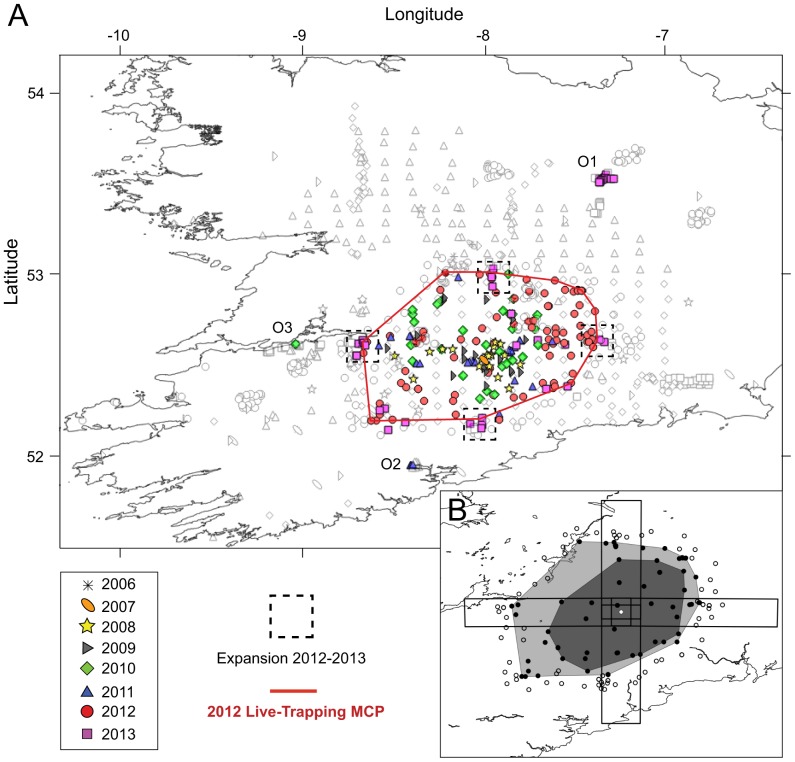
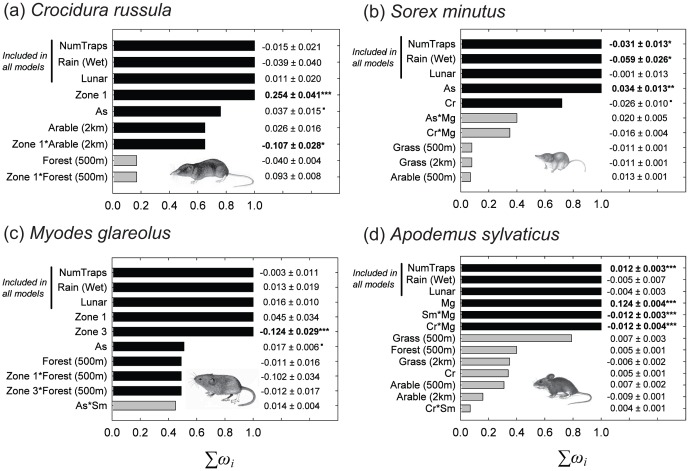
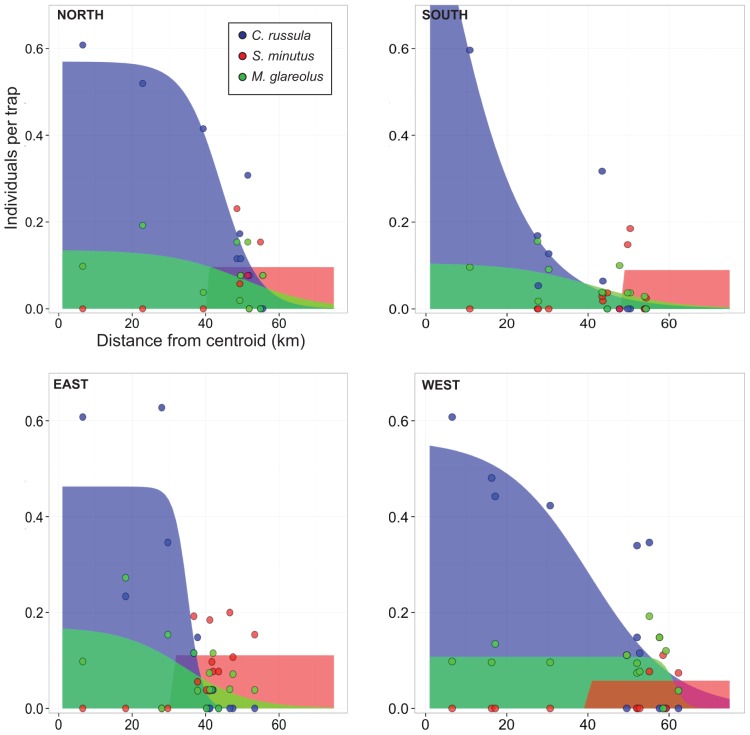
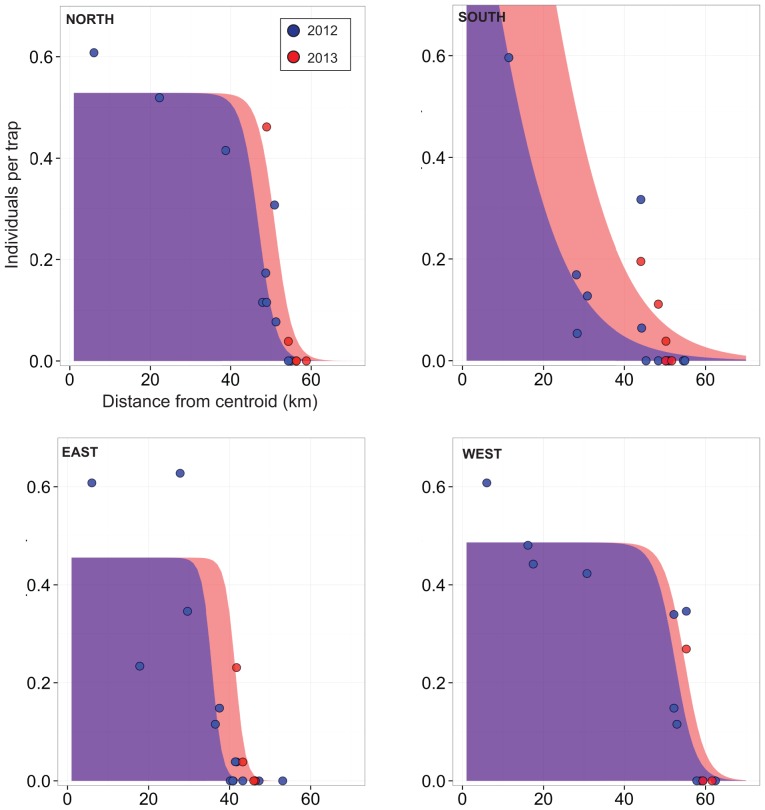
Establishing how invasive species impact upon pre-existing species is a fundamental question in ecology and conservation biology. The greater white-toothed shrew (Crocidura russula) is an invasive species in Ireland that was first recorded in 2007 and which, according to initial data, may be limiting the abundance/distribution of the pygmy shrew (Sorex minutus), previously Ireland's only shrew species. Because of these concerns, we undertook an intensive live-trapping survey (and used other data from live-trapping, sightings and bird of prey pellets/nest inspections collected between 2006 and 2013) to model the distribution and expansion of C. russula in Ireland and its impacts on Ireland's small mammal community. The main distribution range of C. russula was found to be approximately 7,600 km2 in 2013, with established outlier populations suggesting that the species is dispersing with human assistance within the island. The species is expanding rapidly for a small mammal, with a radial expansion rate of 5.5 km/yr overall (2008-2013), and independent estimates from live-trapping in 2012-2013 showing rates of 2.4-14.1 km/yr, 0.5-7.1 km/yr and 0-5.6 km/yr depending on the landscape features present. S. minutus is negatively associated with C. russula. S. minutus is completely absent at sites where C. russula is established and is only present at sites at the edge of and beyond the invasion range of C. russula. The speed of this invasion and the homogenous nature of the Irish landscape may mean that S. minutus has not had sufficient time to adapt to the sudden appearance of C. russula. This may mean the continued decline/disappearance of S. minutus as C. russula spreads throughout the island.
确定入侵物种如何影响本地物种是生态学和保护生物学中的一个基本问题。大白齿鼩(Crocidura russula)是爱尔兰的一种入侵物种,于2007年首次被记录,根据初步数据,它可能正在限制侏儒鼩(Sorex minutus)的数量/分布,侏儒鼩此前是爱尔兰唯一的鼩鼱物种。出于这些担忧,我们进行了一次密集的活体诱捕调查(并使用了2006年至2013年间收集的来自活体诱捕、目击以及猛禽粪便/巢穴检查的其他数据),以模拟大白齿鼩在爱尔兰的分布和扩散及其对爱尔兰小型哺乳动物群落的影响。2013年,大白齿鼩的主要分布范围约为7600平方公里,已建立的外围种群表明该物种正在人类的帮助下在岛内扩散。作为一种小型哺乳动物,该物种正在迅速扩张,2008 - 2013年期间总体径向扩张速度为每年5.5公里,2012 - 2013年活体诱捕的独立估计显示,根据存在的景观特征,扩张速度分别为每年2.4 - 14.1公里、0.5 - 7.1公里和0 - 5.6公里。侏儒鼩与大白齿鼩呈负相关。在大白齿鼩已定居的地点,侏儒鼩完全不存在,仅存在于大白齿鼩入侵范围边缘及以外的地点。这种入侵的速度以及爱尔兰景观的同质化性质可能意味着侏儒鼩没有足够的时间来适应大白齿鼩的突然出现。这可能意味着随着大白齿鼩在全岛扩散,侏儒鼩数量将持续减少/消失。