Green Benjamin J, Wiriyachaiporn Surasa, Grainge Christopher, Rogers Geraint B, Kehagia Valia, Lau Laurie, Carroll Mary P, Bruce Kenneth D, Howarth Peter H
Academic Unit of Clinical and Experimental Sciences; NIHR Respiratory Biomedical Research Unit, University of Southampton Faculty of Medicine, Southampton, United Kingdom.
Molecular Microbiology Research Laboratory, Pharmaceutical Science Division, King's College London, London, United Kingdom.
PLoS One. 2014 Jun 23;9(6):e100645. doi: 10.1371/journal.pone.0100645. eCollection 2014.
Molecular microbiological analysis of airway samples in asthma has demonstrated an altered microbiome in comparison to healthy controls. Such changes may have relevance to treatment-resistant severe asthma, particularly those with neutrophilic airway inflammation, as bacteria might be anticipated to activate the innate immune response, a process that is poorly steroid responsive. An understanding of the relationship between airway bacterial presence and dominance in severe asthma may help direct alternative treatment approaches.
We aimed to use a culture independent analysis strategy to describe the presence, dominance and abundance of bacterial taxa in induced sputum from treatment resistant severe asthmatics and correlate findings with clinical characteristics and airway inflammatory markers.
Induced sputum was obtained from 28 stable treatment-resistant severe asthmatics. The samples were divided for supernatant IL-8 measurement, cytospin preparation for differential cell count and Terminal Restriction Fragment Length Polymorphism (T-RFLP) profiling for bacterial community analysis.
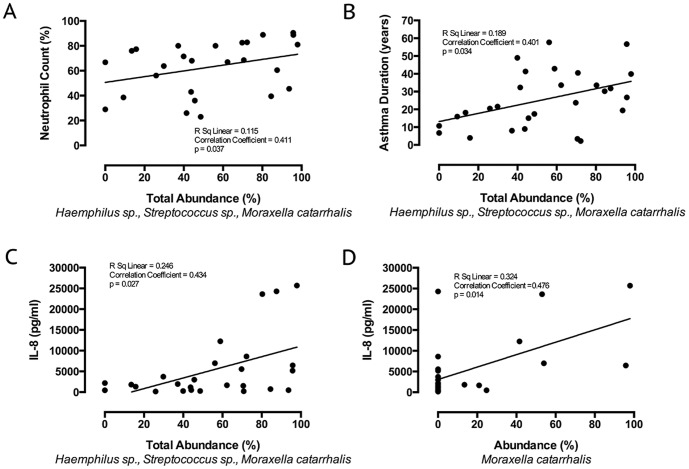
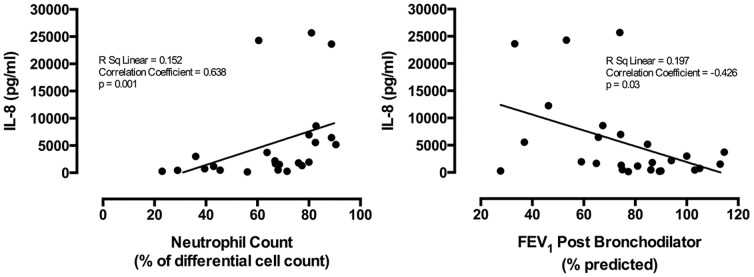
In 17/28 patients, the dominant species within the airway bacterial community was Moraxella catarrhalis or a member of the Haemophilus or Streptococcus genera. Colonisation with these species was associated with longer asthma disease duration (mean (SD) 31.8 years (16.7) vs 15.6 years (8.0), p = 0.008), worse post-bronchodilator percent predicted FEV1 (68.0% (24.0) vs 85.5% (19.7), p = 0.025) and higher sputum neutrophil differential cell counts (median (IQR) 80% (67-83) vs 43% (29-67), p = 0.001). Total abundance of these organisms significantly and positively correlated with sputum IL-8 concentration and neutrophil count.
Airway colonisation with potentially pathogenic micro-organisms in asthma is associated with more severe airways obstruction and neutrophilic airway inflammation. This altered colonisation may have a role in the development of an asthma phenotype that responds less well to current asthma therapies.
与健康对照相比,哮喘气道样本的分子微生物学分析显示微生物群发生了改变。这种变化可能与难治性重度哮喘有关,尤其是那些伴有嗜中性气道炎症的患者,因为细菌可能会激活先天性免疫反应,而这一过程对类固醇反应不佳。了解重度哮喘中气道细菌的存在与优势之间的关系可能有助于指导替代治疗方法。
我们旨在使用一种非培养分析策略来描述难治性重度哮喘患者诱导痰中细菌类群的存在、优势和丰度,并将结果与临床特征和气道炎症标志物相关联。
从28例病情稳定的难治性重度哮喘患者中获取诱导痰。将样本分为用于测量上清液白细胞介素-8的部分、用于进行细胞分类计数的细胞离心涂片制备部分以及用于细菌群落分析的末端限制性片段长度多态性(T-RFLP)分析部分。
在17/28例患者中,气道细菌群落中的优势菌种为卡他莫拉菌或嗜血杆菌属或链球菌属的成员。这些菌种的定植与哮喘病程较长(平均(标准差)31.8年(16.7)对15.6年(8.0),p = 0.008)、支气管扩张剂使用后预测FEV1百分比更差(68.0%(24.0)对85.5%(19.7),p = 0.025)以及痰液嗜中性粒细胞分类计数更高(中位数(四分位间距)80%(67 - 83)对43%(29 - 67),p = 0.001)相关。这些微生物的总丰度与痰液白细胞介素-8浓度和嗜中性粒细胞计数显著正相关。
哮喘患者气道中潜在致病微生物的定植与更严重的气道阻塞和嗜中性气道炎症相关。这种改变的定植可能在对当前哮喘治疗反应较差的哮喘表型的发展中起作用。