Vogt Julia, Bengesser Kathrin, Claes Kathleen B M, Wimmer Katharina, Mautner Victor-Felix, van Minkelen Rick, Legius Eric, Brems Hilde, Upadhyaya Meena, Högel Josef, Lazaro Conxi, Rosenbaum Thorsten, Bammert Simone, Messiaen Ludwine, Cooper David N, Kehrer-Sawatzki Hildegard
Genome Biol. 2014 Jun 2;15(6):R80. doi: 10.1186/gb-2014-15-6-r80.
Genomic disorders are caused by copy number changes that may exhibit recurrent breakpoints processed by nonallelic homologous recombination. However, region-specific disease-associated copy number changes have also been observed which exhibit non-recurrent breakpoints. The mechanisms underlying these non-recurrent copy number changes have not yet been fully elucidated.
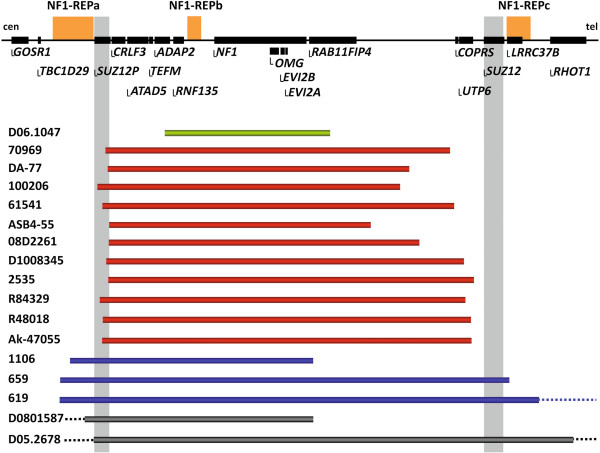
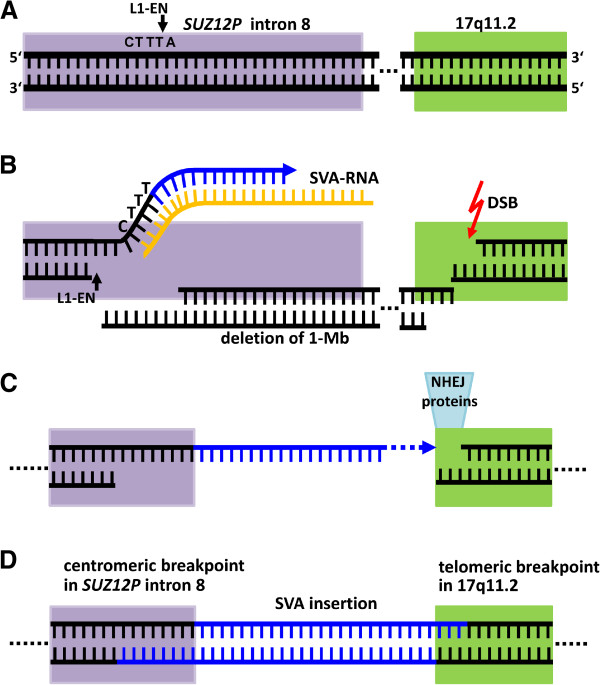
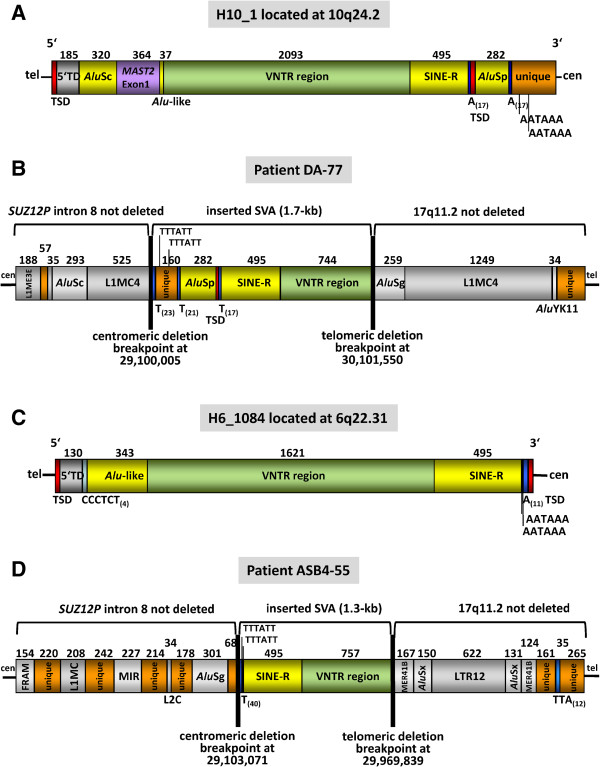
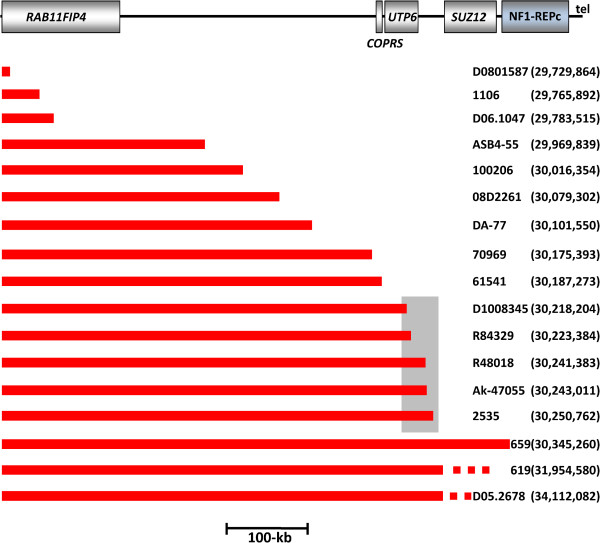
We analyze large NF1 deletions with non-recurrent breakpoints as a model to investigate the full spectrum of causative mechanisms, and observe that they are mediated by various DNA double strand break repair mechanisms, as well as aberrant replication. Further, two of the 17 NF1 deletions with non-recurrent breakpoints, identified in unrelated patients, occur in association with the concomitant insertion of SINE/variable number of tandem repeats/Alu (SVA) retrotransposons at the deletion breakpoints. The respective breakpoints are refractory to analysis by standard breakpoint-spanning PCRs and are only identified by means of optimized PCR protocols designed to amplify across GC-rich sequences. The SVA elements are integrated within SUZ12P intron 8 in both patients, and were mediated by target-primed reverse transcription of SVA mRNA intermediates derived from retrotranspositionally active source elements. Both SVA insertions occurred during early postzygotic development and are uniquely associated with large deletions of 1 Mb and 867 kb, respectively, at the insertion sites.
Since active SVA elements are abundant in the human genome and the retrotranspositional activity of many SVA source elements is high, SVA insertion-associated large genomic deletions encompassing many hundreds of kilobases could constitute a novel and as yet under-appreciated mechanism underlying large-scale copy number changes in the human genome.
基因组疾病由拷贝数变化引起,这些变化可能表现出由非等位基因同源重组处理的反复出现的断点。然而,也观察到了区域特异性疾病相关的拷贝数变化,其表现出非反复出现的断点。这些非反复出现的拷贝数变化背后的机制尚未完全阐明。
我们分析了具有非反复出现断点的大型NF1缺失作为模型,以研究致病机制的全貌,并观察到它们由各种DNA双链断裂修复机制以及异常复制介导。此外,在无关患者中鉴定出的17个具有非反复出现断点的NF1缺失中有两个,与在缺失断点处同时插入SINE/可变数量的串联重复序列/Alu(SVA)逆转录转座子有关。各自的断点难以通过标准的跨越断点PCR进行分析,仅通过设计用于扩增富含GC序列的优化PCR方案来鉴定。在两名患者中,SVA元件均整合在SUZ12P内含子8内,并且由源自逆转录转座活性源元件的SVA mRNA中间体的靶标引发的逆转录介导。两个SVA插入均发生在合子后早期发育过程中,并且分别与插入位点处1 Mb和867 kb的大缺失独特相关。
由于活跃的SVA元件在人类基因组中丰富,并且许多SVA源元件的逆转录转座活性很高,因此包含数百千碱基的SVA插入相关的大基因组缺失可能构成人类基因组中大规模拷贝数变化的一种新颖且尚未被充分认识的机制。