Pokhrel Bhupesh, Choi Eun Kwang, Khalid Omer, Sandrasegaran Kumar, Fogel Evan L, McHenry Lee, Sherman Stuart, Watkins James, Cote Gregory A, Pitt Henry A, Zyromski Nicholas J, Juliar Beth, Lehman Glen A
Department of Medicine, Indiana University School of Medicine, Indianapolis, IN.
Department of Gastroenterology, St Louis University School of Medicine, St Louis, MO.
Clin Exp Gastroenterol. 2014 Jun 9;7:199-204. doi: 10.2147/CEG.S31333. eCollection 2014.
A preliminary study has shown increased pancreatic fat in patients with idiopathic pancreatitis and sphincter of Oddi dysfunction. In this study, we aimed to determine if an increased quantity of pancreatic fat is an independent risk factor for pancreatitis post-endoscopic retrograde cholangiopancreatography (ERCP).
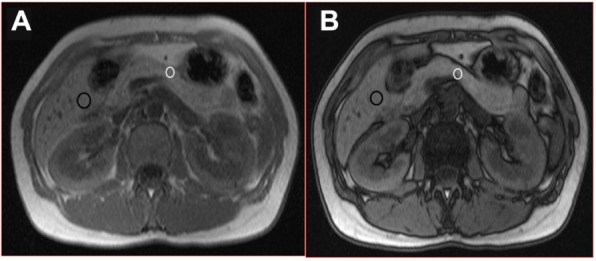
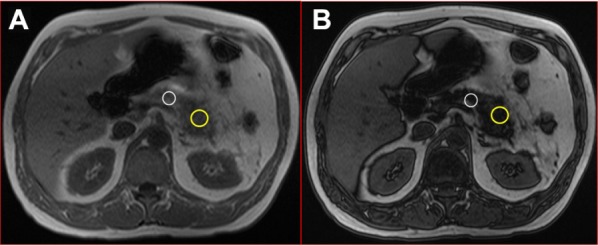
In this case control study, we retrospectively reviewed a local radiological and ERCP database to identify patients who had had abdominal magnetic resonance imaging (MRI) followed by ERCP no more than 60 days later between September 2003 and January 2011. Percentage of fat was determined by recording signal intensity in the in-phase (Sin) and out-of-phase (Sout) T1-weighted gradient sequences, and calculation of the fat fraction as (Sin - Sout)/(Sin) × 2 by an abdominal radiologist blinded to clinical history. Controls matched for age, gender, and other pancreatobiliary disease were selected from a group with no post-ERCP pancreatitis (before fat content of the pancreas was analyzed).
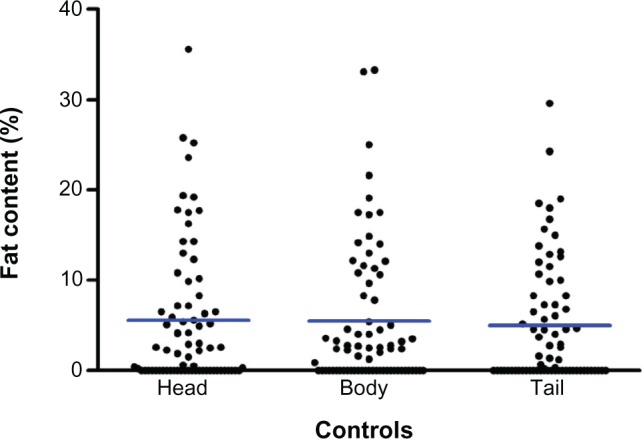
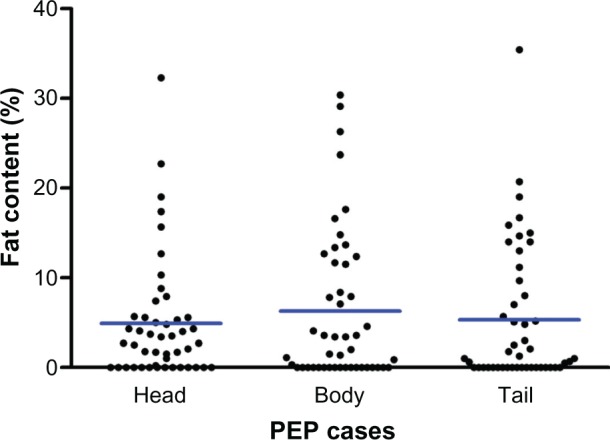
Forty-seven patients were enrolled. Compared with controls, subjects with post-ERCP pancreatitis were similar in terms of age (41.4 years versus 41.1 years), gender (21.2% versus 20.2% males), pancreatobiliary disease characteristics, and most ERCP techniques. Measurements of pancreatic head, body, and tail fat and body mass index were similar in patients and controls.
Increased pancreatic fat on MRI criteria is not an independent predictor of post-ERCP pancreatitis.
一项初步研究显示,特发性胰腺炎和Oddi括约肌功能障碍患者的胰腺脂肪增加。在本研究中,我们旨在确定胰腺脂肪量增加是否是内镜逆行胰胆管造影术(ERCP)后胰腺炎的独立危险因素。
在这项病例对照研究中,我们回顾性分析了本地放射学和ERCP数据库,以确定在2003年9月至2011年1月期间接受腹部磁共振成像(MRI)检查且在不超过60天后接受ERCP检查的患者。脂肪百分比通过记录同相位(Sin)和反相位(Sout)T1加权梯度序列中的信号强度来确定,并由对临床病史不知情的腹部放射科医生计算脂肪分数为(Sin - Sout)/(Sin)×2。从一组无ERCP后胰腺炎的患者(在分析胰腺脂肪含量之前)中选择年龄、性别和其他胰腺疾病相匹配的对照组。
共纳入47例患者。与对照组相比,ERCP后胰腺炎患者在年龄(41.4岁对41.1岁)、性别(男性分别为21.2%对20.2%)、胰腺疾病特征以及大多数ERCP技术方面相似。患者和对照组在胰头、胰体、胰尾脂肪测量及体重指数方面相似。
根据MRI标准,胰腺脂肪增加并非ERCP后胰腺炎的独立预测因素。