Fujita Noriko, Kagara Naofumi, Yamamoto Noriaki, Shimazu Kenzo, Shimomura Atsushi, Shimoda Masafumi, Maruyama Naomi, Naoi Yasuto, Morimoto Koji, Oda Naofumi, Kim Seung Jin, Noguchi Shinzaburo
Department of Breast and Endocrine Surgery, Osaka University Graduate School of Medicine, Suita-shi, Osaka 565-0871, Japan.
Central Research Laboratories, Sysmex Corporation, Kobe 651-2271, Japan.
Oncol Lett. 2014 Jul;8(1):397-403. doi: 10.3892/ol.2014.2068. Epub 2014 Apr 15.
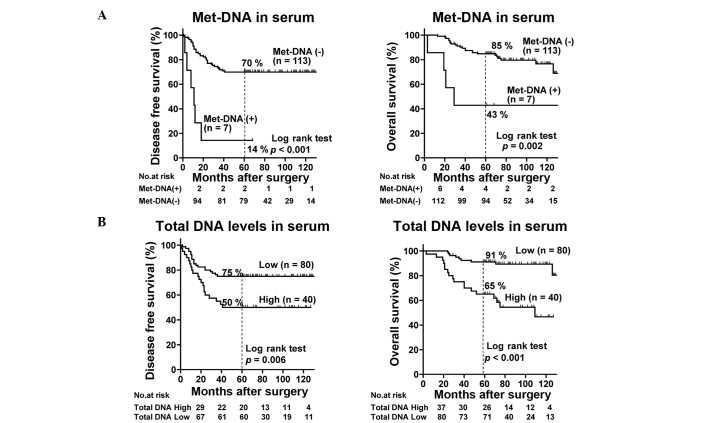
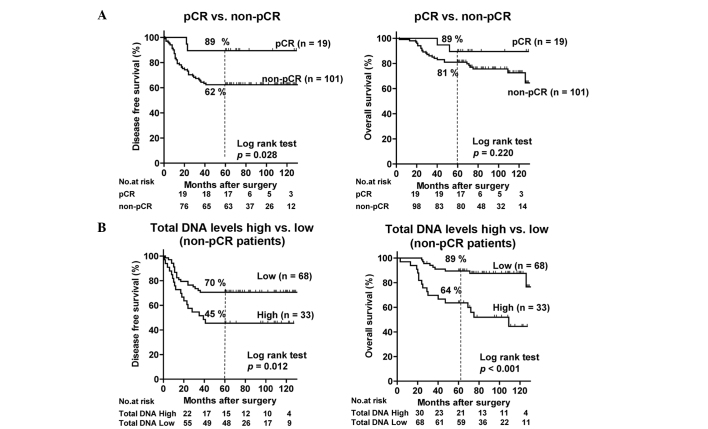
In a previous study, we established a one-step methylation-specific polymerase chain reaction (OS-MSP) assay for the detection of methylated DNA (met-DNA) and total DNA levels in serum. For the present study, this OS-MSP assay was used for patients with breast cancer treated with neoadjuvant chemotherapy (NAC) in order to investigate the prognostic significance of met-DNA and total DNA levels. Following treatment with NAC and prior to surgery, serum samples obtained from 120 patients with stage II/III breast cancer were subjected to the OS-MSP assay for analysis of the glutathione S-transferase pi 1, Ras association (RalGDS/AF-6) domain family member 1 and retinoic acid receptor β2 genes. The detection of methylation in a minimum of one of these genes indicated a positive outcome of the assay. The total DNA content of the serum was also determined. Of the 120 stage II/III patients, seven (6%) were positive for met-DNA in serum and showed a significantly worse overall survival (OS) time compared with patients negative for met-DNA (n=113) (5-year OS, 43 vs. 85%; P=0.002). The patients with high total DNA levels in serum (n=40) also showed a significantly worse OS compared with those with low total DNA levels (n=80) (65 vs. 91%; P<0.001). The presence of met-DNA and high total DNA levels in the serum were found to be significant prognostic factors that are independent of a pathological complete response by multivariate analysis. Following NAC, met-DNA and high total DNA levels in the serum detected with the OS-MSP assay constitute novel prognostic factors for patients with breast cancer; this may be clinically useful for the prognosis prediction for patients who do not achieve a pathological complete response following NAC.
在先前的一项研究中,我们建立了一种一步法甲基化特异性聚合酶链反应(OS-MSP)检测方法,用于检测血清中的甲基化DNA(met-DNA)和总DNA水平。在本研究中,该OS-MSP检测方法用于接受新辅助化疗(NAC)的乳腺癌患者,以研究met-DNA和总DNA水平的预后意义。在接受NAC治疗后且手术前,从120例II/III期乳腺癌患者中采集血清样本,进行OS-MSP检测,以分析谷胱甘肽S-转移酶pi 1、Ras关联(RalGDS/AF-6)结构域家族成员1和视黄酸受体β2基因。这些基因中至少有一个检测到甲基化表明检测结果为阳性。同时还测定了血清中的总DNA含量。在这120例II/III期患者中,7例(6%)血清met-DNA呈阳性,与met-DNA阴性患者(n = 113)相比,其总生存期(OS)明显更差(5年OS,43%对85%;P = 0.002)。血清总DNA水平高的患者(n = 40)与总DNA水平低的患者(n = 80)相比,OS也明显更差(65%对91%;P < 0.001)。多因素分析发现,血清中met-DNA的存在和高总DNA水平是独立于病理完全缓解的重要预后因素。NAC治疗后,用OS-MSP检测法检测到的血清中met-DNA和高总DNA水平是乳腺癌患者的新预后因素;这对于预测NAC治疗后未达到病理完全缓解的患者的预后可能具有临床应用价值。