Rajappa Medha, Sridhar M G, Balachander J, Sethuraman K R, Rajendiran Kalai Selvi
Department of Biochemistry, Jawaharlal Institute of Postgraduate Medical Education and Research, Puducherry 605 006, India.
Department of Cardiology, Jawaharlal Institute of Postgraduate Medical Education and Research, Puducherry 605 006, India.
ISRN Endocrinol. 2014 May 18;2014:981524. doi: 10.1155/2014/981524. eCollection 2014.
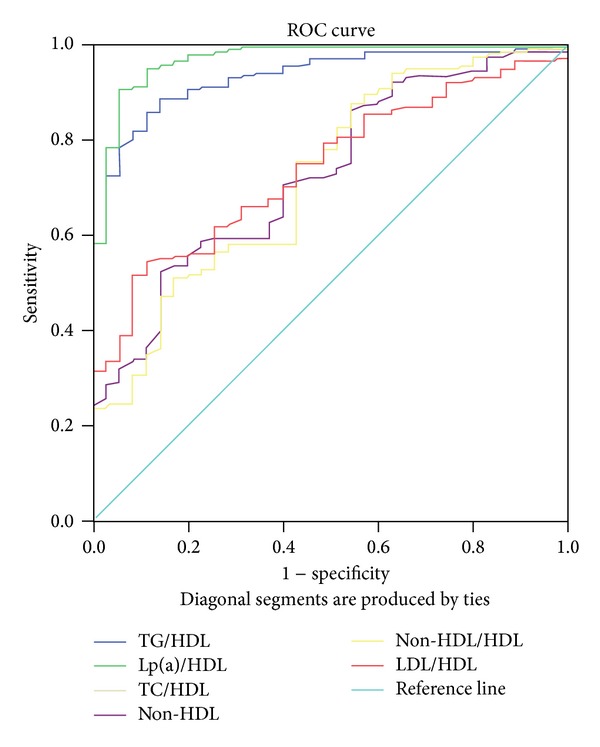
Background. Insulin resistance has been associated with dyslipidemia and cardiovascular disease. Even though homeostasis model assessment of insulin resistance (HOMA-IR) is a well-known insulin resistance predictor, estimation of serum lipoprotein ratios has been recently suggested as a surrogate marker for insulin resistance. Here, we evaluated the relationship between lipoprotein ratios and insulin resistance in normoglycemic nondiabetic south Indians with acute coronary syndrome. Methods. 100 normoglycemic nondiabetic ACS patients and 140 controls were enrolled in the study. Levels of fasting glucose, fasting insulin, and lipid profile [total cholesterol (TC), triglycerides (TG), and high density lipoprotein cholesterol (HDL-C)], lipoprotein(a) [Lp(a)] levels were measured and lipoprotein ratios were computed. HOMA-IR was used to calculate the insulin resistance. Receiver operating characteristic curves (ROC) analysis was used to compare the power of these lipoprotein ratios to predict insulin resistance. Results. Lipoprotein ratios were significantly higher in normoglycemic nondiabetic ACS patients, as compared to healthy controls, and were significantly correlated with HOMA-IR by Spearman's rank correlation analysis. ROC curve showed that Lp(a)/HDL-C and TG/HDL-C ratios were the best surrogate predictors of insulin resistance in normoglycemic nondiabetic ACS. Conclusion. This study demonstrates that serum lipoprotein ratios significantly correlate with insulin resistance in normoglycemic nondiabetic ACS. Lp(a)/HDL-C and TG/HDL-C ratios could be used as surrogate markers of insulin resistance in atherosclerosis-prone south Indians with normoglycemic nondiabetic ACS.
背景。胰岛素抵抗与血脂异常和心血管疾病相关。尽管稳态模型评估胰岛素抵抗(HOMA-IR)是一种广为人知的胰岛素抵抗预测指标,但最近有人提出,血清脂蛋白比率的评估可作为胰岛素抵抗的替代标志物。在此,我们评估了急性冠脉综合征的血糖正常的非糖尿病南印度人中脂蛋白比率与胰岛素抵抗之间的关系。方法。本研究纳入了100例血糖正常的非糖尿病急性冠脉综合征患者和140例对照。测量空腹血糖、空腹胰岛素和血脂谱[总胆固醇(TC)、甘油三酯(TG)和高密度脂蛋白胆固醇(HDL-C)]、脂蛋白(a)[Lp(a)]水平,并计算脂蛋白比率。采用HOMA-IR计算胰岛素抵抗。采用受试者工作特征曲线(ROC)分析比较这些脂蛋白比率预测胰岛素抵抗的能力。结果。与健康对照相比,血糖正常的非糖尿病急性冠脉综合征患者的脂蛋白比率显著更高,且通过Spearman等级相关分析与HOMA-IR显著相关。ROC曲线显示,在血糖正常的非糖尿病急性冠脉综合征患者中,Lp(a)/HDL-C和TG/HDL-C比率是胰岛素抵抗的最佳替代预测指标。结论。本研究表明,在血糖正常的非糖尿病急性冠脉综合征患者中,血清脂蛋白比率与胰岛素抵抗显著相关。在易患动脉粥样硬化的血糖正常的非糖尿病急性冠脉综合征南印度人中,Lp(a)/HDL-C和TG/HDL-C比率可作为胰岛素抵抗的替代标志物。