Ocan Moses, Bbosa Godfrey S, Waako Paul, Ogwal-Okeng Jasper, Obua Celestino
Department of Pharmacology & Therapeutics, Makerere University, P,O, Box 7072, Kampala, Uganda.
BMC Public Health. 2014 Jun 26;14:650. doi: 10.1186/1471-2458-14-650.
Medicines are kept in households Worldwide for first aid, treatment of chronic or acute disease conditions. This promotes inappropriate use of medicines and hence the associated risks. The study explored the factors which predict availability and utilization of medicines in households of Northern Uganda.
A cross sectional survey of 892 households was performed from November-to-December 2012. Five data collectors administered the questionnaires, respondents were requested to bring out any medicines present in their households. Demographic characteristics, drug name, quantity, source, formulation, legibility of drug labels and reasons why the medicines were being kept at home was collected. Data was analyzed using STATA 12.0 at 95% level of significance.
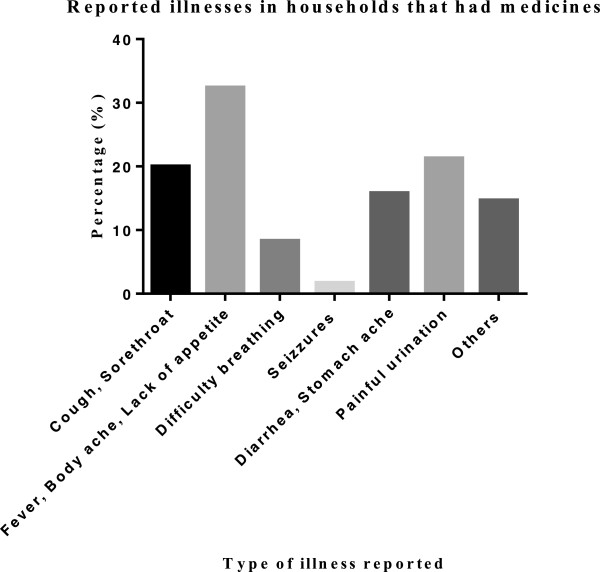
Of the households visited, 35.1% (313/892) had drugs. Paracetamol (11.8%), coartem (11.3%), cotrimoxazole (10%), amoxicillin (9.2%) and metronidazole (8.2%) were the major medicines found. Antibacterial drugs were the most commonly (40.1%) kept type of drugs. The medicines present in households were for on-going treatment (48%); 'leftover' (30.5%) and anticipated future use (21.6%). Symptoms of malaria (34.1%) were common in households which had drugs. The medicines kept in homes were mainly from the private sector 60.5% (497/821). The rate of home drug storage was higher 85.3% (267/313) amongst the educated individuals. There was high prevalence 76% (238/313) of self-medication among respondents in households which stored drugs. The average number of medicines in each household was 6 ± 5 with majority (68.1%) having between 1-10 drugs. Previous successful treatment (OR: 1.3; 95% CI: 0.95-1.77), regular income (OR: 1.8; 95% CI: 1.2-2.6) and sex (OR: 0.63; 95% CI: 0.5-0.9) predicted storage of medicines in households in northern Uganda.
Over a third of households in Northern Uganda store medicines with antibacterial agents being the most common. Self-medication is common among individuals in households which keep drugs. Past successful treatment, regular income and sex predict community home drug storage.
在全球范围内,家庭中都存放着药品用于急救、治疗慢性或急性疾病。这导致了药品的不当使用及其相关风险。本研究探讨了预测乌干达北部家庭药品可得性和使用情况的因素。
2012年11月至12月对892户家庭进行了横断面调查。由五名数据收集员发放问卷,要求受访者拿出家中现存的任何药品。收集了人口统计学特征、药品名称、数量、来源、剂型、药品标签的清晰度以及药品存放在家中的原因。使用STATA 12.0对数据进行分析,显著性水平为95%。
在所走访的家庭中,35.1%(313/892)有药品。发现的主要药品有对乙酰氨基酚(11.8%)、蒿甲醚/本芴醇(11.3%)、复方磺胺甲恶唑(10%)、阿莫西林(9.2%)和甲硝唑(8.2%)。抗菌药物是家庭中最常存放的药品类型(40.1%)。家庭中现存的药品用于正在进行的治疗(48%)、“剩余”(30.5%)和预期未来使用(21.6%)。有药品的家庭中疟疾症状常见(34.1%)。家中存放的药品主要来自私营部门,占60.5%(497/821)。在受过教育的人群中,家庭药品储存率更高,为85.3%(267/313)。在储存药品的家庭中,受访者的自我药疗患病率很高,为76%(238/313)。每户家庭的药品平均数量为6±5,大多数(68.1%)家庭有1至10种药品。既往治疗成功(比值比:1.3;95%置信区间:0.95 - 1.77)、有固定收入(比值比:1.8;95%置信区间:1.2 - 2.6)和性别(比值比:0.63;95%置信区间:0.5 - 0.9)可预测乌干达北部家庭的药品储存情况。
乌干达北部超过三分之一的家庭储存药品,其中抗菌药物最为常见。在储存药品的家庭中,自我药疗很普遍。既往治疗成功、有固定收入和性别可预测社区家庭药品储存情况。