TwoLegs Consulting, Newton, Massachusetts, USA.
Pharmerit International, Cambridge, Massachusetts, USA.
Clin Transl Gastroenterol. 2014 Jun 26;5(6):e59. doi: 10.1038/ctg.2014.7.
Despite a documented clinical need, no patient reported outcome (PRO) symptom measure meeting current regulatory requirements for clinically relevant end points is available for the evaluation of treatment benefit in diarrhea-predominant IBS (IBS-D).
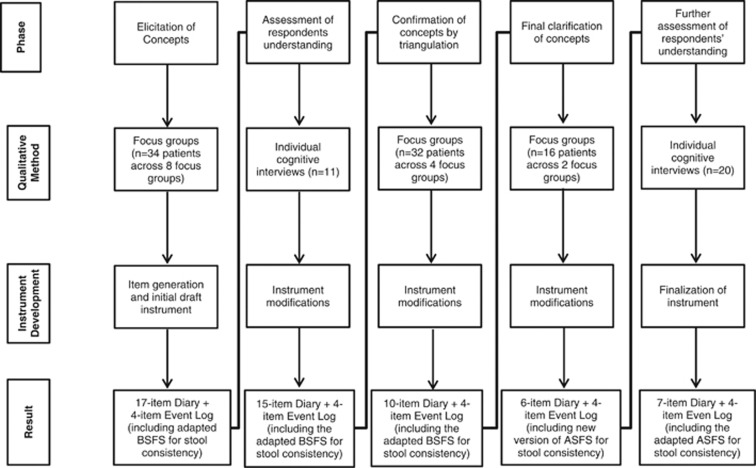
Patients (N=113) with IBS-D participated in five study phases: (1) eight concept elicitation focus groups (N=34), from which a 17-item IBS-D Daily Symptom Diary and four-item IBS-D Symptom Event Log (Diary and Event Log) were developed; (2) one-on-one cognitive interviews (N=11) to assess the instrument's comprehensiveness, understandability, appropriateness, and readability; (3) four data triangulation focus groups (N=32) to confirm the concepts elicited; (4) two hybrid (concept elicitation and cognitive interview) focus groups (N=16); and (5) two iterative sets of one-on-one cognitive interviews (N=20) to further clarify the symptoms of IBS-D and debrief a revised seven-item Diary and four-item Event Log.
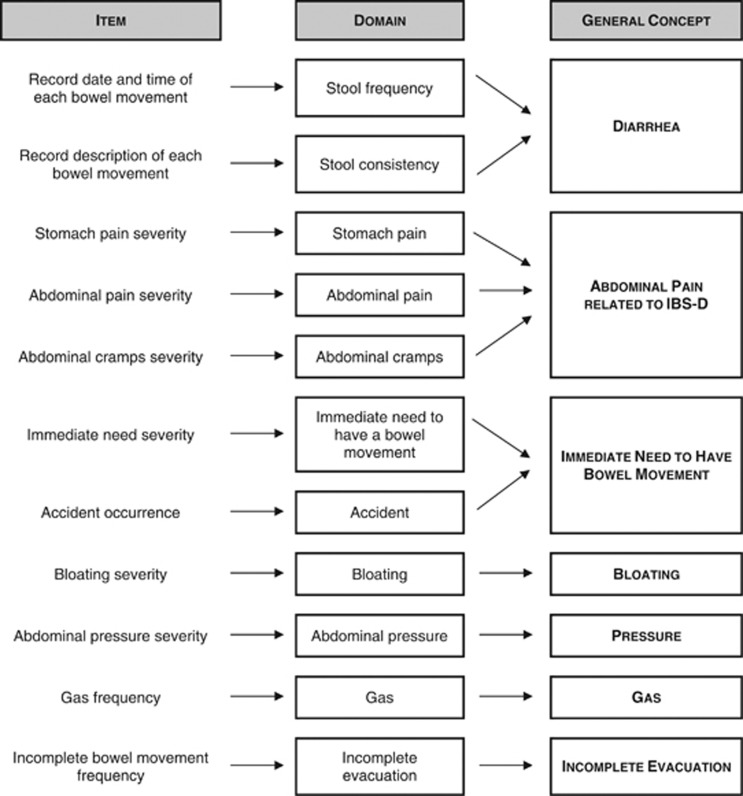
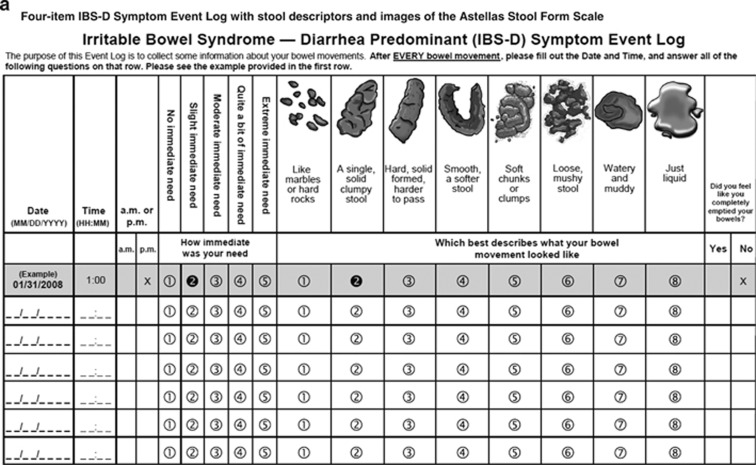
Of thirty-six concepts initially identified, 22 were excluded because they were not saturated, not clinically relevant, not critical symptoms of IBS-D, considered upper GI symptoms, or too broad or vaguely defined. The remaining concepts were diarrhea, immediate need (urgency), bloating/pressure, frequency of bowel movements, cramps, abdominal/stomach pain, gas, completely emptied bowels/incomplete evacuation, accidents, bubbling in intestines (bowel sounds), rectal burning, stool consistency, rectal spasm, and pain while wiping. The final instrument included a daily diary with separate items for abdominal and stomach pain and an event log with four items completed after each bowel movement as follows: (1) a record of the bowel movement/event and an assessment of (2) severity of immediacy of need/bowel urgency, (3) incomplete evacuation, and (4) stool consistency (evaluated using the newly developed Astellas Stool Form Scale). Based on rounds of interviews and clinical input, items considered secondary or nonspecific to IBS-D (rectal burning, bubbling in intestines, spasms, and pain while wiping) were excluded.
The IBS-D Symptom Diary and Event Log represent a rigorously developed PRO instrument for the measurement of the IBS-D symptom experience from the perspective of the patient. Its content validity has been supported, and future work should evaluate the instrument's psychometric properties.
尽管有临床文献记录表明存在需求,但目前尚无满足临床相关终点标准的可用于评估腹泻型肠易激综合征(IBS-D)治疗获益的患者报告结局(PRO)症状测量工具。
113 例 IBS-D 患者参与了五个研究阶段:(1)8 个概念发掘焦点小组(n=34),由此开发了 17 项 IBS-D 日常症状日记和 4 项 IBS-D 症状事件日志(日记和事件日志);(2)一对一认知访谈(n=11),以评估工具的全面性、可理解性、适当性和可读性;(3)4 个数据三角焦点小组(n=32),以确认所引出的概念;(4)2 个混合(概念发掘和认知访谈)焦点小组(n=16);以及(5)2 组迭代一对一认知访谈(n=20),以进一步阐明 IBS-D 的症状并讨论修订后的 7 项日记和 4 项事件日志。
最初确定的 36 个概念中有 22 个被排除,因为它们未达到饱和、与临床不相关、不是 IBS-D 的关键症状、被认为是上消化道症状、过于广泛或定义模糊。其余概念包括腹泻、立即需求(紧迫性)、腹胀/压迫感、排便频率、痉挛、腹部/胃部疼痛、气体、完全排空肠道/不完全排空、意外、肠道中冒泡(肠鸣音)、直肠烧灼感、粪便稠度、直肠痉挛和擦拭时疼痛。最终的工具包括一个带有单独的腹部和胃部疼痛项目的日常日记和一个在每次排便后完成的四个项目的事件日志,具体如下:(1)记录排便/事件,并评估(2)急迫性/紧迫性、(3)不完全排空和(4)粪便稠度的严重程度(使用新开发的 Astellas 粪便形态量表评估)。基于几轮访谈和临床意见,排除了被认为是次要的或与 IBS-D 无关的项目(直肠烧灼感、肠道中冒泡、痉挛和擦拭时疼痛)。
IBS-D 症状日记和事件日志代表了一种经过严格开发的 PRO 工具,可从患者角度测量 IBS-D 的症状体验。其内容效度已得到支持,未来的工作应评估该工具的心理测量特性。