Department of Microbiology, School of Medicine, Iran University of Medical Sciences, Tehran, Iran ; Biophysics Institute, Medical University of Graz, Graz, Austria.
Department of Microbiology, School of Medicine, Iran University of Medical Sciences, Tehran, Iran.
Cancer Cell Int. 2014 Jun 19;14:54. doi: 10.1186/1475-2867-14-54. eCollection 2014.
Many types of tumors are organized in a hierarchy of heterogeneous cell populations with different molecular signature. Such heterogeneity may be associated with different responsiveness to microenvironment stimuli. In the present study, the effects of lipopolysaccharide (LPS) and lipoteichoic acid (LTA), as well-known mediators of inflammation, on cancerous behavior of three prostate tumor cells, LNCaP, PC3 and DU145, were investigated.
Expression of TLR1-10, CD14 and MyD88 transcripts was investigated by RT-PCR. Protein expression of TLR2 and 4 was scrutinized by flow cytometry, immunofluorescent staining and Western blotting. Experiments were set up to assess the effects of LPS and LTA at different concentrations and times on cell proliferation, extracellular matrix invasion, adhesion and cytokine production.
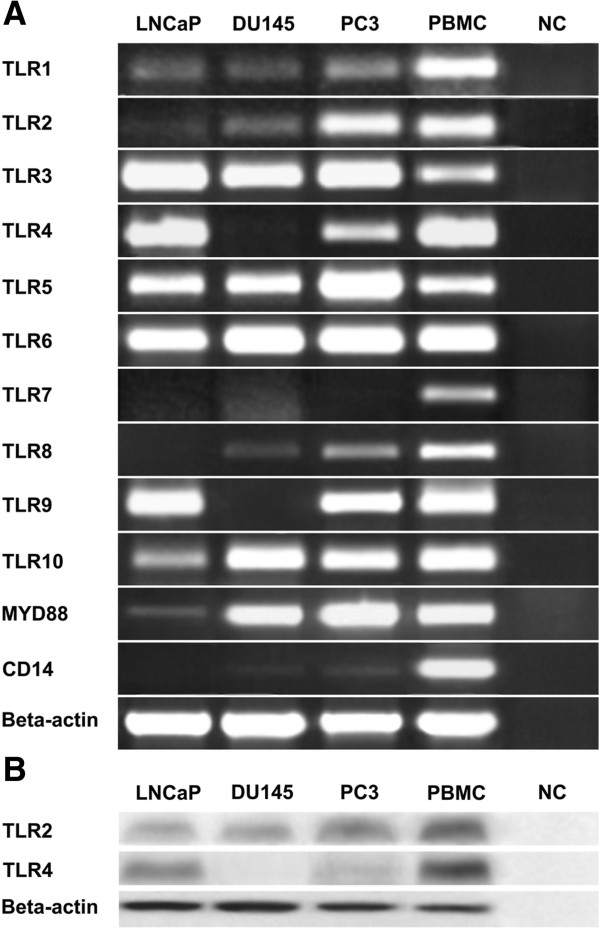
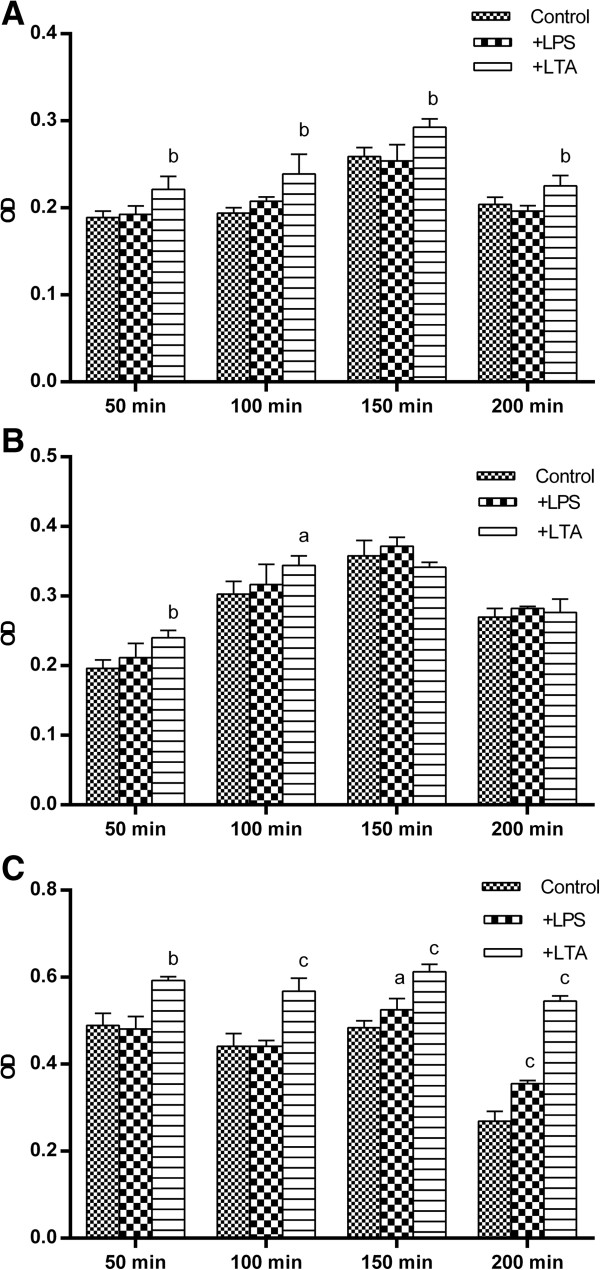
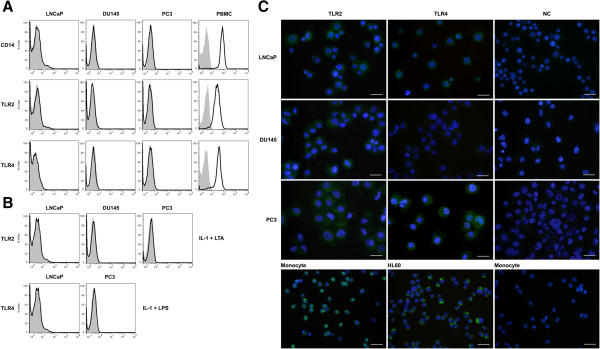
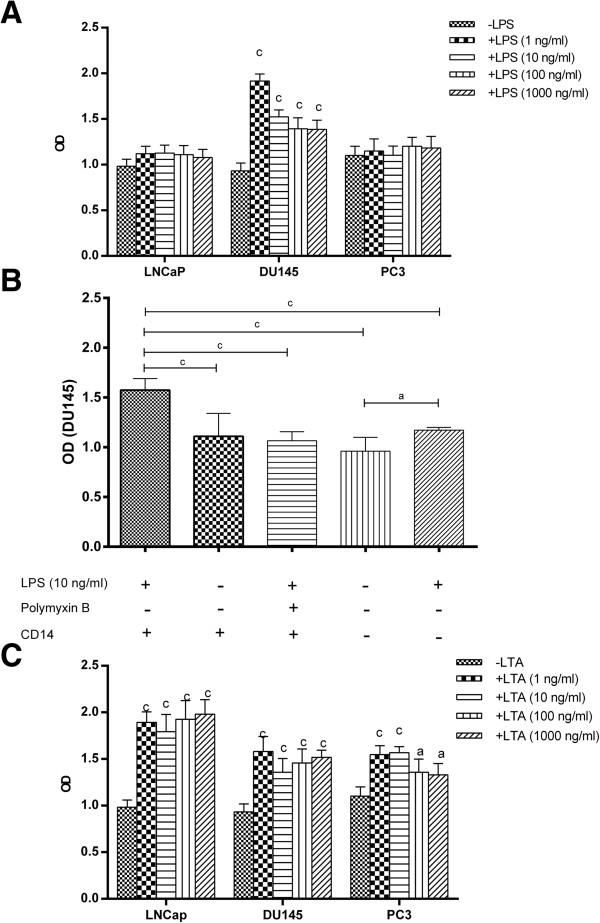
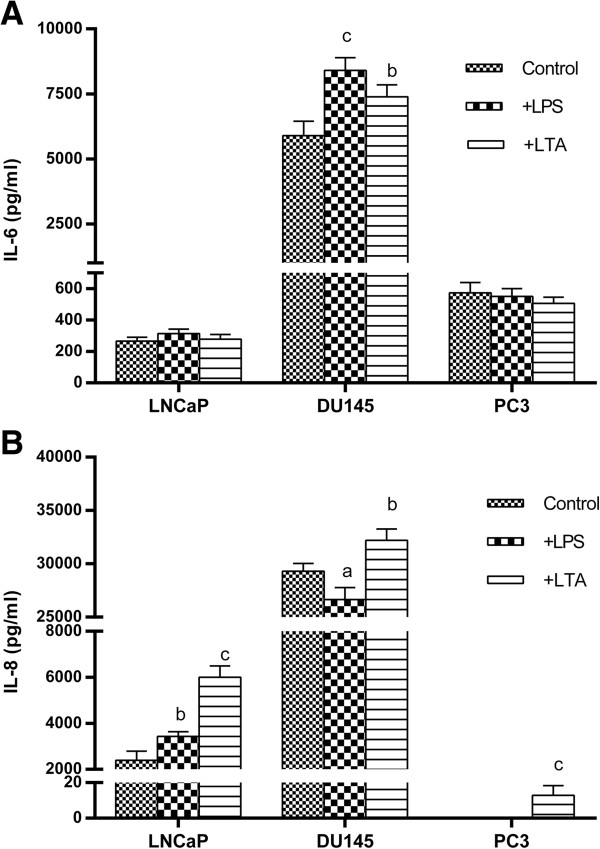
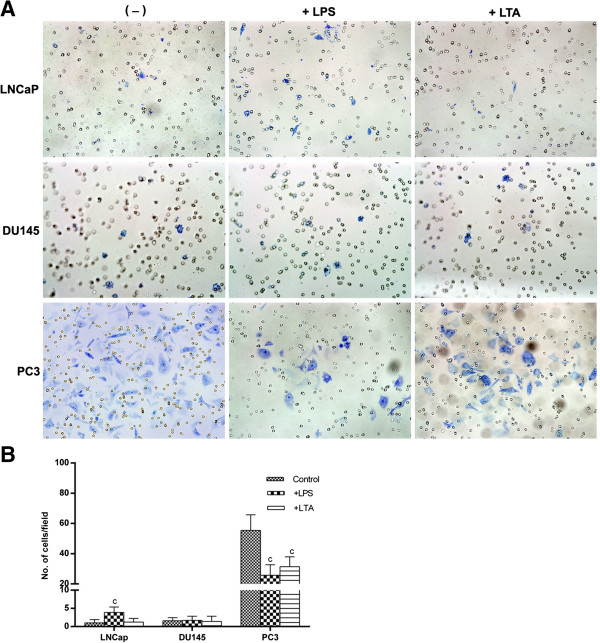
We showed that prostate cancer cell lines differentially express TLR1-10, MyD88 and CD14 transcripts. DU145 failed to express TLR4 gene. Positively-identified TLR2 protein in all prostate cancer cells and TLR4 protein in PC3 and LNCaP by Western blotting was not accompanied by cell surface expression, as judged by flow cytometry. Immunofluorescent staining clearly demonstrated predominantly perinuclear localization of TLR2 and TLR4. LTA activation of all prostate cancer cells significantly increased cell proliferation. Regardless of lacking TLR4, DU145 cells proliferated in response to LPS treatment. While LPS caused increased invasiveness of LNCaP, invasive capacity of PC3 was significantly reduced after LPS or LTA stimulation. Stimulation of all prostate tumor cells with LTA was associated with increased cell adhesion and IL-8 production. IL-6 production, however, was differentially regulated by LPS stimulation in prostate tumor cells.
The data shows that cancer cells originated from the same histologically origin exhibit heterogeneous response to the same TLR ligand. Therefore, a thorough and comprehensive judgment on how and to what extent a particular cancer is affected by TLR agonist could not be inferred by studying an individual cell line.
许多类型的肿瘤在具有不同分子特征的异质细胞群体中呈现出层次性。这种异质性可能与对微环境刺激的不同反应性有关。在本研究中,研究了脂多糖(LPS)和脂磷壁酸(LTA)作为炎症的已知介质对三种前列腺癌细胞 LNCaP、PC3 和 DU145 的癌变行为的影响。
通过 RT-PCR 研究 TLR1-10、CD14 和 MyD88 转录本的表达。通过流式细胞术、免疫荧光染色和 Western blot 检测 TLR2 和 4 的蛋白表达。设置实验以评估 LPS 和 LTA 在不同浓度和时间对细胞增殖、细胞外基质侵袭、黏附和细胞因子产生的影响。
我们表明前列腺癌细胞系差异表达 TLR1-10、MyD88 和 CD14 转录本。DU145 未能表达 TLR4 基因。Western blot 鉴定出所有前列腺癌细胞中的 TLR2 蛋白和 PC3 和 LNCaP 中的 TLR4 蛋白,但流式细胞术检测不到细胞表面表达。免疫荧光染色清楚地表明 TLR2 和 TLR4 主要定位于核周。LTA 激活所有前列腺癌细胞均显著增加细胞增殖。尽管缺乏 TLR4,DU145 细胞仍对 LPS 处理有增殖反应。LPS 导致 LNCaP 的侵袭性增加,而 LPS 或 LTA 刺激后 PC3 的侵袭能力显著降低。LTA 刺激所有前列腺肿瘤细胞均与细胞黏附和 IL-8 产生增加有关。然而,IL-6 的产生在前列腺肿瘤细胞中受 LPS 刺激的调节不同。
数据表明,来自同一组织学起源的癌细胞对相同的 TLR 配体表现出异质性反应。因此,通过研究单个细胞系,不能对特定癌症受到 TLR 激动剂的影响的方式和程度做出全面和综合的判断。