Hattar Katja, Reinert Christian P, Sibelius Ulf, Gökyildirim Mira Y, Subtil Florentine S B, Wilhelm Jochen, Eul Bastian, Dahlem Gabriele, Grimminger Friedrich, Seeger Werner, Grandel Ulrich
Department of Internal Medicine IV/V, University of Giessen and Marburg Lung Center (UGMLC), Klinikstrasse 33, Giessen, Germany.
Department of Radiotherapy and Radiooncology, Philipps-University, Marburg, Germany.
Cancer Immunol Immunother. 2017 Jun;66(6):799-809. doi: 10.1007/s00262-017-1980-4. Epub 2017 Mar 17.
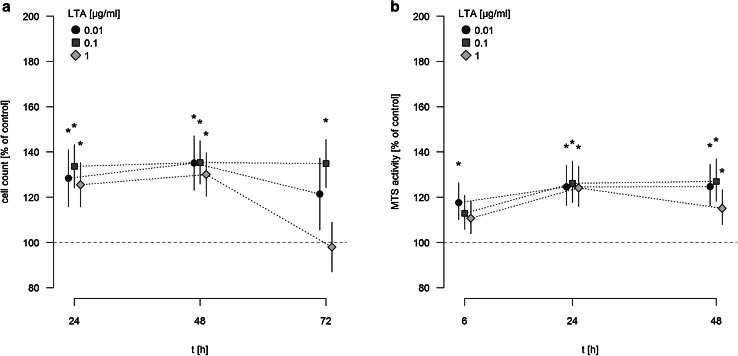
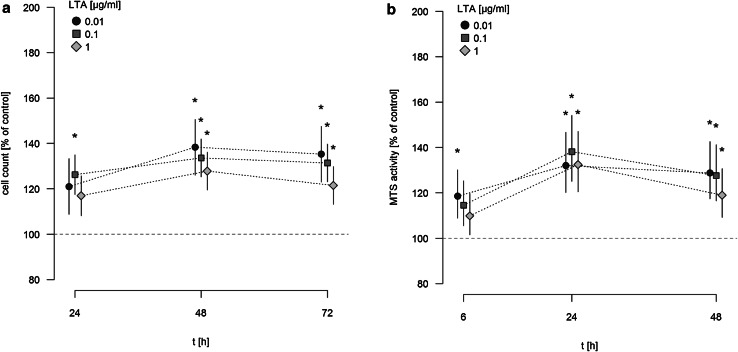
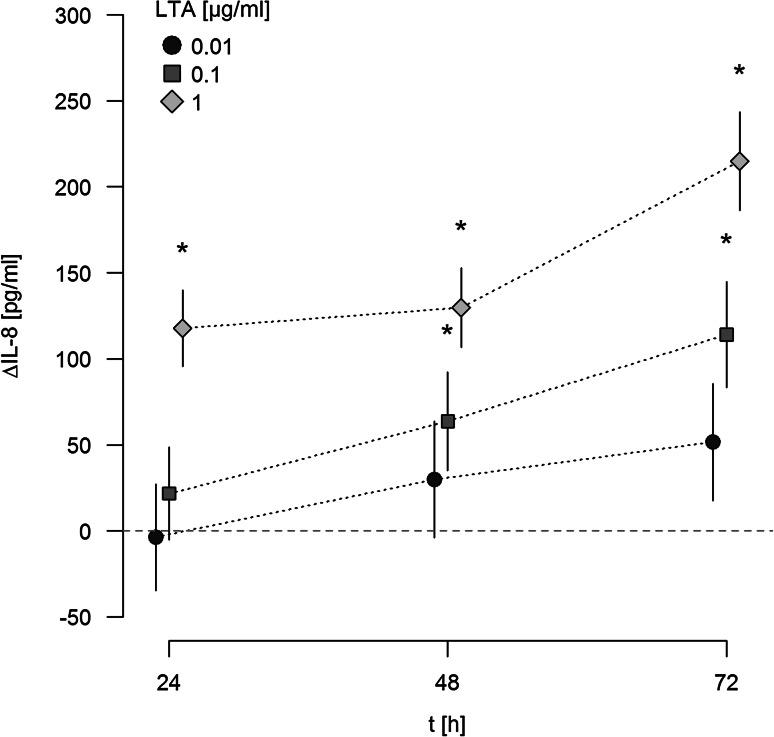
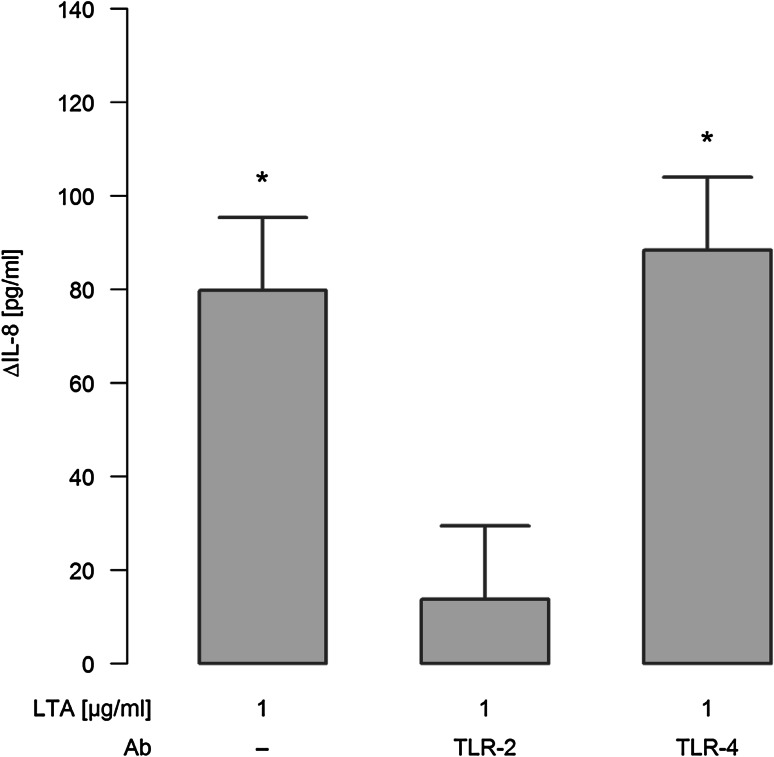
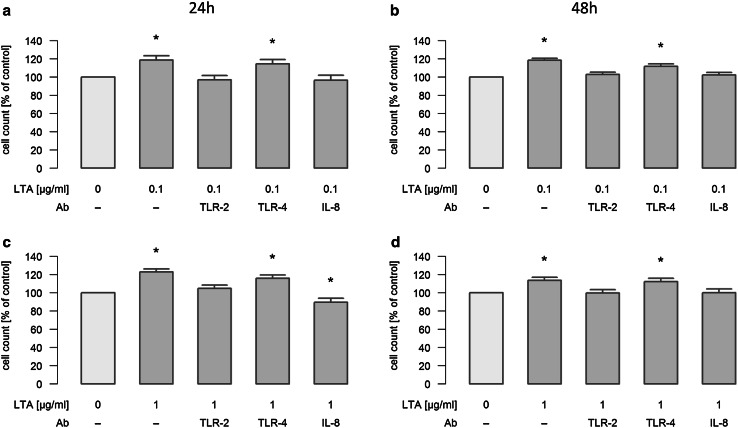
Pulmonary infections are frequent complications in lung cancer and may worsen its outcome and survival. Inflammatory mediators are suspected to promote tumor growth in non-small-cell lung cancer (NSCLC). Hence, bacterial pathogens may affect lung cancer growth by activation of inflammatory signalling. Against this background, we investigated the effect of purified lipoteichoic acids (LTA) of Staphylococcus aureus (S. aureus) on cellular proliferation and liberation of interleukin (IL)-8 in the NSCLC cell lines A549 and H226. A549 as well as H226 cells constitutively expressed TLR-2 mRNA. Even in low concentrations, LTA induced a prominent increase in cellular proliferation of A549 cells as quantified by automatic cell counting. In parallel, metabolic activity of A549 cells was enhanced. The increase in proliferation was accompanied by an increase in IL-8 mRNA expression and a dose- and time-dependent release of IL-8. Cellular proliferation as well as the release of IL-8 was dependent on specific ligation of TLR-2. Interestingly, targeting IL-8 by neutralizing antibodies completely abolished the LTA-induced proliferation of A549 cells. The pro-proliferative effect of LTA could also be reproduced in the squamous NSCLC cell line H226. In summary, LTA of S. aureus induced proliferation of NSCLC cell lines of adeno- and squamous cell carcinoma origin. Ligation of TLR-2 followed by auto- or paracrine signalling by endogenously synthesized IL-8 is centrally involved in LTA-induced tumor cell proliferation. Therefore, pulmonary infections may exert a direct pro-proliferative effect on lung cancer growth.
肺部感染是肺癌常见的并发症,可能会恶化其病情及生存预后。炎症介质被怀疑在非小细胞肺癌(NSCLC)中促进肿瘤生长。因此,细菌病原体可能通过激活炎症信号通路影响肺癌生长。在此背景下,我们研究了金黄色葡萄球菌(S. aureus)纯化脂磷壁酸(LTA)对NSCLC细胞系A549和H226细胞增殖及白细胞介素(IL)-8释放的影响。A549和H226细胞均组成性表达TLR-2 mRNA。即使在低浓度下,通过自动细胞计数定量分析发现,LTA也能显著促进A549细胞的增殖。同时,A549细胞的代谢活性增强。增殖增加伴随着IL-8 mRNA表达的增加以及IL-8的剂量和时间依赖性释放。细胞增殖以及IL-8的释放依赖于TLR-2的特异性结合。有趣的是,用中和抗体靶向IL-8可完全消除LTA诱导的A549细胞增殖。LTA的促增殖作用在鳞状NSCLC细胞系H226中也能重现。总之,金黄色葡萄球菌的LTA可诱导腺源性和鳞状细胞癌源性NSCLC细胞系的增殖。TLR-2结合后通过内源性合成的IL-8进行自分泌或旁分泌信号传导,在LTA诱导的肿瘤细胞增殖中起核心作用。因此,肺部感染可能对肺癌生长产生直接的促增殖作用。