Department of Physiology, Brody School of Medicine, East Carolina University Greenville, NC, USA.
Department of Emergency Medicine, Brody School of Medicine, East Carolina University Greenville, NC, USA.
Front Neural Circuits. 2014 Jun 11;8:62. doi: 10.3389/fncir.2014.00062. eCollection 2014.
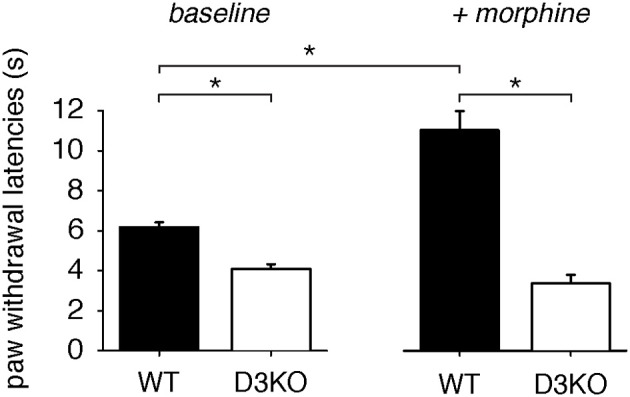
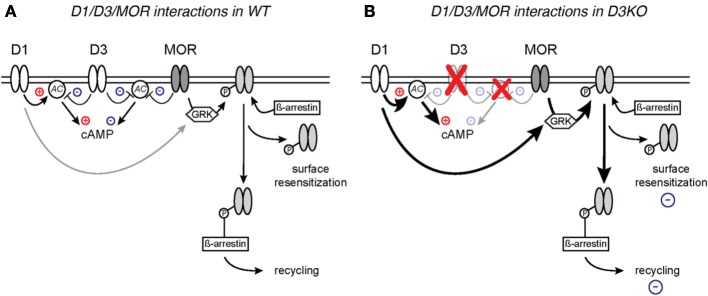
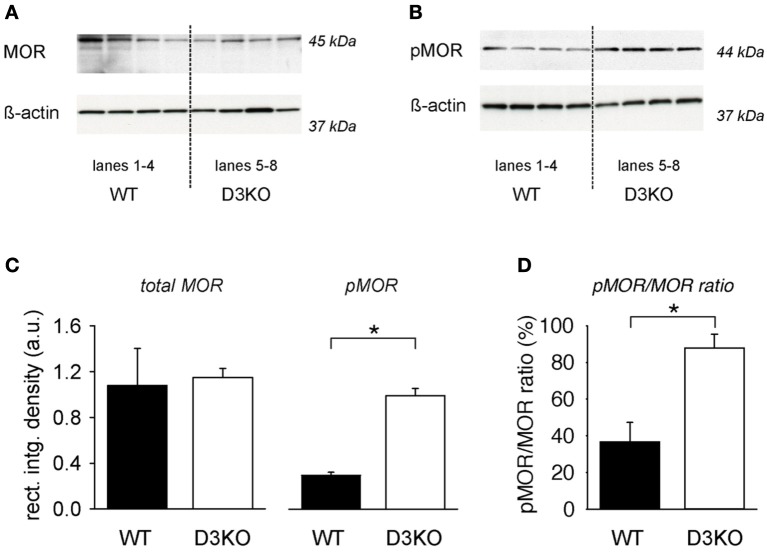
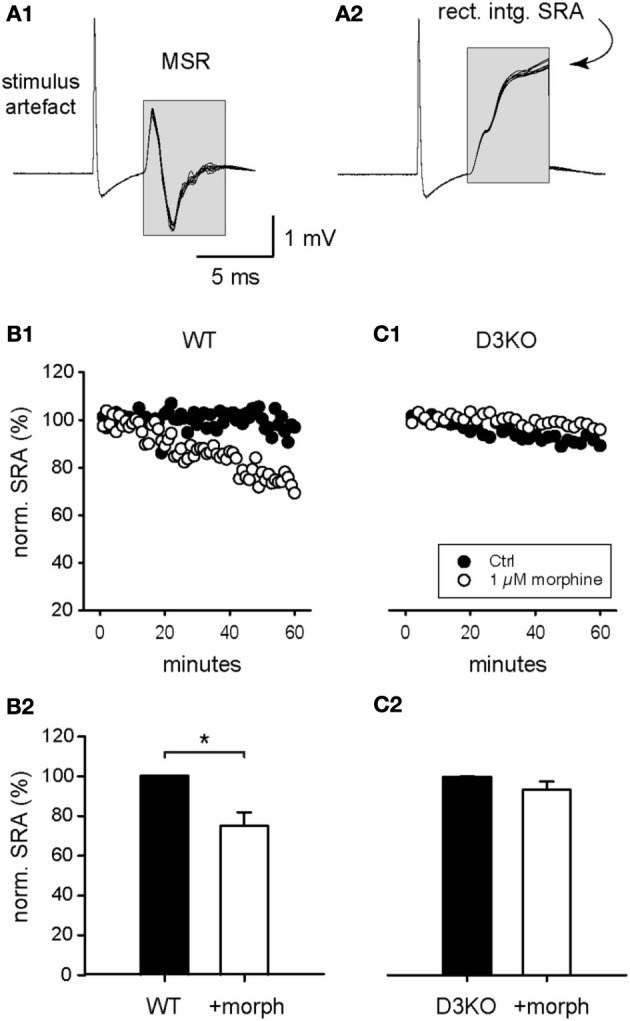
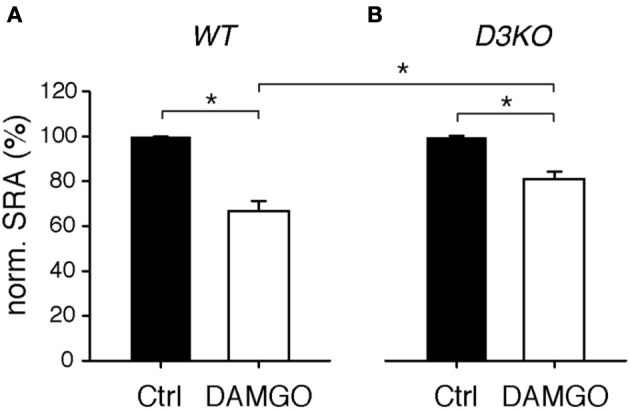
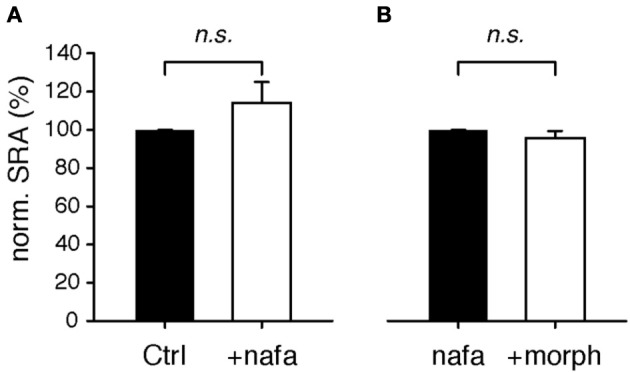
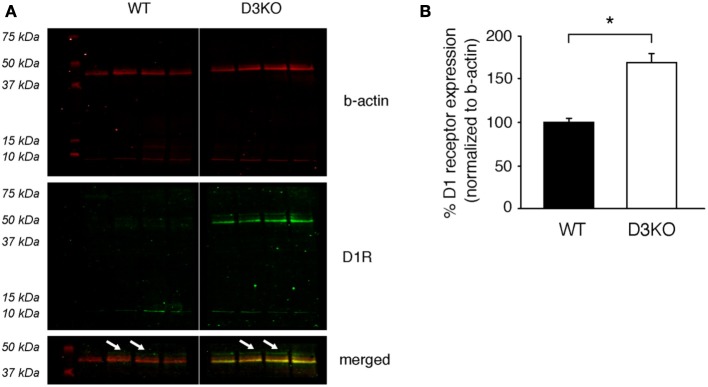
Dopamine (DA) modulates spinal reflexes, including nociceptive reflexes, in part via the D3 receptor subtype. We have previously shown that mice lacking the functional D3 receptor (D3KO) exhibit decreased paw withdrawal latencies from painful thermal stimuli. Altering the DA system in the CNS, including D1 and D3 receptor systems, reduces the ability of opioids to provide analgesia. Here, we tested if the increased pain sensitivity in D3KO might result from a modified μ-opioid receptor (MOR) function at the spinal cord level. As D1 and D3 receptor subtypes have competing cellular effects and can form heterodimers, we tested if the changes in MOR function may be mediated in D3KO through the functionally intact D1 receptor system. We assessed thermal paw withdrawal latencies in D3KO and wild type (WT) mice before and after systemic treatment with morphine, determined MOR and phosphorylated MOR (p-MOR) protein expression levels in lumbar spinal cords, and tested the functional effects of DA and MOR receptor agonists in the isolated spinal cord. In vivo, a single morphine administration (2 mg/kg) increased withdrawal latencies in WT but not D3KO, and these differential effects were mimicked in vitro, where morphine modulated spinal reflex amplitudes (SRAs) in WT but not D3KO. Total MOR protein expression levels were similar between WT and D3KO, but the ratio of pMOR/total MOR was higher in D3KO. Blocking D3 receptors in the isolated WT cord precluded morphine's inhibitory effects observed under control conditions. Lastly, we observed an increase in D1 receptor protein expression in the lumbar spinal cord of D3KO. Our data suggest that the D3 receptor modulates the MOR system in the spinal cord, and that a dysfunction of the D3 receptor can induce a morphine-resistant state. We propose that the D3KO mouse may serve as a model to study the onset of morphine resistance at the spinal cord level, the primary processing site of the nociceptive pathway.
多巴胺(DA)通过 D3 受体亚型调节脊髓反射,包括伤害性反射。我们之前的研究表明,缺乏功能性 D3 受体(D3KO)的小鼠对疼痛性热刺激的足底回缩潜伏期缩短。改变中枢神经系统中的 DA 系统,包括 D1 和 D3 受体系统,会降低阿片类药物提供镇痛的能力。在这里,我们测试了 D3KO 中疼痛敏感性的增加是否可能是由于脊髓水平上 μ-阿片受体(MOR)功能的改变。由于 D1 和 D3 受体亚型具有竞争性的细胞效应,并且可以形成异二聚体,我们测试了 D3KO 中 MOR 功能的变化是否可以通过功能完整的 D1 受体系统介导。我们在 D3KO 和野生型(WT)小鼠中评估了系统给予吗啡前后的热足底回缩潜伏期,测定了腰脊髓中的 MOR 和磷酸化 MOR(p-MOR)蛋白表达水平,并测试了 DA 和 MOR 受体激动剂在离体脊髓中的功能效应。在体内,单次给予吗啡(2mg/kg)可增加 WT 但不增加 D3KO 的潜伏期,而在体外,吗啡调节 WT 但不调节 D3KO 的脊髓反射幅度(SRA),也出现了这种差异效应。WT 和 D3KO 之间的总 MOR 蛋白表达水平相似,但 D3KO 中的 pMOR/总 MOR 比值更高。在离体 WT 脊髓中阻断 D3 受体可阻止在对照条件下观察到的吗啡的抑制作用。最后,我们观察到 D3KO 腰椎脊髓中 D1 受体蛋白表达增加。我们的数据表明,D3 受体调节脊髓中的 MOR 系统,而 D3 受体功能障碍可诱导吗啡抵抗状态。我们提出 D3KO 小鼠可能作为研究脊髓水平阿片类药物耐药性发作的模型,脊髓是伤害性通路的主要处理部位。