Meneely Samantha, Dinkins Mai-Lynne, Kassai Miki, Lyu Shangru, Liu Yuning, Lin Chien-Te, Brewer Kori, Li Yuqing, Clemens Stefan
Department of Physiology, Brody School of Medicine, East Carolina University, Greenville, NC, United States.
Department of Neurology, College of Medicine, University of Florida, Gainesville, FL, United States.
Front Behav Neurosci. 2018 Sep 4;12:199. doi: 10.3389/fnbeh.2018.00199. eCollection 2018.
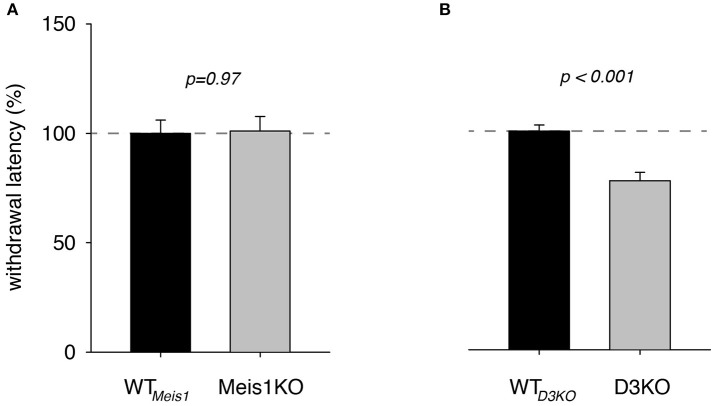
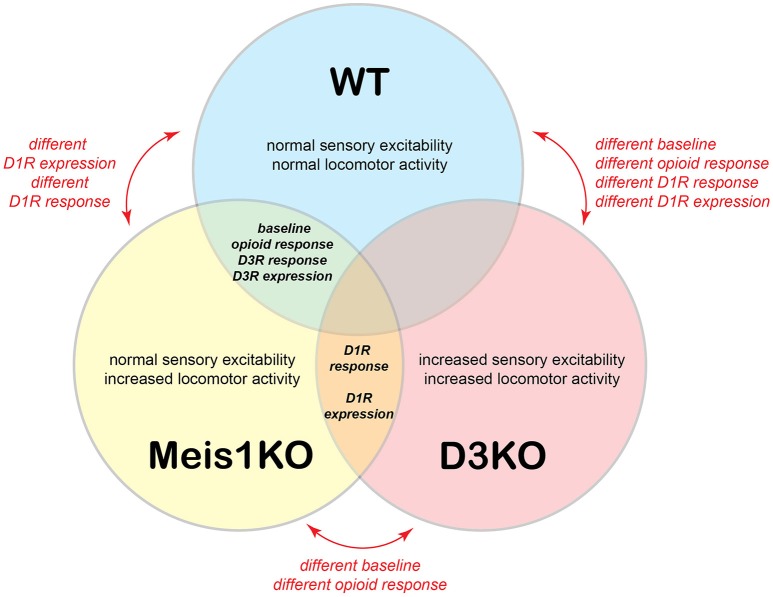
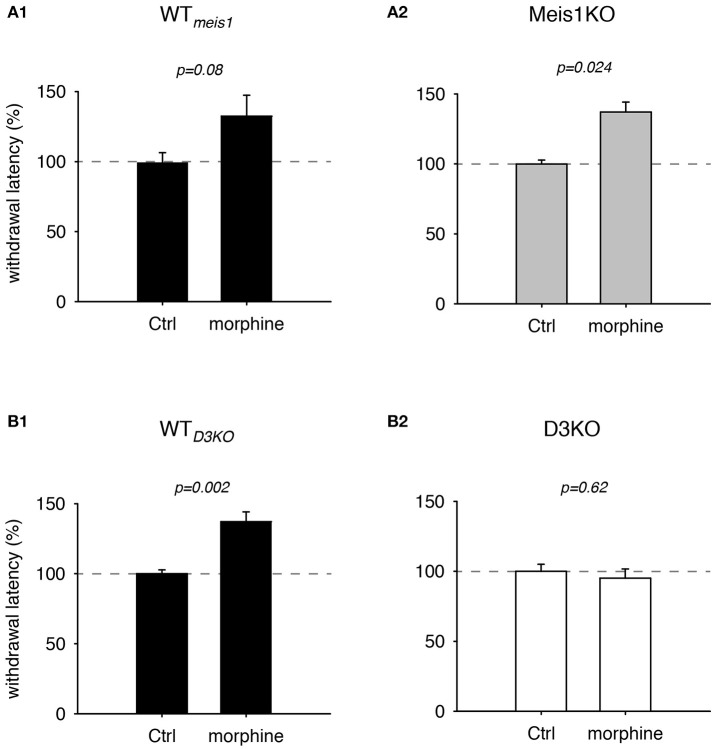
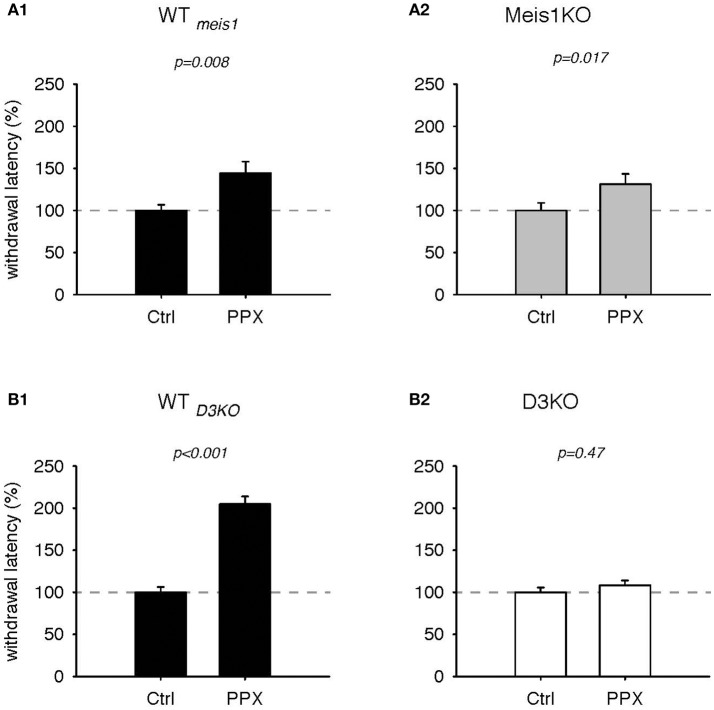
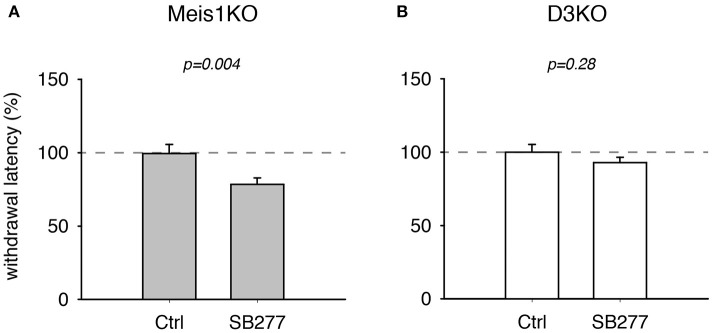
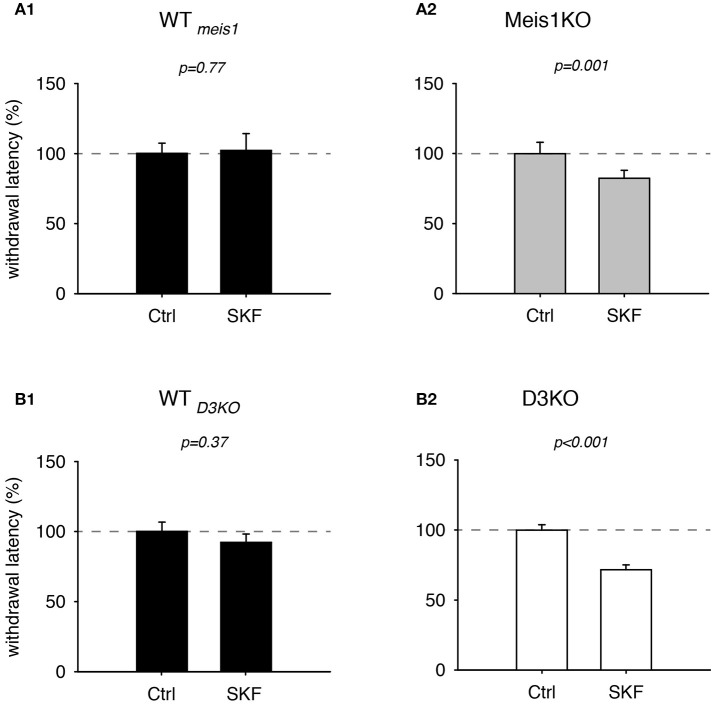
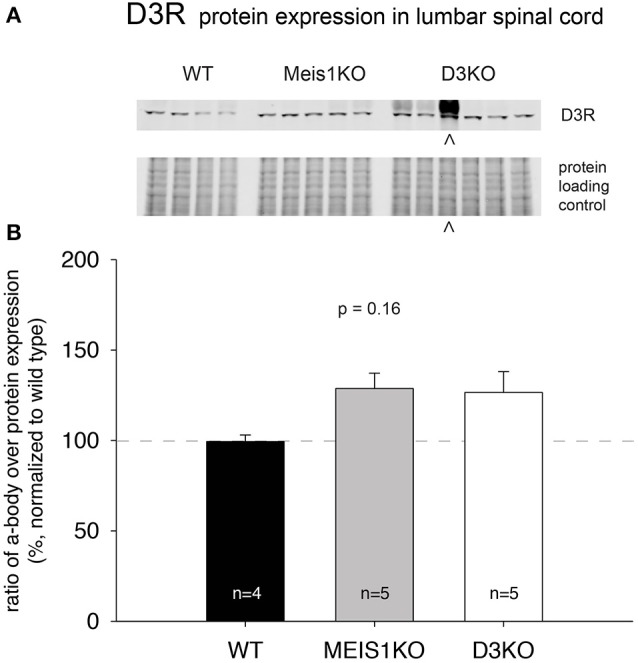
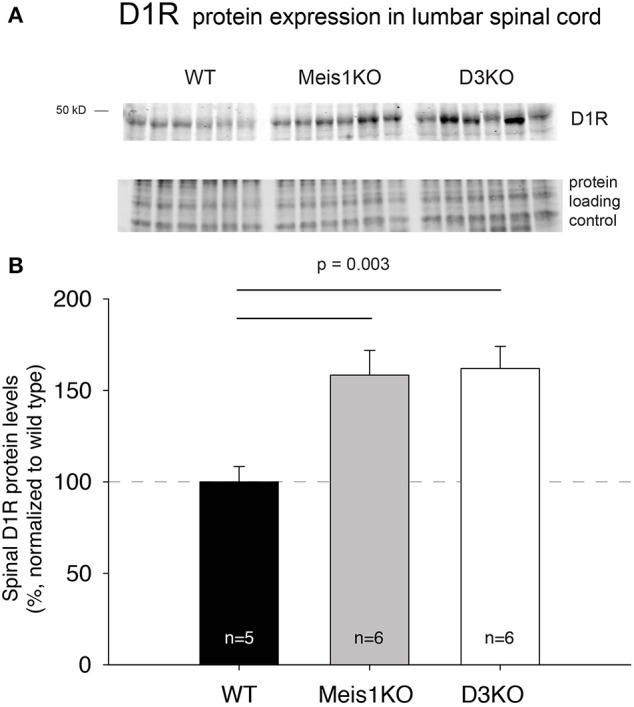
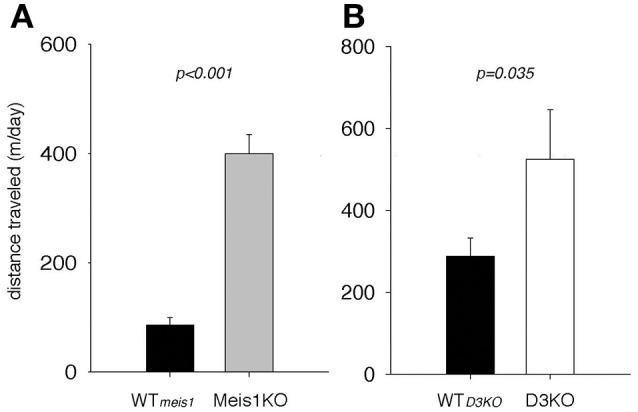
Restless Legs Syndrome (RLS) is often and successfully treated with dopamine receptor agonists that target the inhibitory D3 receptor subtype, however there is no clinical evidence of a D3 receptor dysfunction in RLS patients. In contrast, genome-wide association studies in RLS patients have established that a mutation of the gene is associated with an increased risk in developing RLS, but the effect of dysfunction on sensorimotor function remain unknown. Mouse models for a dysfunctional D3 receptor (D3KO) and Meis1 (Meis1KO) were developed independently, and each animal expresses some features associated with RLS in the clinic, but they have not been compared in their responsiveness to treatment options used in the clinic. We here confirm that D3KO and Meis1KO animals show increased locomotor activities, but that only D3KO show an increased sensory excitability to thermal stimuli. Next we compared the effects of dopaminergics and opioids in both animal models, and we assessed D1 and D3 dopamine receptor expression in the spinal cord, the gateway for sensorimotor processing. We found that Meis1KO share most of the tested behavioral properties with their wild type (WT) controls, including the modulation of the thermal pain withdrawal reflex by morphine, L-DOPA and D3 receptor (D3R) agonists and antagonists. However, Meis1KO and D3KO were behaviorally more similar to each other than to WT when tested with D1 receptor (D1R) agonists and antagonists. Subsequent Western blot analyses of D1R and D3R protein expression in the spinal cord revealed a significant increase in D1R but not D3R expression in Meis1KO and D3KO over WT controls. As the D3R is mostly present in the dorsal spinal cord where it has been shown to modulate sensory pathways, while activation of the D1Rs can activate motoneurons in the ventral spinal cord, we speculate that D3KO and Meis1KO represent two complementary animal models for RLS, in which the mechanisms of sensory (D3R-mediated) and motor (D1R-mediated) dysfunctions can be differentially explored.
不安腿综合征(RLS)通常使用靶向抑制性D3受体亚型的多巴胺受体激动剂进行成功治疗,然而,尚无临床证据表明RLS患者存在D3受体功能障碍。相比之下,对RLS患者进行的全基因组关联研究已证实,该基因突变与患RLS风险增加相关,但该功能障碍对感觉运动功能的影响仍不清楚。分别建立了D3受体功能失调(D3KO)和Meis1(Meis1KO)的小鼠模型,每只动物都表现出一些临床上与RLS相关的特征,但尚未对它们对临床所用治疗方案的反应性进行比较。我们在此证实,D3KO和Meis1KO动物的自发活动增加,但只有D3KO对热刺激的感觉兴奋性增加。接下来,我们比较了多巴胺能药物和阿片类药物在两种动物模型中的作用,并评估了脊髓中D1和D3多巴胺受体的表达,脊髓是感觉运动处理的通道。我们发现,Meis1KO与其野生型(WT)对照具有大多数测试的行为特性,包括吗啡、左旋多巴和D3受体(D3R)激动剂及拮抗剂对热痛退缩反射的调节。然而,在用D1受体(D1R)激动剂和拮抗剂进行测试时,Meis1KO和D3KO在行为上彼此比与WT更相似。随后对脊髓中D1R和D3R蛋白表达进行的蛋白质印迹分析显示,与WT对照相比,Meis1KO和D3KO中D1R表达显著增加,而D3R表达未增加。由于D3R主要存在于脊髓背侧,已证明它可调节感觉通路,而D1R的激活可激活脊髓腹侧的运动神经元,我们推测D3KO和Meis1KO代表RLS的两种互补动物模型,其中感觉(D3R介导)和运动(D1R介导)功能障碍的机制可进行差异探索。