Biotech Research and Innovation Centre, University of Copenhagen, Ole Maaløes Vej 5, DK-2200 Copenhagen N, Denmark.
Biomolecules. 2012 Nov 30;2(4):579-607. doi: 10.3390/biom2040579.
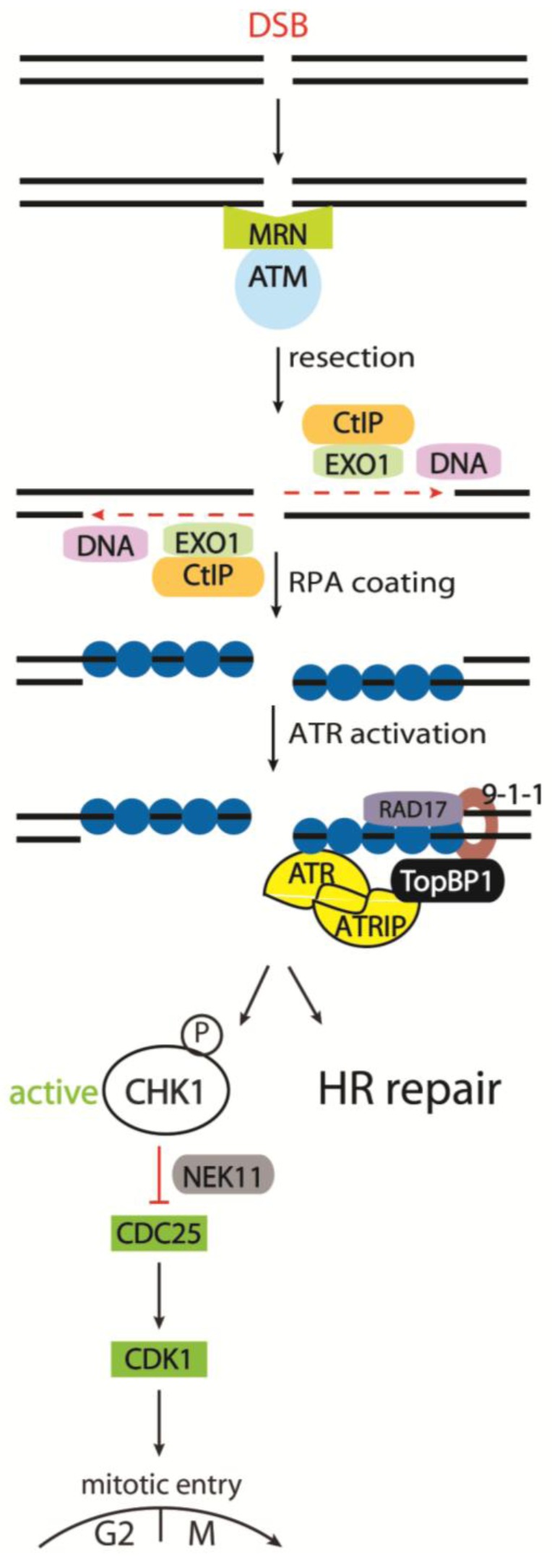
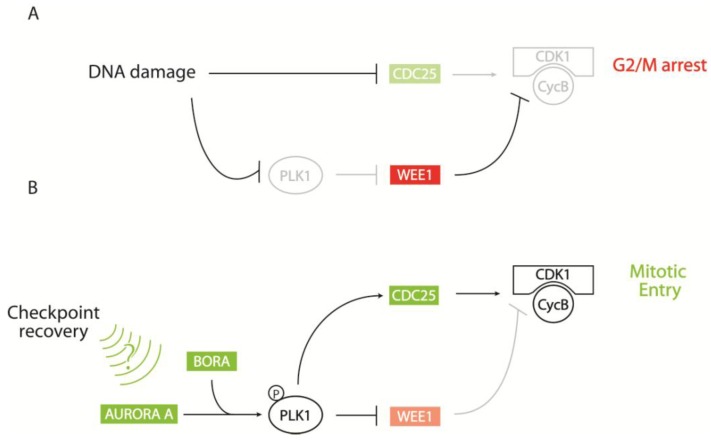
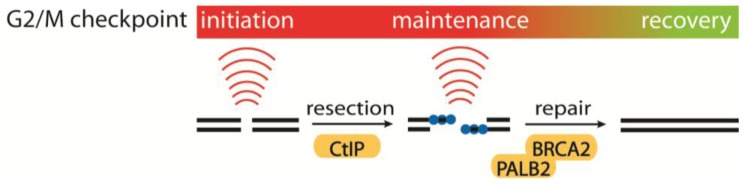
The maintenance of genome integrity is important for normal cellular functions, organism development and the prevention of diseases, such as cancer. Cellular pathways respond immediately to DNA breaks leading to the initiation of a multi-facetted DNA damage response, which leads to DNA repair and cell cycle arrest. Cell cycle checkpoints provide the cell time to complete replication and repair the DNA damage before it can continue to the next cell cycle phase. The G2/M checkpoint plays an especially important role in ensuring the propagation of error-free copies of the genome to each daughter cell. Here, we review recent progress in our understanding of DNA repair and checkpoint pathways in late S and G2 phases. This review will first describe the current understanding of normal cell cycle progression through G2 phase to mitosis. It will also discuss the DNA damage response including cell cycle checkpoint control and DNA double-strand break repair. Finally, we discuss the emerging concept that DNA repair pathways play a major role in the G2/M checkpoint pathway thereby blocking cell division as long as DNA lesions are present.
基因组完整性的维持对于正常的细胞功能、生物体发育和疾病预防(如癌症)非常重要。细胞途径会立即对 DNA 断裂做出反应,从而启动多方面的 DNA 损伤反应,导致 DNA 修复和细胞周期停滞。细胞周期检查点为细胞提供时间,在其进入下一个细胞周期阶段之前,完成复制并修复 DNA 损伤。G2/M 检查点在确保基因组的无差错副本传递到每个子细胞方面起着特别重要的作用。在这里,我们回顾了最近在理解晚期 S 期和 G2 期的 DNA 修复和检查点途径方面的进展。这篇综述首先将描述通过 G2 期到有丝分裂的正常细胞周期进程的最新理解。它还将讨论 DNA 损伤反应,包括细胞周期检查点控制和 DNA 双链断裂修复。最后,我们讨论了一个新兴的概念,即 DNA 修复途径在 G2/M 检查点途径中起着主要作用,只要存在 DNA 损伤,就会阻止细胞分裂。