Darmstadt University of Technology, Radiation Biology and DNA Repair, Darmstadt, Germany.
Crit Rev Biochem Mol Biol. 2011 Aug;46(4):271-83. doi: 10.3109/10409238.2011.575764. Epub 2011 Apr 27.
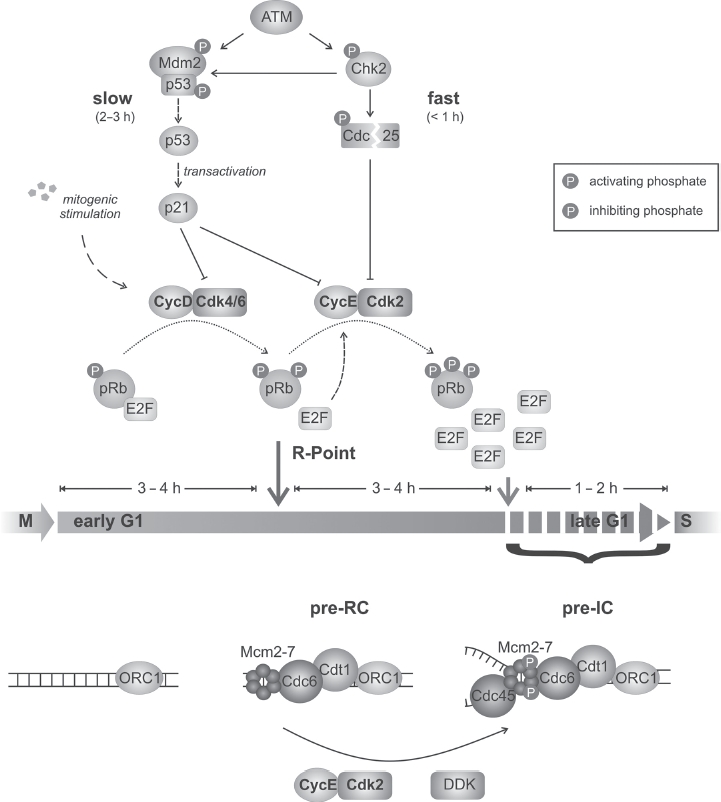
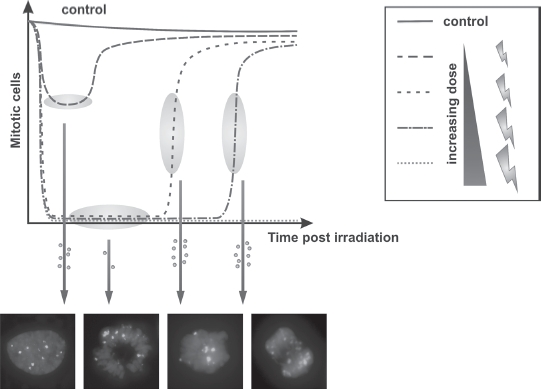
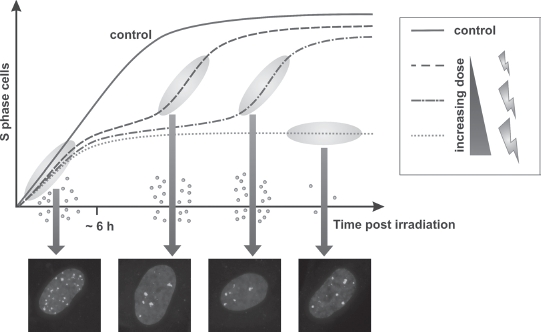
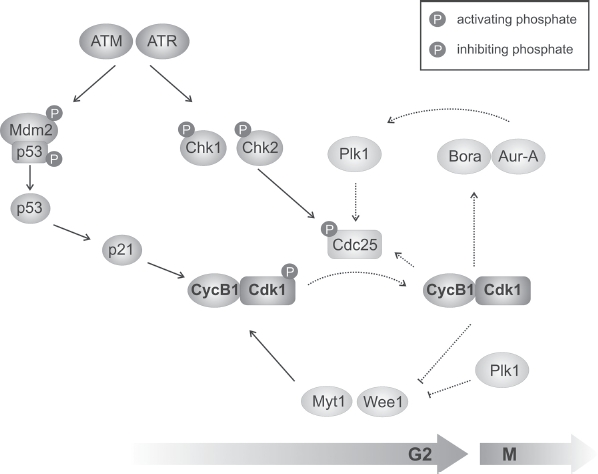
The DNA damage response pathways involve processes of double-strand break (DSB) repair and cell cycle checkpoint control to prevent or limit entry into S phase or mitosis in the presence of unrepaired damage. Checkpoints can function to permanently remove damaged cells from the actively proliferating population but can also halt the cell cycle temporarily to provide time for the repair of DSBs. Although efficient in their ability to limit genomic instability, checkpoints are not foolproof but carry inherent limitations. Recent work has demonstrated that the G1/S checkpoint is slowly activated and allows cells to enter S phase in the presence of unrepaired DSBs for about 4-6 h post irradiation. During this time, only a slowing but not abolition of S-phase entry is observed. The G2/M checkpoint, in contrast, is quickly activated but only responds to a level of 10-20 DSBs such that cells with a low number of DSBs do not initiate the checkpoint or terminate arrest before repair is complete. Here, we discuss the limitations of these checkpoints in the context of the current knowledge of the factors involved. We suggest that the time needed to fully activate G1/S arrest reflects the existence of a restriction point in G1-phase progression. This point has previously been defined as the point when mitogen starvation fails to prevent cells from entering S phase. However, cells that passed the restriction point can respond to DSBs, albeit with reduced efficiency.
DNA 损伤反应途径涉及双链断裂 (DSB) 修复和细胞周期检查点控制过程,以防止或限制在未修复损伤存在的情况下进入 S 期或有丝分裂期。检查点可以永久地将受损细胞从活跃增殖的群体中去除,但也可以暂时停止细胞周期,为 DSB 的修复提供时间。尽管在限制基因组不稳定性方面非常有效,但检查点并非万无一失,而是存在固有局限性。最近的工作表明,G1/S 检查点的激活速度较慢,允许细胞在照射后约 4-6 小时内未修复的 DSB 存在的情况下进入 S 期。在此期间,只观察到 S 期进入速度减慢,但不会完全停止。相比之下,G2/M 检查点迅速激活,但仅对 10-20 个 DSB 水平做出反应,因此,只有少数 DSB 的细胞不会启动检查点或在修复完成之前终止停滞。在这里,我们根据涉及的因素的现有知识讨论了这些检查点的局限性。我们认为,完全激活 G1/S 停滞所需的时间反映了 G1 期进展中存在限制点。该点以前被定义为丝裂原饥饿阻止细胞进入 S 期的点。然而,已经通过限制点的细胞可以对 DSB 做出反应,尽管效率降低。