von der Heyde Silvia, Bender Christian, Henjes Frauke, Sonntag Johanna, Korf Ulrike, Beißbarth Tim
Statistical Bioinformatics, Department of Medical Statistics, University Medical Center Göttingen, Humboldtallee 32, 37073 Göttingen, Germany.
BMC Syst Biol. 2014 Jun 25;8:75. doi: 10.1186/1752-0509-8-75.
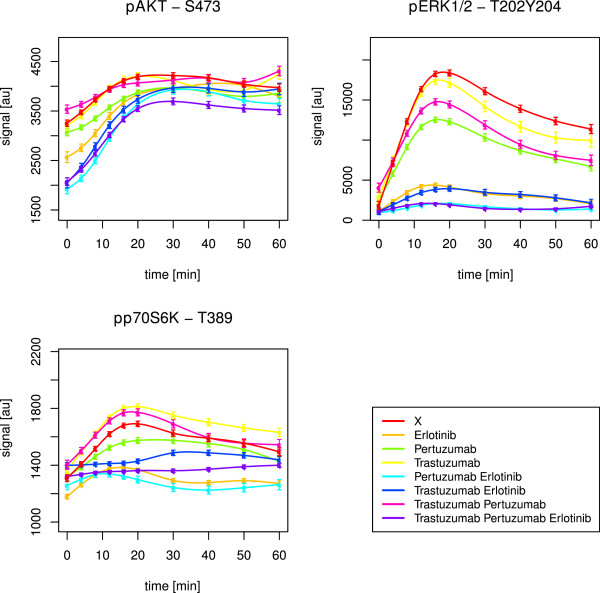
Despite promising progress in targeted breast cancer therapy, drug resistance remains challenging. The monoclonal antibody drugs trastuzumab and pertuzumab as well as the small molecule inhibitor erlotinib were designed to prevent ErbB-2 and ErbB-1 receptor induced deregulated protein signalling, contributing to tumour progression. The oncogenic potential of ErbB receptors unfolds in case of overexpression or mutations. Dimerisation with other receptors allows to bypass pathway blockades. Our intention is to reconstruct the ErbB network to reveal resistance mechanisms. We used longitudinal proteomic data of ErbB receptors and downstream targets in the ErbB-2 amplified breast cancer cell lines BT474, SKBR3 and HCC1954 treated with erlotinib, trastuzumab or pertuzumab, alone or combined, up to 60 minutes and 30 hours, respectively. In a Boolean modelling approach, signalling networks were reconstructed based on these data in a cell line and time course specific manner, including prior literature knowledge. Finally, we simulated network response to inhibitor combinations to detect signalling nodes reflecting growth inhibition.
The networks pointed to cell line specific activation patterns of the MAPK and PI3K pathway. In BT474, the PI3K signal route was favoured, while in SKBR3, novel edges highlighted MAPK signalling. In HCC1954, the inferred edges stimulated both pathways. For example, we uncovered feedback loops amplifying PI3K signalling, in line with the known trastuzumab resistance of this cell line. In the perturbation simulations on the short-term networks, we analysed ERK1/2, AKT and p70S6K. The results indicated a pathway specific drug response, driven by the type of growth factor stimulus. HCC1954 revealed an edgetic type of PIK3CA-mutation, contributing to trastuzumab inefficacy. Drug impact on the AKT and ERK1/2 signalling axes is mirrored by effects on RB and RPS6, relating to phenotypic events like cell growth or proliferation. Therefore, we additionally analysed RB and RPS6 in the long-term networks.
We derived protein interaction models for three breast cancer cell lines. Changes compared to the common reference network hint towards individual characteristics and potential drug resistance mechanisms. Simulation of perturbations were consistent with the experimental data, confirming our combined reverse and forward engineering approach as valuable for drug discovery and personalised medicine.
尽管在靶向乳腺癌治疗方面取得了令人鼓舞的进展,但耐药性仍然是一个挑战。单克隆抗体药物曲妥珠单抗和帕妥珠单抗以及小分子抑制剂厄洛替尼旨在防止ErbB-2和ErbB-1受体诱导的蛋白信号失调,这会促进肿瘤进展。ErbB受体的致癌潜力在过表达或突变的情况下会显现出来。与其他受体二聚化可绕过通路阻断。我们的目的是重建ErbB网络以揭示耐药机制。我们使用了ErbB-2扩增的乳腺癌细胞系BT474、SKBR3和HCC1954中ErbB受体及其下游靶点的纵向蛋白质组学数据,这些细胞系分别用厄洛替尼、曲妥珠单抗或帕妥珠单抗单独或联合处理,处理时间分别长达60分钟和30小时。在布尔建模方法中,基于这些数据以细胞系和时间进程特异性的方式重建信号网络,包括先前的文献知识。最后,我们模拟网络对抑制剂组合的反应以检测反映生长抑制的信号节点。
这些网络指出了MAPK和PI3K通路的细胞系特异性激活模式。在BT474中,PI3K信号通路更受青睐,而在SKBR3中,新的边突出了MAPK信号传导。在HCC1954中,推断出的边刺激了这两条通路。例如,我们发现了放大PI3K信号传导的反馈回路,这与该细胞系已知的曲妥珠单抗耐药性一致。在短期网络的扰动模拟中,我们分析了ERK1/2、AKT和p70S6K。结果表明了由生长因子刺激类型驱动的通路特异性药物反应。HCC1954显示出一种PIK3CA突变的边类型,这导致了曲妥珠单抗无效。药物对AKT和ERK1/2信号轴的影响通过对RB和RPS6的影响反映出来,这与细胞生长或增殖等表型事件相关。因此,我们在长期网络中额外分析了RB和RPS6。
我们推导了三种乳腺癌细胞系的蛋白质相互作用模型。与共同参考网络相比的变化暗示了个体特征和潜在的耐药机制。扰动模拟与实验数据一致,证实了我们的反向和正向工程相结合的方法对药物发现和个性化医疗具有重要价值。