Li Xiaoyun, Lu Jiabao, Liu Shuai, Liu Xu, Lin Yingying, Li Ling
Guangdong Provincial Key Lab of Biotechnology for Plant Development, College of Life Science, South China Normal University, Guangzhou 510631, P R China.
BMC Biotechnol. 2014 Jun 26;14:58. doi: 10.1186/1472-6750-14-58.
Peanut (Arachis hypogaea) is an important crop, but droughts often affect peanut production. There is a lack of genomic information available for peanut; therefore, little is known about the molecular basis of its drought stress response.
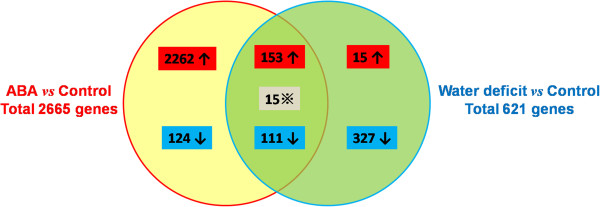
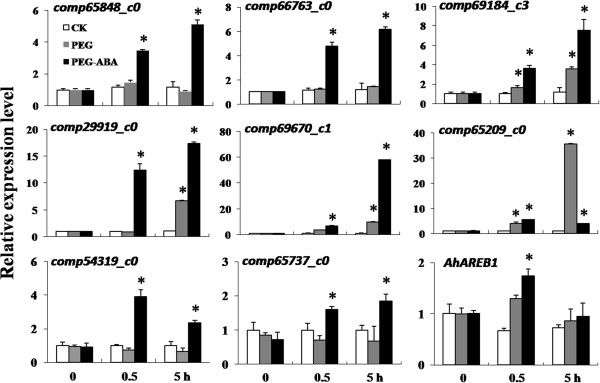
Previously, we found that peanut stomata close rapidly during water deficit and in response to abscisic acid (ABA) treatment, and many genes show changes in their expression levels. To screen for candidate genes involved in the water deficit response, we used the Illumina HiSeq2000/MiSeq sequencing platform to conduct a global transcriptome analysis of peanut seedlings under water deficit with or without an ABA pretreatment. Three peanut tissues (leaves, roots, and stems) collected at each of three developmental stages (four-leaf, flowering, and podding stages) were used to construct sequence libraries. Then, 4.96 × 10⁷ raw sequence reads were generated and the high quality reads were assembled into 47,842 unigenes. We analyzed these sequence libraries to identify differentially expressed genes (DEGs) under water deficit with or without ABA pretreatment. In total, 621 genes were induced rapidly (≥1.5 fold change compared with control) under water deficit, 2,665 genes were induced rapidly under water deficit + ABA pretreatment, and 279 genes overlapped between water deficit and water deficit + ABA pretreatment. Of the 279 overlapping genes, 264 showed the same expression pattern and 15 showed opposite expression patterns. Among the DEGs, 257 were highly induced (>5 fold) by water deficit + ABA pretreatment, while 19 were highly induced (>5 fold) by water deficit alone. The genes induced under water deficit + ABA pretreatment included 100 putative transcription factor (TF) genes, while those induced under water deficit alone included only 22 putative TF genes. To validate the transcriptome results, we conducted quantitative PCR (qPCR) analyses to quantify the transcript levels of nine candidate genes.
The DEGs results show that many genes are rapidly induced in peanut in response to water deficit without or with ABA pretreatment. The results indicate that the main drought response mechanisms in peanut function through an ABA-dependent pathway. Our data provide a comprehensive sequence resource for molecular genetics research on peanut stress responses.
花生(Arachis hypogaea)是一种重要的作物,但干旱常常影响花生产量。目前缺乏花生的基因组信息,因此,对其干旱胁迫响应的分子基础了解甚少。
此前,我们发现花生气孔在水分亏缺期间以及对脱落酸(ABA)处理时会迅速关闭,并且许多基因的表达水平发生变化。为了筛选参与水分亏缺响应的候选基因,我们使用Illumina HiSeq2000/MiSeq测序平台对经过或未经过ABA预处理的水分亏缺条件下的花生幼苗进行了全转录组分析。在三个发育阶段(四叶期、开花期和结荚期)的每个阶段收集的三种花生组织(叶、根和茎)用于构建序列文库。然后,产生了4.96×10⁷条原始序列读数,高质量读数被组装成47,842个单基因。我们分析这些序列文库以鉴定在有或没有ABA预处理的水分亏缺条件下差异表达的基因(DEGs)。总共,621个基因在水分亏缺条件下被迅速诱导(与对照相比变化≥1.5倍),2,665个基因在水分亏缺+ABA预处理下被迅速诱导,并且279个基因在水分亏缺和水分亏缺+ABA预处理之间重叠。在这279个重叠基因中,264个显示相同的表达模式,15个显示相反的表达模式。在差异表达基因中,257个在水分亏缺+ABA预处理下被高度诱导(>5倍),而19个仅在水分亏缺下被高度诱导(>5倍)。在水分亏缺+ABA预处理下诱导的基因包括100个假定的转录因子(TF)基因,而仅在水分亏缺下诱导的基因仅包括22个假定的TF基因。为了验证转录组结果,我们进行了定量PCR(qPCR)分析以量化九个候选基因的转录水平。
差异表达基因结果表明,许多基因在花生中对有或没有ABA预处理的水分亏缺迅速作出响应而被诱导。结果表明,花生中的主要干旱响应机制通过ABA依赖途径起作用。我们的数据为花生胁迫响应的分子遗传学研究提供了全面的序列资源。