Ma Dongyun, Ding Huina, Wang Chenyang, Qin Haixia, Han Qiaoxia, Hou Junfeng, Lu Hongfang, Xie Yingxin, Guo Tiancai
National Engineering Research Center for Wheat, Agronomy, Henan Agricultural University, Zhengzhou 450002, China.
The National Key Laboratory of Wheat and Maize Crop Science, Henan Agricultural University, Zhengzhou 450002, China.
PLoS One. 2016 Sep 20;11(9):e0163082. doi: 10.1371/journal.pone.0163082. eCollection 2016.
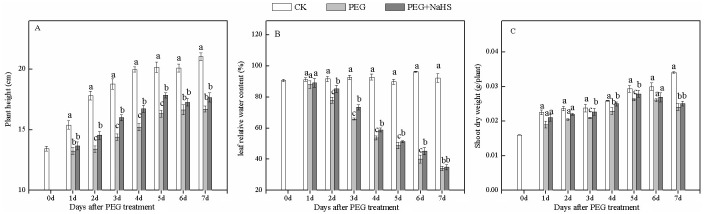
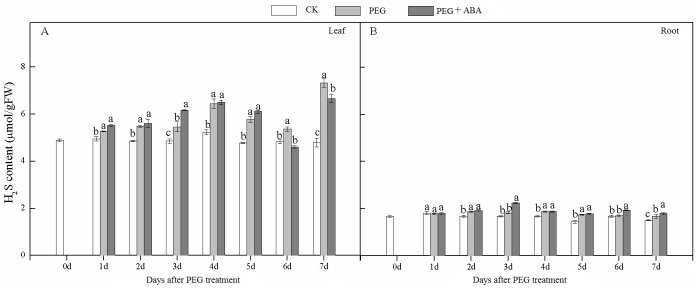
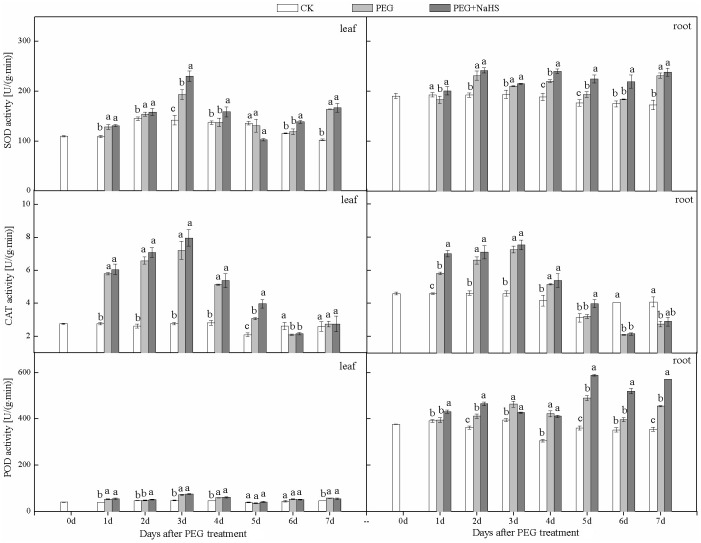
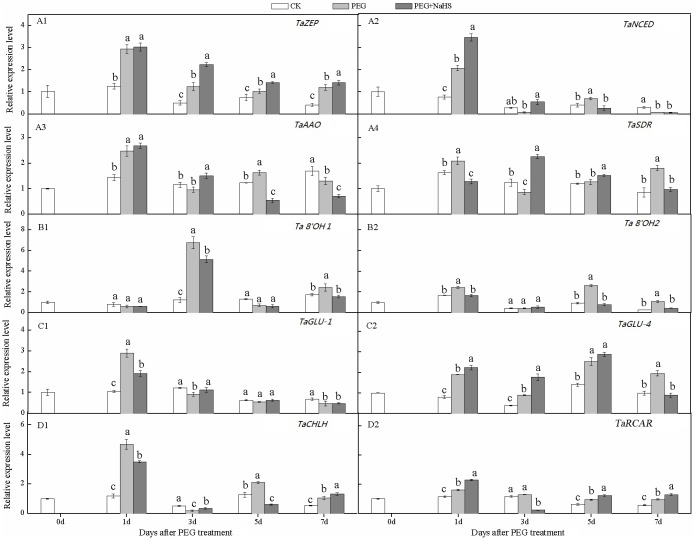
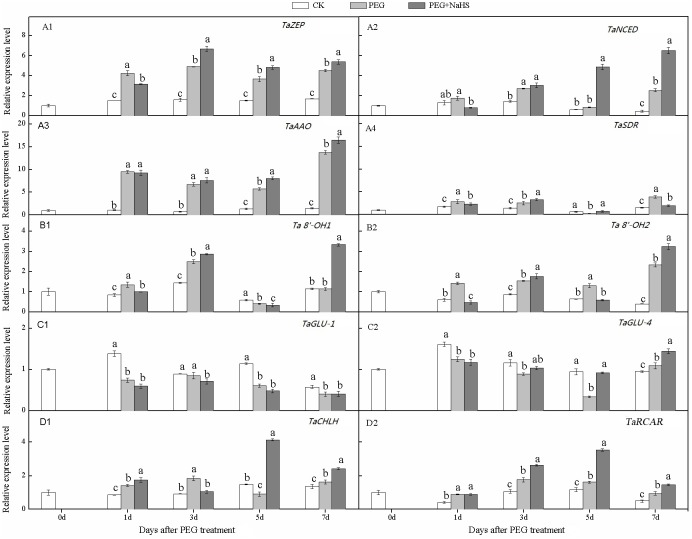
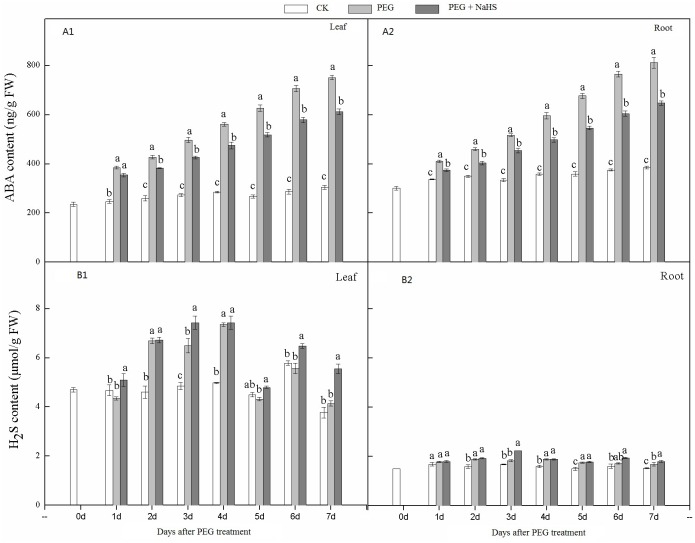
Little information is available describing the effects of exogenous H2S on the ABA pathway in the acquisition of drought tolerance in wheat. In this study, we investigated the physiological parameters, the transcription levels of several genes involved in the abscisic acid (ABA) metabolism pathway, and the ABA and H2S contents in wheat leaves and roots under drought stress in response to exogenous NaHS treatment. The results showed that pretreatment with NaHS significantly increased plant height and the leaf relative water content of seedlings under drought stress. Compared with drought stress treatment alone, H2S application increased antioxidant enzyme activities and reduced MDA and H2O2 contents in both leaves and roots. NaHS pretreatment increased the expression levels of ABA biosynthesis and ABA reactivation genes in leaves; whereas the expression levels of ABA biosynthesis and ABA catabolism genes were up-regulated in roots. These results indicated that ABA participates in drought tolerance induced by exogenous H2S, and that the responses in leaves and roots are different. The transcription levels of genes encoding ABA receptors were up-regulated in response to NaHS pretreatment under drought conditions in both leaves and roots. Correspondingly, the H2S contents in leaves and roots were increased by NaHS pretreatment, while the ABA contents of leaves and roots decreased. This implied that there is complex crosstalk between these two signal molecules, and that the alleviation of drought stress by H2S, at least in part, involves the ABA signaling pathway.
关于外源硫化氢(H2S)对小麦干旱耐受性获得过程中脱落酸(ABA)途径的影响,目前可用信息较少。在本研究中,我们调查了干旱胁迫下,外源硫氢化钠(NaHS)处理对小麦叶片和根系的生理参数、ABA代谢途径中几个相关基因的转录水平以及ABA和H2S含量的影响。结果表明,NaHS预处理显著增加了干旱胁迫下幼苗的株高和叶片相对含水量。与单独的干旱胁迫处理相比,施用H2S提高了叶片和根系中抗氧化酶的活性,并降低了丙二醛(MDA)和过氧化氢(H2O2)的含量。NaHS预处理提高了叶片中ABA生物合成和ABA再激活基因的表达水平;而根系中ABA生物合成和ABA分解代谢基因的表达水平上调。这些结果表明,ABA参与了外源H2S诱导的干旱耐受性,且叶片和根系中的响应有所不同。干旱条件下,NaHS预处理使叶片和根系中编码ABA受体的基因转录水平上调。相应地,NaHS预处理增加了叶片和根系中的H2S含量,而叶片和根系中的ABA含量则降低。这意味着这两种信号分子之间存在复杂的相互作用,且H2S对干旱胁迫的缓解作用至少部分涉及ABA信号通路。