Boyce Maria B, Browne John P, Greenhalgh Joanne
Department of Epidemiology and Public Health, University College Cork, Cork, Ireland.
Implement Sci. 2014 Jun 27;9:84. doi: 10.1186/1748-5908-9-84.
The use of patient-reported outcome measures (PROMs) to provide healthcare professionals with peer benchmarked feedback is growing. However, there is little evidence on the opinions of professionals on the value of this information in practice. The purpose of this research is to explore surgeon's experiences of receiving peer benchmarked PROMs feedback and to examine whether this information led to changes in their practice.
This qualitative research employed a Framework approach. Semi-structured interviews were undertaken with surgeons who received peer benchmarked PROMs feedback. The participants included eleven consultant orthopaedic surgeons in the Republic of Ireland.
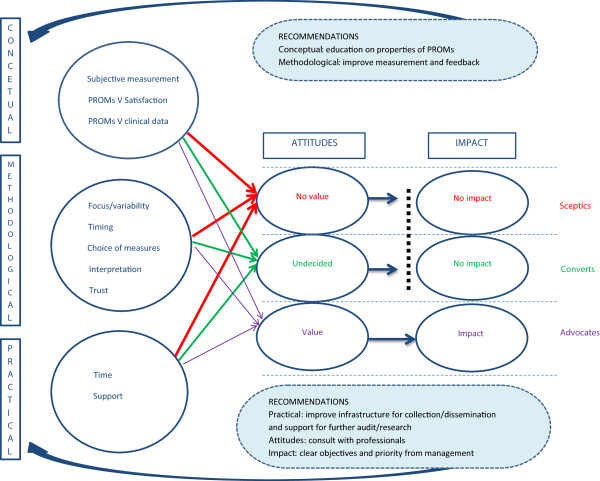
Five themes were identified: conceptual, methodological, practical, attitudinal, and impact. A typology was developed based on the attitudinal and impact themes from which three distinct groups emerged. 'Advocates' had positive attitudes towards PROMs and confirmed that the information promoted a self-reflective process. 'Converts' were uncertain about the value of PROMs, which reduced their inclination to use the data. 'Sceptics' had negative attitudes towards PROMs and claimed that the information had no impact on their behaviour. The conceptual, methodological and practical factors were linked to the typology.
Surgeons had mixed opinions on the value of peer benchmarked PROMs data. Many appreciated the feedback as it reassured them that their practice was similar to their peers. However, PROMs information alone was considered insufficient to help identify opportunities for quality improvements. The reasons for the observed reluctance of participants to embrace PROMs can be categorised into conceptual, methodological, and practical factors. Policy makers and researchers need to increase professionals' awareness of the numerous purposes and benefits of using PROMs, challenge the current methods to measure performance using PROMs, and reduce the burden of data collection and information dissemination on routine practice.
使用患者报告结局测量指标(PROMs)为医疗保健专业人员提供同行基准反馈的做法日益普遍。然而,关于专业人员对该信息在实际应用中的价值的看法,几乎没有证据。本研究的目的是探讨外科医生接受同行基准PROMs反馈的经历,并检查该信息是否导致他们的实践发生改变。
本定性研究采用框架法。对接受同行基准PROMs反馈的外科医生进行了半结构化访谈。参与者包括爱尔兰共和国的11名骨科顾问外科医生。
确定了五个主题:概念、方法、实践、态度和影响。基于态度和影响主题开发了一种类型学,从中出现了三个不同的群体。“倡导者”对PROMs持积极态度,并确认该信息促进了自我反思过程。“转变者”对PROMs的价值不确定,这降低了他们使用数据的倾向。“怀疑者”对PROMs持消极态度,并声称该信息对他们的行为没有影响。概念、方法和实践因素与该类型学相关。
外科医生对同行基准PROMs数据的价值看法不一。许多人赞赏这种反馈,因为它让他们放心,自己的实践与同行相似。然而,仅PROMs信息被认为不足以帮助识别质量改进的机会。观察到的参与者不愿接受PROMs的原因可分为概念、方法和实践因素。政策制定者和研究人员需要提高专业人员对使用PROMs的众多目的和益处的认识,挑战当前使用PROMs衡量绩效的方法,并减轻日常实践中数据收集和信息传播的负担。