Tang Cuong Q, Obertegger Ulrike, Fontaneto Diego, Barraclough Timothy G
Department of Life Sciences, Imperial College London, Ascot, Berkshire, SL5 7PY, United Kingdom.
Evolution. 2014 Oct;68(10):2901-16. doi: 10.1111/evo.12483. Epub 2014 Jul 25.
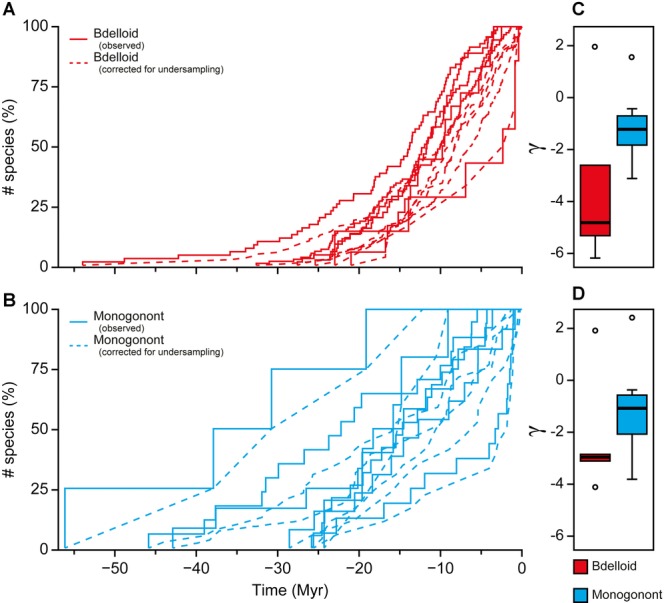
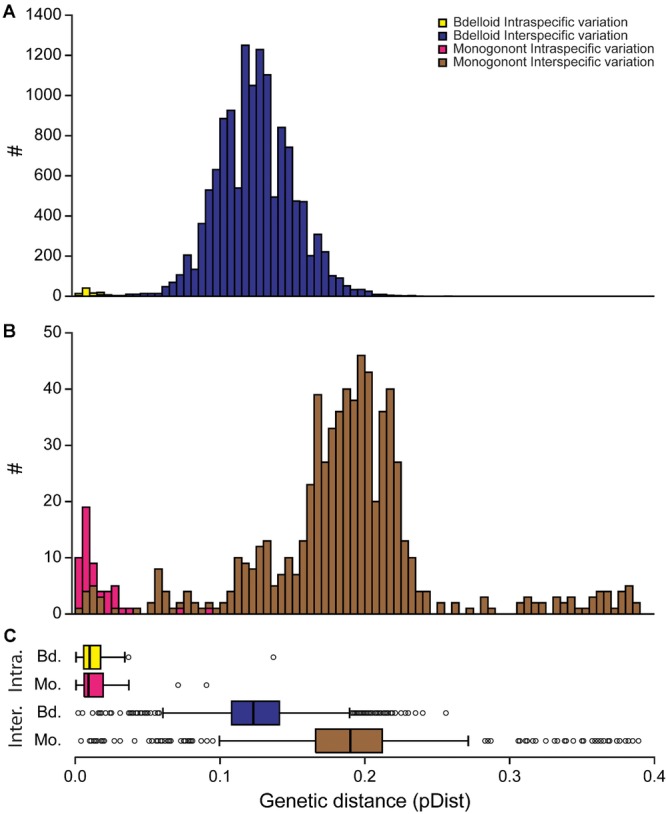
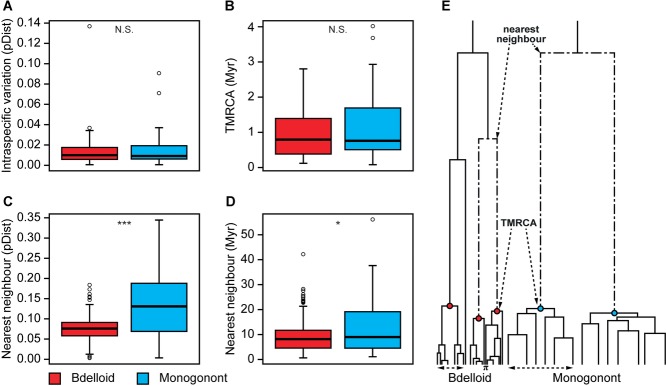
Why organisms diversify into discrete species instead of showing a continuum of genotypic and phenotypic forms is an important yet rarely studied question in speciation biology. Does species discreteness come from adaptation to fill discrete niches or from interspecific gaps generated by reproductive isolation? We investigate the importance of reproductive isolation by comparing genetic discreteness, in terms of intra- and interspecific variation, between facultatively sexual monogonont rotifers and obligately asexual bdelloid rotifers. We calculated the age (phylogenetic distance) and average pairwise genetic distance (raw distance) within and among evolutionarily significant units of diversity in six bdelloid clades and seven monogonont clades sampled for 4211 individuals in total. We find that monogonont species are more discrete than bdelloid species with respect to divergence between species but exhibit similar levels of intraspecific variation (species cohesiveness). This pattern arises because bdelloids have diversified into discrete genetic clusters at a faster net rate than monogononts. Although sampling biases or differences in ecology that are independent of sexuality might also affect these patterns, the results are consistent with the hypothesis that bdelloids diversified at a faster rate into less discrete species because their diversification does not depend on the evolution of reproductive isolation.
为何生物体会分化成离散的物种,而非呈现出基因型和表型的连续体,这是物种形成生物学中一个重要却鲜少被研究的问题。物种的离散性是源于对离散生态位的适应,还是源于生殖隔离产生的种间间隙呢?我们通过比较兼性有性的单巢轮虫和专性无性的蛭形轮虫在种内和种间变异方面的遗传离散性,来研究生殖隔离的重要性。我们计算了总共对4211个个体进行采样的六个蛭形轮虫分支和七个单巢轮虫分支中,多样性的进化显著单元内部和之间的年龄(系统发育距离)以及平均成对遗传距离(原始距离)。我们发现,就物种间的分歧而言,单巢轮虫物种比蛭形轮虫物种更离散,但种内变异水平(物种凝聚力)相似。这种模式的出现是因为蛭形轮虫以比单巢轮虫更快的净速率分化成离散的基因簇。尽管与有性生殖无关的采样偏差或生态差异也可能影响这些模式,但结果与以下假设一致:蛭形轮虫以更快的速率分化成离散性较低的物种,因为它们的分化不依赖于生殖隔离的进化。