Division of Molecular Neurobiology, Institute for Enzyme Research, The University of Tokushima, Kuramoto-cho, Tokushima 770-8503, Japan.
Division of Enzyme Chemistry, Institute for Enzyme Research, The University of Tokushima, Kuramoto-cho, Tokushima 770-8503, Japan.
Cancer Cell Int. 2014 Jun 20;14:56. doi: 10.1186/1475-2867-14-56. eCollection 2014.
In general, growth and differentiation are mutually exclusive but are cooperatively regulated throughout development. Thus, the process of a cell's switching from growth to differentiation is of great importance not only for the development of organisms but also for malignant transformation, in which this process is reversed. We have previously demonstrated using a Dictyostelium model system that the Dictyostelium mitochondrial ribosomal protein S4 (Dd-mrp4) gene expression is essential for the initiation of cell differentiation: Dd-mrp4-null cells fail to initiate differentiation, while the initial step of cell differentiation and the subsequent morphogenesis are markedly enhanced in mrp4 (OE) cells overexpressing the Dd-mrp4 in the extramitochondrial cytoplasm. This raised a possibility that the ectopically enforced expression of the Dd-mrp4 in human cells might inhibit their growth, particularly of malignant tumor cells, by inducing cell differentiation.
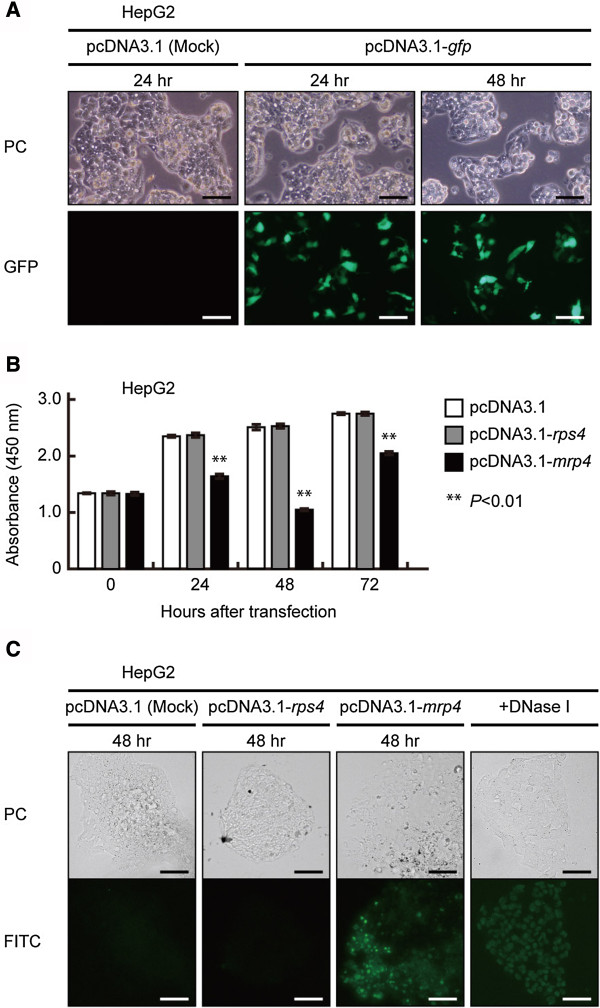
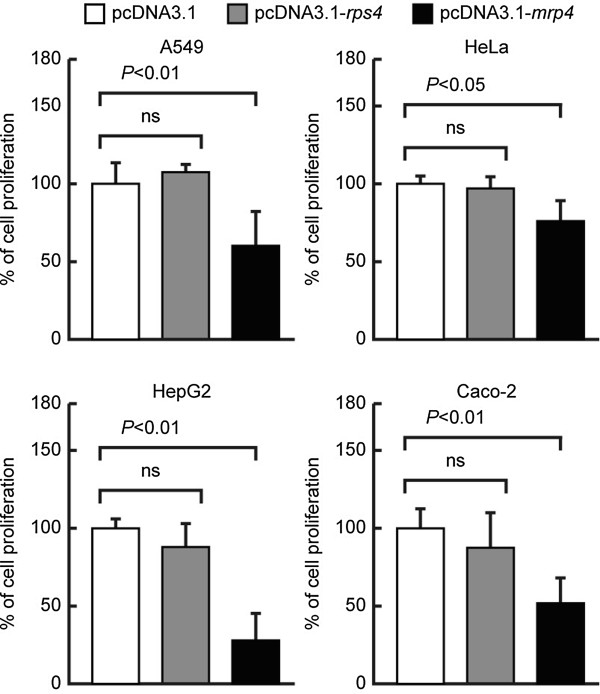
FOUR KINDS OF HUMAN TUMOR CELL LINES WERE TRANSFECTED BY THREE KIND OF VECTOR CONSTRUCTS (THE EMPTY VECTOR: pcDNA3.1 (Mock); pcDNA3.1-rps4 bearing Dictyostelium cytoplasmic ribosomal protein S4; pcDNA3.1-mrp4 bearing Dictyostelium mitochondrial ribosomal protein S4). As controls, four kinds of human primary cultured cells were similarly transfected by the above vector constructs. After transfection, growth kinetics of cells was analyzed using cell viability assay, and also the TUNEL method was used for evaluation of apoptotic cells.
Ectopically expressed Dd-mrp4 suppressed cell proliferation through inducing apoptotic cell death specifically in the human lung adenocarcinoma (A549), epithelial cervical cancer (HeLa), hepatocellular carcinoma (HepG2) and colonic carcinoma (Caco-2), but not in primary cultured normal cells, such as human brain microvascular endothelial cells (HBMECs); human umbilical vein endothelial cells (HUVECs) and human normal hepatocytes (hHeps™), with one exception (human cardiac fibloblasts (HCF)).
The present finding that the ectopically enforced expression of Dd-mrp4 in human several tumor cell lines specifically suppresses their proliferation suggests strongly that the Dd-mrp4 gene derived from Dictyostelium mitochondria may provide a new promising therapeutic strategy for disrupting cell viability pathways in human cancers.
一般来说,生长和分化是相互排斥的,但在整个发育过程中是协同调节的。因此,细胞从生长到分化的转变过程不仅对生物体的发育很重要,而且对恶性转化也很重要,在恶性转化中,这个过程是逆转的。我们之前曾使用粘菌模型系统证明,粘菌线粒体核糖体蛋白 S4(Dd-mrp4)基因的表达对于细胞分化的启动是必不可少的:Dd-mrp4 缺失细胞不能启动分化,而在细胞质中外源表达 Dd-mrp4 的 mrp4(OE)细胞中,细胞分化的初始步骤和随后的形态发生明显增强。这就提出了一种可能性,即外源强制表达人源细胞中的 Dd-mrp4 可能通过诱导细胞分化来抑制其生长,特别是恶性肿瘤细胞的生长。
四种人肿瘤细胞系通过三种载体构建体(空载体:pcDNA3.1(Mock);携带粘菌细胞质核糖体蛋白 S4 的 pcDNA3.1-rps4;携带粘菌线粒体核糖体蛋白 S4 的 pcDNA3.1-mrp4)进行转染。作为对照,四种人原代培养细胞也通过上述载体构建体进行类似转染。转染后,通过细胞活力测定分析细胞的生长动力学,并使用 TUNEL 法评估凋亡细胞。
外源表达的 Dd-mrp4 通过诱导凋亡性细胞死亡特异性抑制人肺腺癌(A549)、上皮宫颈癌(HeLa)、肝癌(HepG2)和结肠癌(Caco-2)的细胞增殖,但不抑制原代培养的正常细胞,如人脑微血管内皮细胞(HBMECs);人脐静脉内皮细胞(HUVECs)和人正常肝细胞(hHeps™),除了一个例外(人心肌成纤维细胞(HCF))。
本研究发现,外源强制表达 Dd-mrp4 可特异性抑制人几种肿瘤细胞系的增殖,这强烈表明,来源于粘菌线粒体的 Dd-mrp4 基因可能为破坏人类癌症中的细胞存活途径提供一种新的有前途的治疗策略。