Department of Physiology, Federal University of Sergipe, São Cristóvão, SE, Brazil.
Department of Pharmacy, Federal University of Sergipe, São Cristóvão, SE, Brazil.
Evid Based Complement Alternat Med. 2014;2014:960258. doi: 10.1155/2014/960258. Epub 2014 May 26.
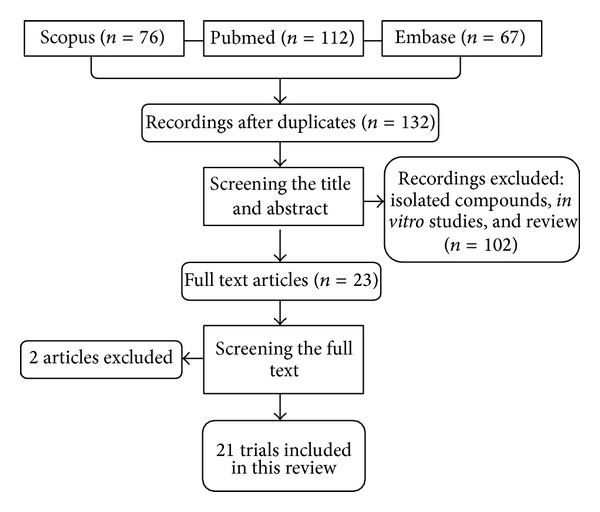
Background. Clusiaceae family (sensu lato) is extensively used in ethnomedicine for treating a number of disease conditions which include cancer, inflammation, and infection. The aim of this review is to report the pharmacological potential of plants of Clusiaceae family with the anti-inflammatory activity in animal experiments. Methods. A systematic review about experiments investigating anti-inflammatory activity of Clusiaceae family was carried out by searching bibliographic databases such as Medline, Scopus and Embase. In this update, the search terms were "anti-inflammatory agents," "Clusiaceae," and "animals, laboratory." Results. A total of 255 publications with plants this family were identified. From the initial 255 studies, a total of 21 studies were selected for the final analysis. Studies with genera Allanblackia, Clusia, Garcinia or Rheedia, and Hypericum showed significant anti-inflammatory activity. The findings include a decrease of total leukocytes, a number of neutrophils, total protein concentration, granuloma formation, and paw or ear edema formation. Other interesting findings included decreased of the MPO activity, and inflammatory mediators such as NF- κ B and iNOS expression, PGE2 and Il-1 β levels and a decrease in chronic inflammation. Conclusion. The data reported suggests the anti-inflammatory effect potential of Clusiaceae family in animal experiments.
藤黄科(广义)家族广泛应用于民族医学,用于治疗多种疾病,包括癌症、炎症和感染。本综述旨在报告具有抗炎活性的藤黄科植物在动物实验中的药理学潜力。
通过检索 Medline、Scopus 和 Embase 等文献数据库,对调查藤黄科植物抗炎活性的实验进行了系统评价。在本次更新中,搜索词为“抗炎药”、“藤黄科”和“动物,实验室”。
共确定了 255 篇关于该家族植物的出版物。从最初的 255 项研究中,共选择了 21 项进行最终分析。研究表明,Allanblackia、Clusia、Garcinia 或 Rheedia 和 Hypericum 等属具有显著的抗炎活性。研究结果包括总白细胞数、中性粒细胞数、总蛋白浓度、肉芽肿形成、爪或耳肿胀形成的减少。其他有趣的发现包括 MPO 活性、炎症介质如 NF- κ B 和 iNOS 表达、PGE2 和 Il-1 β 水平以及慢性炎症的减少。
报告的数据表明,藤黄科在动物实验中具有抗炎作用的潜力。