Shen Zheng, Fahey John V, Bodwell Jack E, Rodriguez-Garcia Marta, Kashuba Angela D M, Wira Charles R
Department of Physiology and Neurobiology, Geisel School of Medicine at Dartmouth, Lebanon, New Hampshire, United States of America.
Division of Pharmacotherapy and Experimental Therapeutics, University of North Carolina Eshelman School of Pharmacy, Chapel Hill, North Carolina, United States of America.
PLoS One. 2014 Jun 30;9(6):e100863. doi: 10.1371/journal.pone.0100863. eCollection 2014.
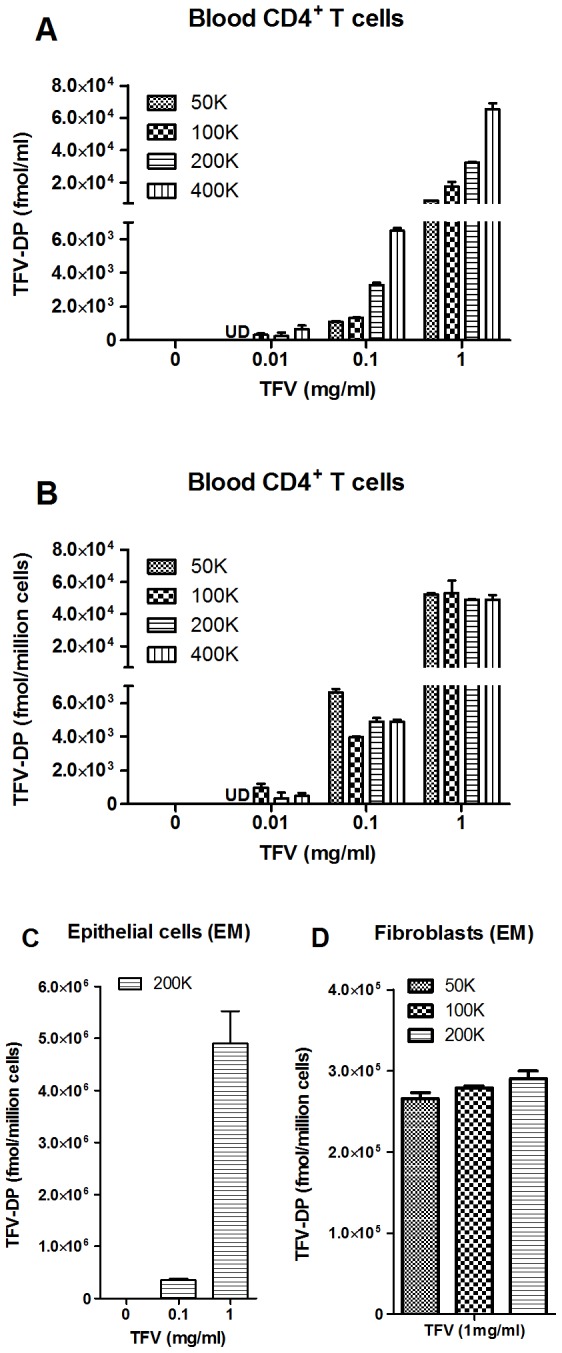
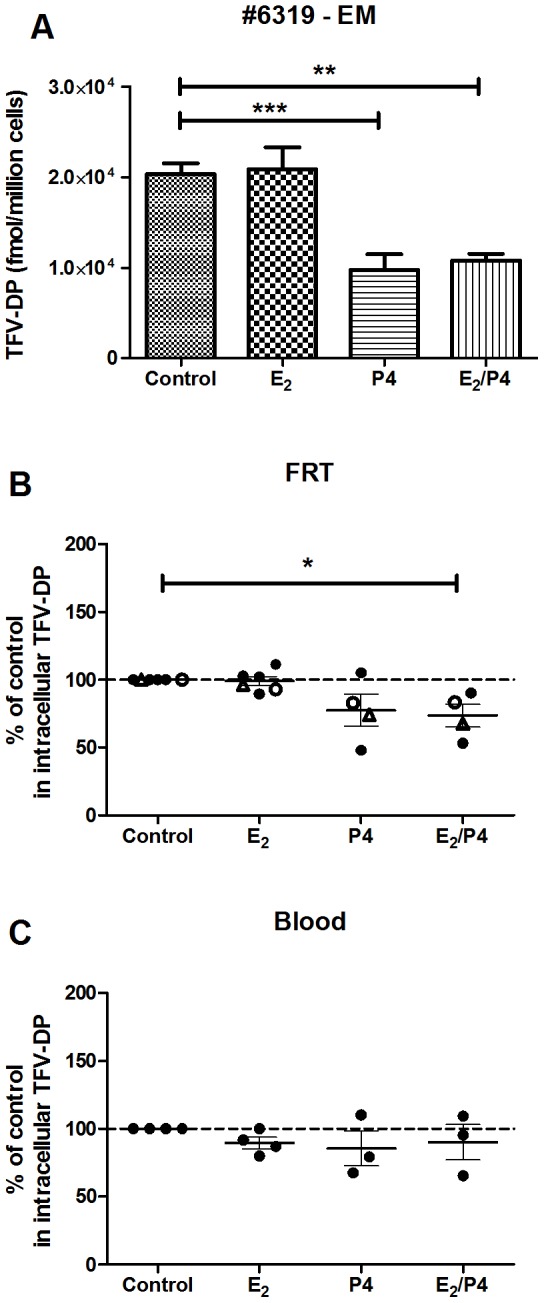
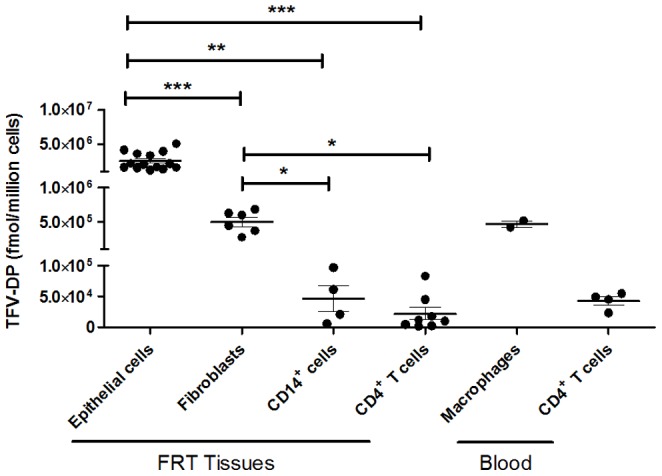
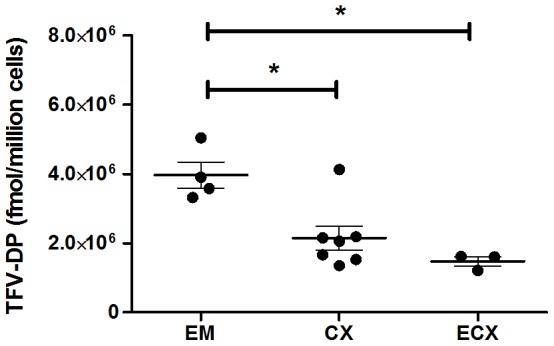
The conflicting results of recent pre-exposure prophylaxis (PrEP) trials utilizing tenofovir (TFV) to prevent HIV infection in women led us to evaluate the accumulation of intracellular TFV-diphosphate (TFV-DP) in cells from the female reproductive tract (FRT) and whether sex hormones influence the presence of TFV-DP in these cells. Following incubation with TFV, isolated epithelial cells, fibroblasts, CD4+ T cells and CD14+ cells from the FRT as well as blood CD4+ T cells and monocyte-derived macrophages convert TFV to TFV-DP. Unexpectedly, we found that TFV-DP concentrations (fmol/million cells) vary significantly with the cell type analyzed and the site within the FRT. Epithelial cells had 5-fold higher TFV-DP concentrations than fibroblasts; endometrial epithelial cells had higher TFV-DP concentrations than cells from the ectocervix. Epithelial cells had 125-fold higher TFV-DP concentrations than FRT CD4+ T cells, which were comparable to that measured in peripheral blood CD4+ T cells. These findings suggest the existence of a TFV-DP gradient in the FRT where epithelial cells > fibroblasts > CD4+ T cells and macrophages. In other studies, estradiol increased TFV-DP concentrations in endometrial and endocervical/ectocervical epithelial cells, but had no effect on fibroblasts or CD4+ T cells from FRT tissues. In contrast, progesterone alone and in combination with estradiol decreased TFV-DP concentrations in FRT CD4+ T cells. Our results suggest that epithelial cells and fibroblasts are a repository of TFV-DP that is under hormonal control. These cells might act either as a sink to decrease TFV availability to CD4+ T cells and macrophages in the FRT, or upon conversion of TFV-DP to TFV increase TFV availability to HIV-target cells. In summary, these results indicate that intracellular TFV-DP varies with cell type and location in the FRT and demonstrate that estradiol and/or progesterone regulate the intracellular concentrations of TFV-DP in FRT epithelial cells and CD4+ T cells.
近期利用替诺福韦(TFV)预防女性HIV感染的暴露前预防(PrEP)试验结果相互矛盾,这促使我们评估女性生殖道(FRT)细胞中细胞内二磷酸替诺福韦(TFV-DP)的蓄积情况,以及性激素是否会影响这些细胞中TFV-DP的存在。用TFV孵育后,从FRT分离出的上皮细胞、成纤维细胞、CD4+ T细胞和CD14+细胞,以及血液中的CD4+ T细胞和单核细胞衍生的巨噬细胞都会将TFV转化为TFV-DP。出乎意料的是,我们发现TFV-DP浓度(fmol/百万细胞)会因所分析的细胞类型和FRT内的部位而有显著差异。上皮细胞的TFV-DP浓度比成纤维细胞高5倍;子宫内膜上皮细胞的TFV-DP浓度比子宫颈外口细胞高。上皮细胞的TFV-DP浓度比FRT CD4+ T细胞高125倍,这与外周血CD4+ T细胞中测得的浓度相当。这些发现表明FRT中存在TFV-DP梯度,即上皮细胞>成纤维细胞>CD4+ T细胞和巨噬细胞。在其他研究中,雌二醇增加了子宫内膜和子宫颈内/外口上皮细胞中的TFV-DP浓度,但对FRT组织中的成纤维细胞或CD4+ T细胞没有影响。相反,单独使用孕酮以及孕酮与雌二醇联合使用会降低FRT CD4+ T细胞中的TFV-DP浓度。我们的结果表明上皮细胞和成纤维细胞是受激素控制的TFV-DP储存库。这些细胞可能要么作为一个汇,降低FRT中CD4+ T细胞和巨噬细胞可利用的TFV量,要么在TFV-DP转化为TFV后增加HIV靶细胞可利用的TFV量。总之,这些结果表明细胞内TFV-DP因细胞类型和FRT中的位置而异,并证明雌二醇和/或孕酮调节FRT上皮细胞和CD4+ T细胞中TFV-DP的细胞内浓度。