Chen Hongjie, Qiang Hao, Fan Kaichun, Wang Shousen, Zheng Zhaocong
Department of Neurosurgery, Fuzhou General Hospital, Second Military Medical University, Fuzhou, Fujian, China.
Department of Radiology, Changhai Hospital, Second Military Medical University, Shanghai, China.
PLoS One. 2014 Jun 30;9(6):e99986. doi: 10.1371/journal.pone.0099986. eCollection 2014.
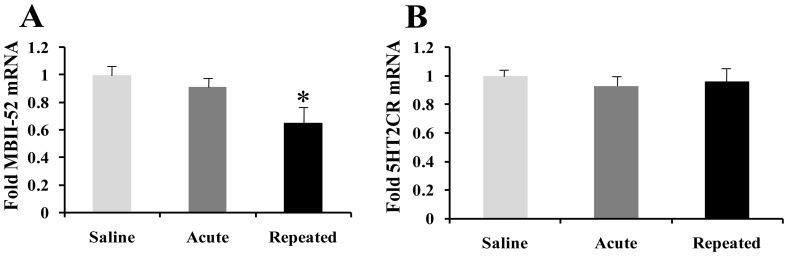
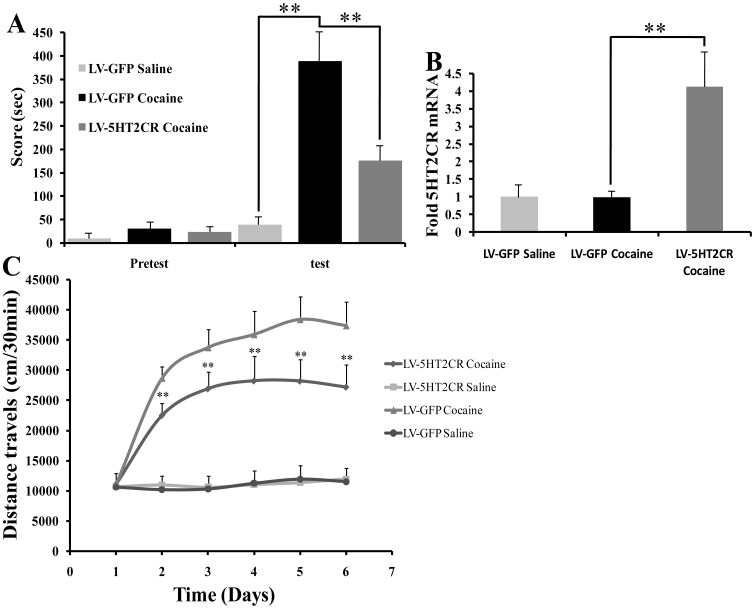
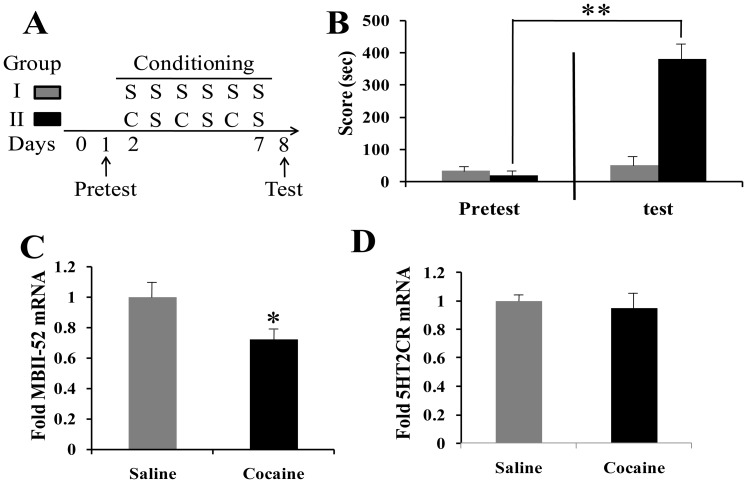
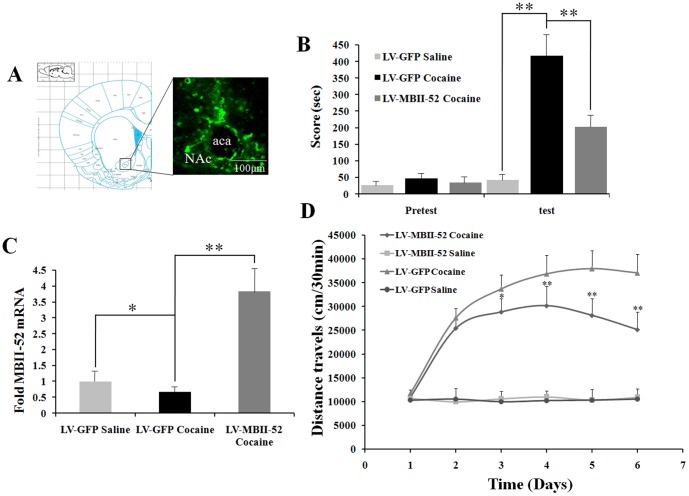
Cocaine dependence involves in the brain's reward circuit as well as nucleus accumbens (NAc), a key region of the mesolimbic dopamine pathway. Many studies have documented altered expression of genes and identified transcription factor networks and epigenetic processes that are fundamental to cocaine addiction. However, all these investigations have focused on mRNA and/or miRNA, which may not reflect the involvement of small nucleolar RNAs (snoRNAs), which has been implied in a broad range of biological processes and complex diseases including brain development and neuropathologocal process. To further address the role of snoRNA in cocaine addiction, we show that repeated exposure and conditioned place preference (CPP) training to cocaine negatively regulates the expression of MBII-52 mRNA level, which is a brain-specific C/D box snoRNA, but not influences the serotonin receptor 2C (5HT2CR) mRNA level in NAc. Furthemore, we show, developing lentiviral vector (LV)-expressing MBII-52 and LV-5HT2CR for stable and regulatable MBII-52 and LV-5HT2CR expression. LV-MBII-52 and LV-5HT2CR expression in NAc attenuate cocaine induced CPP and locomotor activity. Taken together, these findings show that MBII-52 and 5HT2CR exert an inhibitory influence on the behavioral responses to cocaine exposure.
可卡因成瘾涉及大脑的奖赏回路以及伏隔核(NAc),它是中脑边缘多巴胺通路的关键区域。许多研究记录了基因表达的改变,并确定了对可卡因成瘾至关重要的转录因子网络和表观遗传过程。然而,所有这些研究都集中在mRNA和/或miRNA上,这可能无法反映小核仁RNA(snoRNAs)的参与情况,而小核仁RNA已被认为参与了包括大脑发育和神经病理过程在内的广泛生物过程和复杂疾病。为了进一步探讨snoRNA在可卡因成瘾中的作用,我们发现反复接触可卡因并进行条件性位置偏爱(CPP)训练会负向调节MBII-52 mRNA水平的表达,MBII-52是一种脑特异性C/D盒snoRNA,但不影响NAc中5-羟色胺受体2C(5HT2CR)的mRNA水平。此外,我们展示了开发用于稳定和可调节MBII-52和LV-5HT2CR表达的慢病毒载体(LV),分别表达MBII-52和LV-5HT2CR。NAc中LV-MBII-52和LV-5HT2CR的表达减弱了可卡因诱导的CPP和运动活性。综上所述,这些发现表明MBII-52和5HT2CR对可卡因暴露的行为反应具有抑制作用。