Milovanovic Ivana, Njuieyon Falucar, Deghmoun Samia, Chevenne Didier, Levy-Marchal Claire, Beltrand Jacques
INSERM CIE 05 - Unité d'épidémiologie clinique, Hôpital Robert Debré, Paris, France.
Service de biochimie et hormonologie, Hôpital Robert Debré, Paris, France.
PLoS One. 2014 Jun 30;9(6):e100337. doi: 10.1371/journal.pone.0100337. eCollection 2014.
Being born small for gestational age (SGA) is a risk factor for later development of type 2 diabetes. The development of glucose tolerance disorders in adults involves insulin resistance and impaired insulin secretion.
To evaluate insulin secretion and insulin sensitivity in a 4-yr old cohort of SGA.
85 children were prospectively followed from mid-gestation to 4 years of age. Fetal growth velocity (FGV) was measured using ultrasound measurements. Body composition and hormonal profile were measured at birth, 1 and 4 years.
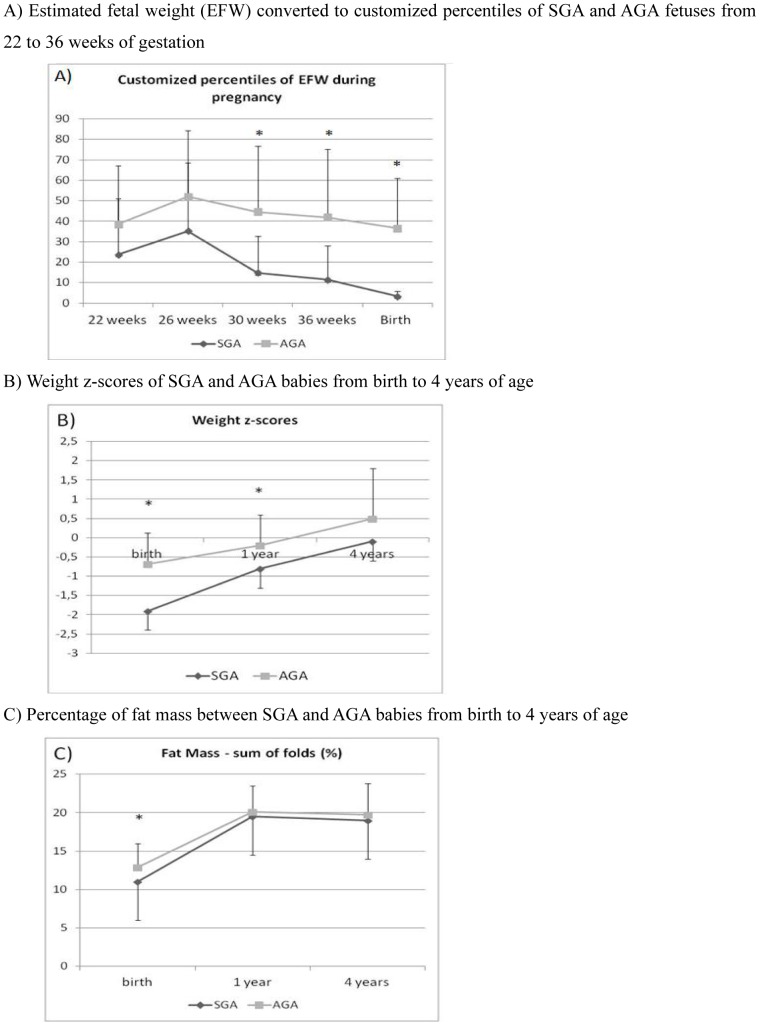
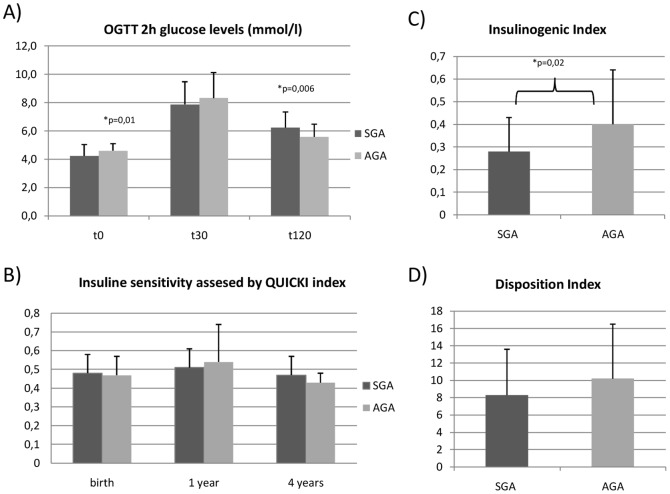
23 SGA babies had lower birth weight compared to 62 AGA (-1.9±0.3 vs. -0.6±0.8 z-score; p<0.0001) and they were thinner at birth (ponderal index 24.8±1.8 vs. 26.3±3.1 kg/m3; p = 0.01 and fat mass 11±2.6 vs. 12.9±3.1%; p = 0.01). No significant differences in other measured metabolic and hormonal parameters were observed between two groups at birth. SGA infants experienced an early catch-up growth in weight (mean gain of 1.1±0.6 SD) during the first year of life. At 4 years, SGA children remain lighter than AGA, but with weight z-score in the normal range (-0.1±1.3 vs. 0.5±1.3 z-score; p = 0.05). No excess of fat mass was observed (19±4.8 vs. 19.7±4.1%; p = 0.45). 120-min plasma glucose was significantly higher (6.2±1.1 vs. 5.6±0.9 mmol/l; p = 0.006) and insulinogenic index was significantly lower (0.28±0.15 vs. 0.40±2.4; p = 0.02) in the SGA group at 4-yrs of life contrasting with a preserved insulin sensitivity (QUICKI 0.47±0.09 vs. 0.43±0.05; p = 0.06).
SGA children with compensatory catch-up growth in first year of life show mild disturbances of glucose tolerance associated to a lower insulinogenic index at 4-yrs of age suggesting impairment of β-cell function.
小于胎龄儿(SGA)是2型糖尿病后期发病的一个危险因素。成人糖耐量异常的发生涉及胰岛素抵抗和胰岛素分泌受损。
评估一组4岁SGA儿童的胰岛素分泌和胰岛素敏感性。
对85名儿童从妊娠中期开始进行前瞻性随访直至4岁。使用超声测量胎儿生长速度(FGV)。在出生时、1岁和4岁时测量身体成分和激素水平。
与62名适于胎龄儿(AGA)相比,23名SGA婴儿出生体重较低(-1.9±0.3 vs. -0.6±0.8 z评分;p<0.0001),且出生时更瘦(体重指数24.8±1.8 vs. 26.3±3.1 kg/m³;p=0.01,脂肪量11±2.6 vs. 12.9±3.1%;p=0.01)。两组出生时其他测量的代谢和激素参数无显著差异。SGA婴儿在生命的第一年体重出现早期追赶生长(平均增加1.1±0.6标准差)。4岁时,SGA儿童仍比AGA儿童轻,但体重z评分在正常范围内(-0.1±1.3 vs. 0.5±1.3 z评分;p=0.05)。未观察到脂肪量过多(19±4.8 vs. 19.7±4.1%;p=0.45)。4岁时,SGA组120分钟血浆葡萄糖显著更高(6.2±1.1 vs. 5.6±0.9 mmol/l;p=0.006),胰岛素生成指数显著更低(0.28±0.15 vs. 0.40±2.4;p=0.02),与之形成对比的是胰岛素敏感性保持正常(定量胰岛素敏感性检查指数0.47±0.09 vs. 0.43±0.05;p=0.06)。
出生后第一年有代偿性追赶生长的SGA儿童在4岁时显示出糖耐量轻度紊乱,与较低的胰岛素生成指数相关,提示β细胞功能受损。